Get Full Government Meeting Transcripts, Videos, & Alerts Forever!
Get email alerts on the Legislative Ethics topic
No spam. Unsubscribe anytime.
Subcommittee votes not to open investigation after hearing on complaint over Senator Mitchell’s vote
Summary
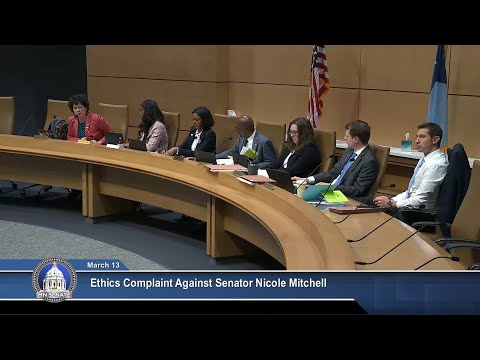
The Minnesota Senate Subcommittee on Ethical Conduct voted not to proceed with an investigation after a contested hearing about an ethics complaint alleging Senator Nicole Mitchell improperly voted to block consideration of a motion that could have led to her expulsion.
The Minnesota Senate Subcommittee on Ethical Conduct voted not to proceed with an investigation after a contested hearing about an ethics complaint alleging Senator Nicole Mitchell improperly voted to block consideration of a motion that could have led to her expulsion.
The complaint, introduced at the hearing by fellow senators, argued Mitchell cast the deciding vote on a procedural appeal Jan. 27 that prevented the body from considering a motion to expel her. Mitchell told the subcommittee she had taken a “procedural vote” and argued the statutes and rules cited in the complaint did not require recusal.
Why it matters: The hearing centered on when lawmakers must recuse themselves and what counts as a financial interest under Minnesota law. Complainants said the vote was uniquely personal because it affected Mitchell’s salary, benefits and staff. Mitchell said the legal definition of financial interest does not cover ordinary legislative employment and that voting on procedural questions does not carry the same recusal requirements as voting on an actual expulsion.
At the hearing, Mitchell said she had intended to avoid any conflict in similar past situations and that she would have excused herself if the matter had reached a final expulsion vote. “I respectfully request that this ethics complaint against me is dismissed,” she said.
Complainants emphasized the appearance and standard-setting implications of the vote. In rebuttal, Senator Jaskowski said: “As a result, senator Mitchell literally cast the deciding vote to prevent the body from considering her own political future.” He argued that a member who stands to lose salary and other benefits should not participate in such a vote.
The hearing focused heavily on statutory language. Committee members and Mitchell debated the interpretation of the statute cited in the complaint (referred to repeatedly in the hearing as “Minnesota statute section 10 8.07”) and on whether employment, an election certificate or associated pay and benefits amount to an “ownership or control in an asset that has a potential to produce a monetary return,” language read and discussed during the session.
After oral statements and questions from members, Senator Kunish moved that the subcommittee not proceed with an investigation; the chair announced the motion carried. The record shows the body then considered other motions: members debated and rejected motions to defer action until a later date, to go into an executive session, and a motion framed as a finding of “no probable cause,” which did not carry on a roll-call vote reported in the hearing.
Committee members repeatedly noted that some provisions of the statute and administrative policy cited in the complaint were written with other types of public officials in mind and that legislative self-governance and Mason’s parliamentary guidance factor into how recusal rules are applied to senators. Senator Mitchell repeatedly argued that the statute’s definition of financial interest and the legislative rules make mandatory recusal narrow in scope and that many legislative votes by necessity affect members similarly.
The subcommittee closed the hearing without opening a formal investigation. Chair Senator Champion said the committee would revisit the matter only if new information were provided: “Unless there’s new information that is provided,” the chair said as the panel adjourned. The subcommittee said it would resume business after another scheduled trial referenced in the hearing record.
The hearing record includes questions about salary and benefits that were discussed on the floor: a figure of $51,750 per year for legislative salary was cited during questioning and a member estimated per diem payments averaged in the range of $10,000 per senator; Mitchell also noted she is eligible for VA and state benefits as applicable. The committee referenced Senate rules and policies repeatedly during the hearing and discussed administrative policy 1.35, Senate rules (including cited rules read in the hearing as rule 56.4, 56.1 and 56.3), and guidance drawn from Mason’s parliamentary manual.
The subcommittee made no finding of misconduct in the hearing record and adjourned. Members said the decision could be reopened if demonstrably new evidence or information is introduced to the panel.