Get Full Government Meeting Transcripts, Videos, & Alerts Forever!
Get email alerts on the Direct Care Workforce topic
No spam. Unsubscribe anytime.
Committee sends Senate File 1418 back to Human Services to continue work on direct care workforce council
Summary
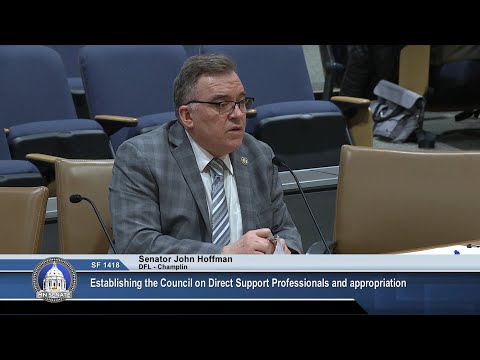
Senate File 1418, which would establish or extend an advisory council to address Minnesota's direct care workforce shortage, was amended and re‑referred to the Senate Human Services Committee after debate about the number and role of advisory councils and whether appointees should be primarily government officials or practitioners.
Senate File 1418, discussed March 13 before the Minnesota Senate Committee on State and Local Government, would (as amended) create or extend a council focused on Minnesota's direct care workforce and refer the bill back to the Human Services Committee for further work.
Senator Nick Hoffman, the bill's author, told the committee the measure responds to a severe shortage of direct care workers and relied on stakeholder work groups including the Metropolitan Center for Independent Living: "There are 53,000 job openings for caregivers in Minnesota," he said, and the bill lays out a tiered approach to address the shortage.
The proposal drew sustained debate about the broader practice in the 2023–2025 legislative session of creating many boards, councils, and task forces. Senator Grant Drazkowski recited a long list of recently created advisory entities and said the Legislature "is growing government at massive rates," expressing concern about cost, per diems, and scope. Supporters and other committee members emphasized the need for spaces that bring together providers, people with lived experience, counties and state agencies to develop durable solutions for complex social services. Senator Karin Kran (committee member) said such councils "give us the opportunity to bring together people with lived experiences who sit in between multi complex areas of law" and that human services issues "deal with seniors, people with disabilities, people with complex needs." Senator Hoffman and others argued the council continues work begun after a 1998 Supreme Court decision and an ad hoc Olmstead‑related group established in 2018.
Amendments: Senator Carlson moved and the committee adopted an A3 amendment (described on the record as cleaning up language suggested by counsel). Senator Barr offered an A1 amendment (to change composition by removing some executive branch commissioners and replacing them with practitioners) but the amendment failed on a 6–5 roll call. Senator Drazkowski later offered an A2 amendment (adding a member focused on fraud/waste oversight); it also failed on a 6–5 roll call. Several senators also urged that further work take place in the Human Services Committee to shape pilots and tiered approaches discussed during testimony.
Action: After debate and amendment, the committee voted to recommend Senate File 1418, as amended, and re‑refer it to the Senate Human Services Committee. The motion to recommend the bill was made and approved by voice vote: "Senator Gustafson moves that Senate file 1418 as amended be recommended to pass and re referred to the Human Services Committee. All in favor say aye. Aye." The clerk recorded the re‑referral in the hearing minutes.
Next steps: The bill will return to the Senate Human Services Committee for additional hearings and stakeholder consultation; witnesses and several senators said they expect further work on pilot projects, staffing, regulatory burdens, and workforce training.