Get Full Government Meeting Transcripts, Videos, & Alerts Forever!
Get email alerts on the Liquor License Policy topic
No spam. Unsubscribe anytime.
House Commerce committee hears a slate of bills expanding local authority to issue liquor licenses; all laid over for possible omnibus inclusion
Summary
The Minnesota House Commerce Finance and Policy Committee on March 13 heard more than a dozen bills that would expand or clarify which local entities may hold on‑sale intoxicating‑liquor licenses; the committee laid each measure over for possible inclusion in a future omnibus liquor bill.
The Minnesota House Commerce Finance and Policy Committee on March 13 heard more than a dozen bills that would expand or clarify which local entities may hold on‑sale intoxicating‑liquor licenses. Chair opened the hearing and moved each measure "to be laid over for possible inclusion in a future omnibus liquor bill," and the committee did so for every item considered.
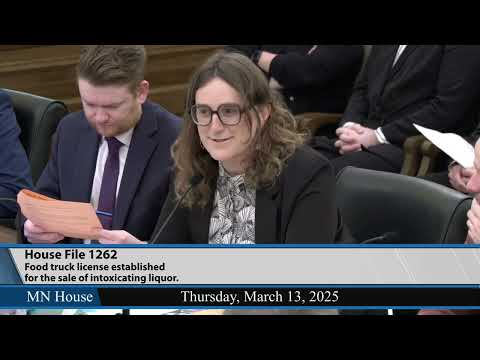
The bills would allow municipalities or special applicants to seek new or clarified liquor authority in several settings: temporary on‑sale licenses for licensed food trucks at private events (House File 1262); on‑sale authority for food halls in Minneapolis and St. Louis Park (House Files 1741, 1876); on‑sale service at Minnesota State University, Mankato’s Taylor Center (House File 472); updated liquor rules across the University of Minnesota system including removing a cap on system licenses (House File 1668); special provisions for cultural venues such as the Science Museum of Minnesota and St. Paul’s Union Depot (House File 2055); cosmetology‑licensed businesses and salons to receive on‑sale licenses for service‑linked events (House File 1786); an on‑sale license for Bloomington’s Duane Golf Course (House File 1089); authorization for the Baudette (Lake of the Woods County) arena to request temporary licenses for certain events (House File 1121); a special law change request for Rochester’s Chateau Theatre (House File 509); and other proposals including bills to change age and staffing rules for service (House Files 2027 and 1545, identical language in 2027/1545).
Why it matters: Local officials, venue operators and business owners told committee members they seek consistent authority across municipalities and institutions to host events, support operations and attract customers. University and municipal representatives said making licensing rules clearer or expanding options could reduce reliance on outside caterers, centralize purchasing and create new revenue streams. Opponents raised questions about public safety, enforcement (including preventing alcohol from leaving premises) and workforce and training implications for servers.
Testimony highlights and examples
- Jason Schmidt, owner of Smokin’ Bruisin’ Q’s food truck (Alexandria), said his business “lost some jobs because we're not able to have the liquor to have for the groom's dinner, the wedding reception” and asked the committee to permit temporary on‑sale licenses for licensed food trucks at private catering events (HF 1262).
- Patty Wall, owner‑operator of the Market at Malcolm Yards food hall, described wristbanding, ID checks and staff monitoring at her existing Minneapolis food‑hall operation and said, “We take our responsibility very seriously,” while urging permission for cities to authorize licenses for food halls (HF 1741 as amended).
- Kevin Biesman, director of athletics at Minnesota State University, Mankato, said dining services provider Sodexo would hold any license for Taylor Center events, citing safety protocols, wristbanding and locked storage as protections if on‑sale service is allowed (HF 472).
- Amy Karen, director of contract administration at the University of Minnesota, said the system currently is capped at nine university liquor licenses (eight already issued) and the bill would remove the cap while preserving Board of Regents and Commissioner of Public Safety oversight (HF 1668).
- Tara Upman of the Science Museum said the museum currently uses caterers for events and wants authority for on‑sale licenses so the museum can offer alcohol directly at after‑hours and special events (HF 2055). The City of St. Paul testified it seeks a special‑provision approach similar to other cultural venues permitted by statute.
- Salon owners Laura Hanks and Jared Cooley described spa parties and said allowing on‑sale service tied to chair services or parties would create a revenue stream and differentiate businesses; nonpartisan staff confirmed such service is not currently lawful without a change in statute (HF 1786).
- Ann Catry, Bloomington parks and recreation director, said Duane Golf Course hosts roughly 50,000 rounds per year and currently is limited to a 3.2 malt‑liquor license; the bill would allow an on‑sale intoxicating license for the municipal course if the Bloomington City Council approves (HF 1089).
- Anthony Perkle, public works director for Lake of the Woods County (Baudette), said the Baudette Arena — funded in part by a 2018 donation — needs authority to obtain temporary licenses for weddings, concerts and similar events and noted the county board supports the measure and would follow statute 645.021 if the special law is approved (HF 1121).
Committee concerns and process
Committee members repeatedly asked how each proposal would prevent alcohol from leaving licensed premises (wristbands, signage, locked storage), how local licensing and enforcement would work, and whether fiscal notes or secondary referrals (for taxation or public safety) would be needed. Authors and testifiers generally said local licensing authorities would define the licensed premises on applications and that existing server‑training, insurance, and other regulatory requirements would apply.
No final enactments or recorded roll‑call votes occurred in the hearing. The chair moved each bill to be “laid over for possible inclusion in a future omnibus liquor bill” and the committee laid them over for further consideration and any necessary secondary referrals.
What’s next
Bills laid over may be refined for statutory language (for example, clarifying the exact premises covered by a university license or narrowing a food‑truck proposal to private catering events), receive fiscal notes from agencies such as the Department of Public Safety, and face additional referrals (taxation, public safety, judiciary) depending on the bill. Sponsors said many of the measures are intended to give local governments or institutional license holders optional authority rather than a mandatory new program.
Ending note
Committee members and testifiers framed the measures as tools local governments and institutions could use at their discretion; several members emphasized that safety, enforcement and clear application language will determine whether the proposals proceed beyond lay‑over status.