Get Full Government Meeting Transcripts, Videos, & Alerts Forever!
Get email alerts on the Paid Family Medical Leave topic
No spam. Unsubscribe anytime.
Minn. committee hears wide split on changes to paid family and medical leave; author’s amendment adopted and bill laid over
Summary
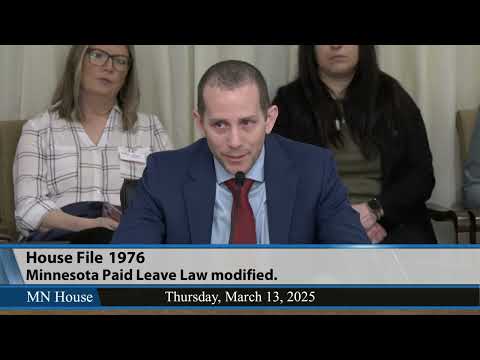
Representative Baker, author of House File 1976, presented the bill and an A-1 amendment and the committee adopted the amendment by voice vote before laying the bill over for further consideration.
Representative Baker, author of House File 1976, presented the bill and an A-1 amendment and the committee adopted the amendment by voice vote before laying the bill over for further consideration.
The bill would modify the Minnesota paid family and medical leave program enacted in 2023. Baker told the committee the measure is intended to "right-size" the law and to offer more choices for employers and unions, including a proposed 67% wage replacement level and options for smaller employers. "What this bill does, it provides the ability to have a discussion at the next collective bargaining agreement," Baker said, describing provisions that would require bargaining units and employers to address how the state program fits with existing contracts.
Supporters of HF 1976 -- including many small-business owners, the Minnesota Chamber of Commerce, the League of Minnesota Cities and county officials -- told the committee the existing law creates administrative and financial challenges for small and public employers. Andy Wilkie, executive vice president of Greater Mankato Growth (a chamber/economic development organization), said his members "sympathize with the goals" of paid leave but welcomed the bill's changes because the program "as passed . . . will be the most generous and expansive in the nation." Small-business owners described narrow staffing margins and urged shorter leave periods for businesses under 50 employees. Tammy Phillippe, owner of Frame Minnesota in Eagan, said replacing skilled workers for "12 or 20 weeks . . . is just difficult and probably impossible," and praised a provision that would limit small-business leave to six weeks.
Opponents -- led by unions, children's and health-advocacy groups, and some caregiving organizations -- urged the committee to preserve the law as passed. Chris Rubish, president of the Minnesota Nurses Association, called the original law "nothing short of a second Minnesota miracle" and urged legislators to vote no on the changes, arguing the amended bill would exclude categories of workers, reduce leave length and create opportunities for private insurers to profit. Multiple witnesses representing school employees, teachers, cancer and child-advocacy organizations emphasized that reducing maximum leave or narrowing the definition of family would harm caregivers and patients who need extended absences for treatment or recovery. "The thought that we would shorten their leave access to six weeks . . . gives us pause," said Dana Bacon of the Leukemia and Lymphoma Society.
Public employers and multi-jurisdiction groups pressed for a clear, legislated employer-employee premium split to aid budgeting and implementation. Kim Lewis, speaking for the Minnesota School Boards Association and related school organizations, said the A-1 amendment's clarification that premiums be split 50/50 "allows districts to better predict costs and allow for more accurate long term budget planning." County and city representatives described projected budget impacts and administrative complexity if units must negotiate distinct contribution rates for multiple bargaining units.
The committee accepted the A-1 author's amendment and adopted it by voice vote after Representative Baker requested its addition; the recorded response was a voice "Aye," with no recorded roll-call totals in the transcript. Earlier in the hearing Vice Chair Mecklen (acting as presiding member at one point) formally moved to lay House File 1976 over for further consideration; Chair Baker said the bill is "being laid over" and the committee will return to it next Wednesday to continue testimony and questions.
The Department of Employment and Economic Development (DEED) deputy commissioner, Evan Roe, testified briefly in committee discussion, noting the department lacks visibility into every collective bargaining agreement and could not say how holdover contract provisions would apply to premium allocation disputes. Roe also confirmed the department administers the payroll tax reporting process through existing unemployment-insurance reporting systems.
The committee heard roughly two dozen testifiers representing business groups, unions, health and children's advocacy organizations, counties, cities and individual small-business owners and workers. Many speakers urged either rejection (unions, patient advocates, many caregiving organizations) or adoption of HF 1976 to provide relief for small employers and clarify implementation (chamber of commerce, county officials, city HR groups). Chair Baker and others said the bill is intended as a starting point for further negotiation and implementation discussion; the committee laid the bill over for future consideration.
Votes and formal actions recorded in the hearing transcript - A-1 author's amendment added to HF 1976 and adopted by voice vote after a request from the author. (No roll-call recorded in transcript; transcript records "Aye" and "Motion prevails.") - Motion to lay HF 1976 over for further consideration moved on the record; the bill was laid over and the committee scheduled additional consideration the following Wednesday.
What remains unresolved - Specific negotiated treatment for employees covered by collective bargaining agreements and the interaction between HF 1976 and existing contracts. - Whether DEED will contract any elements of administration to private vendors or operate the program in-house (the bill would allow certain contractor options). DEED witnesses said they lack visibility into all bargaining agreements and did not commit in the hearing to a vendor model.
The committee laid HF 1976 over for further consideration; members and staff signaled they expect continued hearings and follow-up with stakeholders on implementation questions, bargaining impacts and cost projections.