Get Full Government Meeting Transcripts, Videos, & Alerts Forever!
Get email alerts on the Veterans Benefits topic
No spam. Unsubscribe anytime.
Committee approves amendment and refers bill to give Minnesota Veterans read-only Maxis access
Summary
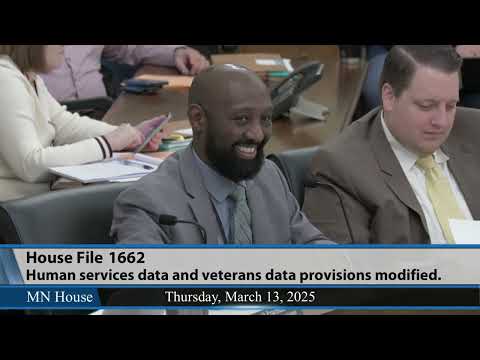
The House Human Services Finance and Policy Committee adopted an amendment and re‑referred House File 1662 to the Judiciary, Finance and Civil Law Committee after testimony that the bill would let Minnesota Department of Veterans Affairs staff use the Maxis eligibility database in read‑only mode to connect veterans to other state benefits.
The House Human Services Finance and Policy Committee on March 12, 2025, adopted an amendment and re‑referred House File 1662, an agency bill to allow the Minnesota Department of Veterans Affairs (MDVA) read‑only access to the Maxis eligibility database, to the Judiciary, Finance and Civil Law Committee.
The bill, carried in committee by Representative Rearower, would amend state statute to permit MDVA veterans program staff to electronically access the Maxis system — managed by the Department of Children, Youth and Families (DCYF) — in a read‑only capacity so staff can verify eligibility for other state benefits while assisting veterans. Representative Rearower described the proposal as a technical change intended to “reduce the time it takes to get assistance to those needing it” and to help connect veterans to services such as the Veterans Stable Housing Initiative.
MDVA Government Affairs Liaison Coltrace testified that read‑only Maxis access would let veterans program staff verify applicants’ eligibility status for the State Soldiers Assistance Program, the Veterans Stable Housing Initiative and other MDVA programs. Coltrace said the change would also allow MDVA to “streamline the process to verify eligibility and complete entry of veterans onto the Minnesota Homeless Veteran Registry,” and to gather data on eligibility gaps.
Members questioned how the proposal would protect privacy and consent for data sharing. Representative Noor noted that existing Maxis authorizations use a consent process for children and families; she asked whether MDVA would obtain individual authorizations for records accessed under the bill. Christy Grom of the Department of Human Services (DHS) told the committee the DHS amendment intent was to codify current practice and to make clear in law that MDVA obtains consent as part of the MDVA application form. Grom said DHS would work with MDVA and the bill author to refine the statutory language if needed.
Other committee members raised training and audit concerns. Representative Hicks asked whether MDVA staff would receive the same privacy and Maxis‑use training DHS requires of other users; Grom said DHS would work with MDVA to provide training. Multiple members urged that the statute and implementing policies include clear consent language and program safeguards to avoid any violation of federal Medicaid data‑sharing rules.
The committee adopted the A2 amendment without recorded roll‑call and approved Representative Rearower’s motion that House File 1662, as amended, be re‑referred to the Judiciary, Finance and Civil Law Committee. The bill will appear next at the Judiciary, Finance and Civil Law Committee for further consideration.
Votes at a glance: The committee adopted the A2 amendment by voice vote and approved re‑referral of the bill by voice vote; no roll‑call tally was recorded in the transcript.
Provenance: First related remarks appear where the chair introduced House File 1662 and asked the author to present the bill; testimony and discussion about consent, training, and the A2 amendment continue through the committee’s adoption of the amendment and motion to re‑refer.