Get Full Government Meeting Transcripts, Videos, & Alerts Forever!
Get email alerts on the Prompt Payment Transparency topic
No spam. Unsubscribe anytime.
Panel backs transparency measures for public construction payments; bill HF1234 laid over for revision
Summary
Lawmakers and contractors discussed House File 1234, a bipartisan proposal to require public owners to notify subcontractors when payments are made to prime contractors and to bar contract clauses that prevent subcontractors from invoicing. The committee laid the bill over to continue stakeholder negotiations.
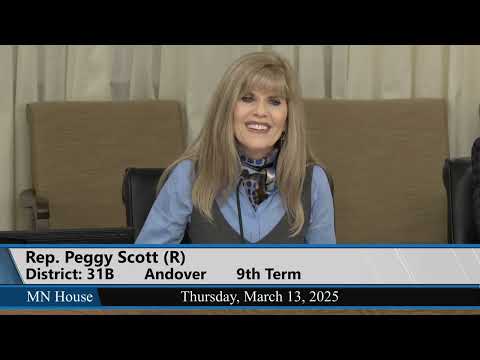
Representative Kelly Scott introduced House File 1234 on March 13, a bill aimed at increasing payment transparency for subcontractors on public construction projects, and the committee laid the measure over for further work with stakeholders.
Representative Kelly Scott (state representative) described the bill as intended "to provide predictability and fairness in the payment process," saying it would require public owners to notify subcontractors when payments are made to the general contractor or prime and would bar contract provisions that prevent subcontractors from invoicing electronically.
Contractors and legal experts said they support the bill. John Lloyd, vice president of Lloyd's Construction Services in Chaska, described a recent project for the Metropolitan Council in which his company submitted 276 pages of contract documentation for roughly $200,000 in billings and said the final undisputed owed amount on that job was $8,417.83 as of March 2025. "If HF1234 is passed, it would allow us to plan cash flow and know when we should be getting paid," Lloyd told the committee.
Aaron Dean, a construction lawyer with more than 25 years of experience, said the bill would reduce litigation and promote collaboration. He pointed to line 3.3 of the bill, which requires notification from the public owner when it makes payment to the general contractor, and he noted the existing prompt-payment requirement that primes must pay subs within 10 days after receiving payment. "All of the options that I outlined in my initial testimony cost 0 to the public owner," Dean said, listing contract clauses, posting pay applications on platforms like Procore, or confirming payment status in weekly architect-owner-contractor (AOC) meetings.
Public-owner representatives and local government groups raised practical questions about implementation. Wayne Waslowski, assistant commissioner at the Department of Administration, said owners do not always have a complete list of subcontractors across multiple tiers and noted that current payment systems do not automatically notify a full distribution list when payments occur. Tori Key, representing the League of Minnesota Cities, explained that many city contracts do not require prime contractors to disclose subcontractor names and contact information to the municipality; she suggested adding a mechanism in the bill requiring primes to provide updated subcontractor contact details to keep any notification process accurate.
John Kondrowski of the Metropolitan Airports Commission said MAC supports prompt payment and already includes related contract provisions (payment performance bonds, interest for late payments and attorney fees) but that airport projects can have many tiers of subcontractors across long, multi-year contracts. He said MAC routinely makes weekly payments to general contractors and that the bill as written would require an administrative process to collect tiered subcontractor information.
Committee members stressed the need for a workable mechanism and broader stakeholder participation. Representative Scott and several members noted the bill seeks to address cases where subcontractors waited months or years for payment; one committee member said he recalled a subcontractor waiting four years for payment. Representative Scott said she and stakeholders would continue negotiating language, including how to capture subcontractor contact lists and whether to require contract terms obligating primes to notify subs.
Actions and status: The committee considered but did not vote on substantive amendments. Chair Nash moved the bill before the committee, the proposed A1 amendment was withdrawn by the author for further stakeholder work, and the measure was laid over for continued discussion.
Ending: Committee members encouraged ongoing negotiations among primes, subcontractors, public owners and software providers to create an operationally feasible notification method that preserves transparency and minimizes administrative cost.