Get Full Government Meeting Transcripts, Videos, & Alerts Forever!
Get email alerts on the Foreclosure Surplus topic
No spam. Unsubscribe anytime.
Committee lays over bill to clarify handling of foreclosure-sale surpluses and to extend homeowner redemption time
Summary
The Committee on Judiciary, Finance, and Civil Law laid over House File 1027 after adopting an A1 author's amendment. The bill would increase notice to homeowners, limit the sheriff's role in adjudicating competing surplus claims, allow surplus funds to be applied to a homeowner's redemption, and extend certain timing windows.
The Committee on Judiciary, Finance, and Civil Law on March 11 laid over House File 1027 after adopting an A1 author's amendment that Representative West and testifiers said clarifies how sheriffs should handle surplus proceeds from foreclosure sales and increases protections for homeowners.
Supporters and attorneys who helped draft the amendment said the bill is intended to reduce litigation and confusion by improving notice, clarifying priorities among lienholders and homeowners, and extending certain redemption and post-loss-mitigation timelines.
Representative Nick West moved the bill for the purpose of laying it over and described the bill as the product of extensive stakeholder work involving sheriffs, legal aid and the real estate bar. Ron Elwood of Legal Aid told the committee the A1 amendment does three things: increase notice to homeowners, remove from sheriffs the role of acting as adjudicators of competing claims, and add 30 days to the homeowner's redemption period. Colleen Daley, an attorney with Mid Minnesota Legal Aid, said the bill would let a homeowner apply a surplus from a sheriff sale to the redemption amount so a homeowner with a $50,000 unpaid balance facing a $100,000 bid could use a $50,000 surplus toward the redemption rather than having to produce the full bid amount.
Daley and other testifiers described other key features: when a surplus exceeds $100, the sheriff would hold the funds for the length of the homeowner's redemption period; junior lienholders would have a claims process that requires them to notify the sheriff and explain their claimed entitlement; and when competing claims are not clearly resolved, the sheriff may initiate a court proceeding for the court to determine priority. For very small surpluses (under $100), the bill directs payment to the homeowner to avoid needless disputes.
Eric Cook, a foreclosure attorney with Wilford, Geske & Cook, said the bill mostly adjusts procedural timelines rather than substantive law. Cook described proposed changes that would codify timelines sheriffs in some counties have already used, including holding surplus funds for the homeowner's redemption period (typically six months), lengthening creditor windows for redemption and recording (for example, moving a creditor window from seven days to 14 days and allowing a seven-day recording window instead of four), and clarifying how to calculate redemption amounts (requiring dates and interest rates be stated for advances). He also said the proposal clarifies the interaction with federal loss-mitigation rules such as RESPA and gives lenders more discretion to postpone or cancel scheduled sales while loss-mitigation applications are evaluated.
Cook and others also cited litigation that has resulted when sheriffs paid funds to the wrong party; he referenced an instance in Carver County where a sheriff paid a large surplus and the county later faced a judgment and a 20 percent penalty. Supporters said the bill seeks to reduce such county exposure by creating clearer procedures.
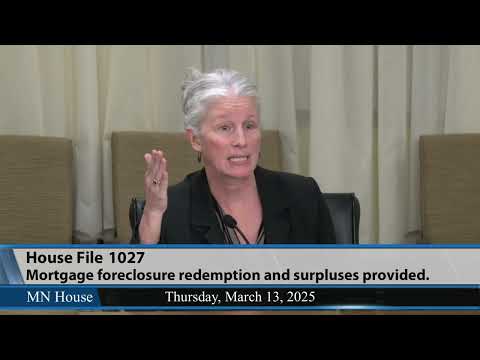
Committee members voiced support for the stakeholder-driven approach. Representative Kristin Feist said she would co-author and praised the bill as the product of detailed negotiation among parties. Representative Mary Liebling asked testifiers to identify their affiliations; Cook confirmed he is a foreclosure attorney with Wilford, Geske & Cook.
After discussion the committee adopted the A1 author's amendment by voice vote and laid the bill over for further consideration.
House File 1027 now awaits further committee scheduling and any subsequent refinements or formal votes.