Get Full Government Meeting Transcripts, Videos, & Alerts Forever!
Get email alerts on the Student Loan Tax Credit topic
No spam. Unsubscribe anytime.
House tax committee lays out bill to double student loan credit, make it refundable
Summary
The House Tax Committee laid out House File 1933, which would raise Minnesota's maximum student loan tax credit from $500 to $1,000 and make it refundable; medical students testified in support and committee members discussed the bill's fiscal note.
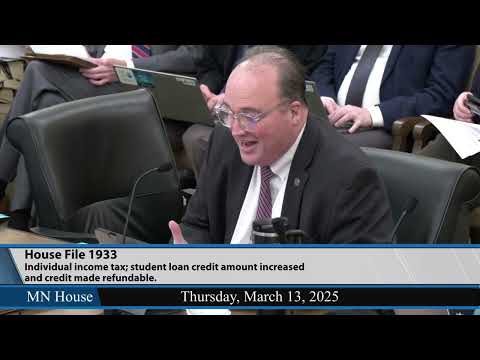
The House Tax Committee voted to lay out House File 1933, a bill that would raise the maximum student loan tax credit from $500 to $1,000 and make the credit refundable, the bill's author said during the committee hearing.
The bill, presented to the committee as House File 1933, would modify the existing student loan credit by increasing the maximum credit and making it refundable so taxpayers can receive a payment if the credit exceeds their tax liability. Representative Herr, the bill author, told members the measure had been considered in prior bienniums and that the updated fiscal estimate is about $15,000,000.
"This bill modifies the existing student loan credit in 2 ways. It increases the maximum credit from $500 to $1,000 and then it also makes the credit refundable," Representative Herr said in opening remarks. She described the change as "a step in the right direction" to provide relief as student loan debt continues to grow.
Two University of Minnesota medical students testified in support. Ben Fisher said he and his partner had relied on loans through multiple stages of higher education and described the emotional and financial pressure of carrying balances through training. "While this bill will not solve all my debt concerns, I see it as a step in the right direction and will help provide financial relief to me, Becca, and families across Minnesota," Fisher said.
Hunter Cantrell said rising college costs and uncertain federal policy make state-level relief important. "Simply put, this bill is a stimulus not to big corporations, but to the middle and working classes at a time when it is desperately needed," Cantrell testified, adding that many health-care professionals carry substantial debt even after they begin to earn higher incomes.
Committee members asked testifiers about the scale of student debt. Cantrell estimated his total medical education debt at about $180,000 to $200,000 when asked by Representative Hewitt. Representative Herr and other members noted the average student loan balance for all students in the state is lower than medical school levels; Representative Herr cited an average of about $34,000 for the typical student.
Representative Herr renewed her motion that House File 1933 be laid out for possible inclusion in the omnibus tax bill; the committee voice vote carried with the motion prevailing. The committee did not adopt substantive amendments during the hearing and directed the bill to further negotiation for inclusion in the larger tax package.
Votes at a glance: House File 1933 ' Motion: lay out for possible inclusion in the omnibus tax bill. Mover: Representative Herr. Outcome: laid out for possible inclusion (motion prevailed by voice vote).