Get Full Government Meeting Transcripts, Videos, & Alerts Forever!
Get email alerts on the State Legislation topic
No spam. Unsubscribe anytime.
Senate committee approves bill clarifying police leave accrual and a six-month continuing-education grace period
Summary
The Senate Standing Committee on Veterans, Military Affairs and Public Protection unanimously approved two House bills: HB 369, which clarifies how certain city police departments may accrue annual paid leave, and HB 403, which creates a six-month grace period for required continuing education.
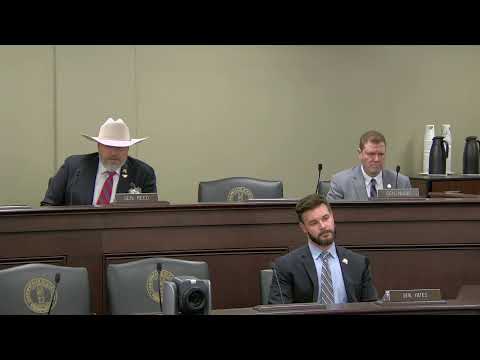
FRANKFORT — The Senate Standing Committee on Veterans, Military Affairs and Public Protection unanimously approved two House bills on a voice and roll-call vote Tuesday, clearing HB 369 and HB 403 for the full Senate.
House Bill 369, carried to the committee by Representative Mark Hart, clarifies how municipal police departments in cities formerly classified as second and third class may allow officers to accrue the 15 days of annual paid leave required under Kentucky Revised Statutes (KRS). Representative Mark Hart said the bill does not change the leave requirement but “provides needed clarity on the accrual process,” allowing departments to adopt policies such as monthly accrual so the 15 days accumulate incrementally over a calendar year.
The committee also considered House Bill 403, introduced by Representative Deanna Frazier Gordon. Representative Frazier Gordon said HB 403 “adds a grace period for continuing education,” giving affected licensees a six-month window to complete two courses instead of one when unforeseen circumstances prevent timely completion under current rules.
Why it matters: HB 369 addresses implementation details of an existing statute (cited in committee testimony as KRS 95.495 as read into the record) that affects how officers’ annual leave is scheduled and tracked in certain municipalities. Supporters told the committee that clear accrual rules can help departments schedule staffing and treat new and experienced officers equitably. HB 403 responds to complaints that the current continuing-education process lacks a makeup mechanism and would force licensees to restart training if they miss a requirement.
Support and procedure: HB 369 was presented for a committee substitute and the substitute was adopted before a motion on the bill. Testimony supporting HB 369 came from Representative Mark Hart and representatives of local government and law enforcement associations, including JD Cheney of the Kentucky League of Cities and Sean Baller, executive director of the Kentucky Police Chiefs Association. The bill’s explanation to the committee repeatedly noted that it does not change the statutory entitlement to 15 days of paid leave; it clarifies accrual mechanics and scheduling procedures.
For HB 403, Representative Deanna Frazier Gordon outlined the six-month makeup period and said it allows completion of two courses instead of one during that window. The motion to report HB 403 favorably was made by Senator Higdon and seconded by Senator Richardson.
Votes at a glance: Both bills passed the committee unanimously. Committee members recorded affirmative votes during roll call for each bill; the committee chair announced that each bill “passes unanimously.”
What’s next: Both measures were reported favorably from committee and are expected to be scheduled for consideration by the full Senate in the normal legislative calendar. The committee did not include any amendments to either bill on the record during the hearing.
Meeting context: The committee convened for a brief session that included introductions, two substantive agenda items (HB 369 and HB 403), and unanimous committee action on both items. Representatives of municipal government and law enforcement associations spoke in support of HB 369; HB 403 was presented by its sponsor and moved forward with no recorded opposition.