Get Full Government Meeting Transcripts, Videos, & Alerts Forever!
Get email alerts on the Tax Legislation Sf132 topic
No spam. Unsubscribe anytime.
Senate Taxes Committee advances early, noncontroversial tax bill (SF132), adopts amendment adding resort-tier change
Summary
The Senate Taxes Committee voted March 13, 2025, to pass Senate File 132, a compilation of noncontroversial tax provisions, to the Senate floor. The committee adopted an amendment inserting the language of Senate File 2076 (resort tier adjustments) into the A2 amendment before advancing the bill.
Senate File 132, described in committee as an "early tax bill" gathering previously considered, noncontroversial provisions, was advanced to the Senate floor by the Minnesota Senate Taxes Committee on March 13, 2025, after the panel adopted amendments including insertion of Senate File 2076 into the A2 amendment.
Senator Matt Putnam presented SF132 as a bill that consolidates items from last year's tax bill that did not persist through conference committee and other technical and substantive provisions negotiated with both parties. Committee counsel and staff walked members through a spreadsheet summarizing fiscal effects. Committee staff reported a net fiscal cost in the packet of about $138,000 for fiscal years 2025–27 and roughly $120,000 for the 2028–29 biennium, with many items carrying negligible or unknown fiscal effects.
The bill's contents as described in committee include a range of measures across income, property, aids and credits, and public finance articles. Staff highlighted provisions such as modifications to the Tax Expenditure Review Commission procedures; changes to the online political contribution refund program; repeal of assignability for the K–12 credit; an income subtraction for discharged coerced debt; modifications to the short-line railroad infrastructure modernization credit; multiple property-tax provisions including tribal exemptions for specified properties (Leech Lake Band of Ojibwe and Grand Portage Band of Lake Superior Chippewa), an attachments-and-appurtenances clarification for utilities, and changes to agricultural homestead definitions (including a proposal to increase allowable shareholders from 12 to 18); and a provision to pay the City of Stewart about $87,501.50 for foregone local government aid payments in 2023.
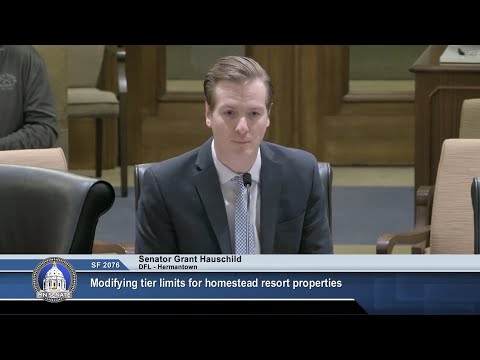
Committee counsel described the amendment process, and Senator Andrew Hauschild moved to insert the language of Senate File 2076 into the A2 amendment at line 25.5 and to update the committee fiscal spreadsheet accordingly; the committee adopted that motion by voice vote. The committee then adopted the DE/A2 amendment as amended, and by voice vote passed SF132 as amended to the Senate floor; no roll-call tallies were recorded in the hearing transcript.
Several staff members and counsel took turns describing article-by-article contents and specific sections (income and corporate franchise tax, property tax article, aids and credits, and public finance). For example, staff noted the public finance article clarifies volume-cap allocation timing for tax-exempt bond allocations and that one section expands the definition of a debt obligation to include courthouse or justice-center construction if connected to a jail or law-enforcement facility, for purposes of a credit enhancement program.
Committee members were asked to consult the fiscal spreadsheet and to note interactions with property tax refund provisions and other fiscal effects; several provisions were carried forward from prior omnibus tax proposals. After the committee vote the panel announced it would meet all three days next week with agendas to be posted.
The committee advanced SF132, as amended, to the Senate floor for further action.