Get Full Government Meeting Transcripts, Videos, & Alerts Forever!
Get email alerts on the Property Tax Resort Classification topic
No spam. Unsubscribe anytime.
Senate committee hears owners on bill to raise valuation tiers for 'mom-and-pop' resorts
Summary
The Minnesota Senate Taxes Committee heard testimony supporting Senate File 2076, which raises the taxable-value tier thresholds for Class 1C homestead resort properties. Owners described economic pressures on small resorts; the bill would take effect for assessment year 2026 and was later added into a broader tax bill as an amendment.
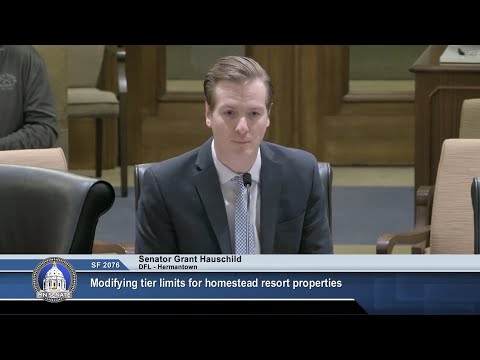
Senator Andrew Hauschild introduced Senate File 2076 on March 13, 2025, proposing to raise the three taxable-value tier thresholds that apply to Class 1C homestead resort properties, commonly called "mom-and-pop" resorts, with changes effective beginning with assessment year 2026.
The measure would raise the first tier from $600,000 to $1,500,000; set the second tier for the next $3,000,000 of value (raising the upper bound of tier two to $4,500,000, up from $2,300,000); and make the third tier any value above $4,500,000. The bill leaves the classification rates unchanged at 0.5 percent, 1 percent and 1.25 percent for tiers one through three, and preserves the existing rule that value in the third tier is subject to the state general levy.
Supporters told the committee the change is intended to preserve small, family-run resorts that they say face rising valuations and competition from short-term rentals. Joel Carlson, testifying for the Community of Minnesota Resorts, said assessors often value resort property at its "highest and best use," which he described as a scenario where land is split and sold as individual lake lots rather than kept as a resort. "The assessing system doesn't work for resorts because most times the assessor assesses your property at its highest and best use and the highest and best use, as determined by the assessor, is literally to break that property up individually and sell it off," Carlson said.
Several resort owners described the role their businesses play in small communities. Beth Kielinski, who identified herself as owner-operator of Knotty Pines Resort in Nevis, said her resort hosts about 135 families each summer and supports local shops and restaurants. "We're not in it for the money," Kielinski said. "We're in it for those families making memories every summer." Emily Norris, owner of Pamush Resort near Bemidji, tied the industry to community stability and mental health, noting higher property-tax burdens she said have grown from about 1.3 percent to 2.8 percent of her gross revenue since 2020. Michael Bolt, owner of Cedar Point Resort and a board member of the Community of Minnesota Resorts, said resorts are often the largest summer employer in their towns and draw hundreds of visitors weekly during peak season.
The Department of Revenue revenue estimate cited in committee materials reported about 1,901 parcels containing Class 1C property in 2025 with a statewide taxable market value of about $813 million. The estimate projects that 45 percent of those properties have taxable market value exceeding the current first-tier limit of $600,000; under the bill the estimate projects roughly 72 percent of homestead resorts would fall under the new first-tier threshold (0.5 percent rate), about 22 percent of value would be in the second tier and about 6 percent in the third tier above $4.5 million.
Committee members asked members to consult the revenue estimate, which also notes an interaction with the property tax refund beginning in fiscal year 2028. The bill was initially laid over in committee. Later in the hearing the committee adopted an amendment to Senate File 132 inserting the language of Senate File 2076 into that A2 amendment; the motion to insert the language was moved by Senator Hauschild and adopted by voice vote. The committee then advanced the larger Senate File 132, as amended, to the Senate floor.
If enacted as drafted, the tier adjustments would apply beginning with assessment year 2026; the bill does not change the classification rates or the application of the state general levy to third-tier value.
Testimony in the hearing focused on economic and community impacts described by resort owners and industry representatives; the committee did not adopt final legislative text for SF 2076 as a standalone bill during the portion of the hearing dedicated solely to it, but later incorporated it into SF 132 through the adopted amendment.