Get Full Government Meeting Transcripts, Videos, & Alerts Forever!
Get email alerts on the Child Protection Screening topic
No spam. Unsubscribe anytime.
Senate committee backs bill to bar child-protection screening when discharge lacks services
Summary
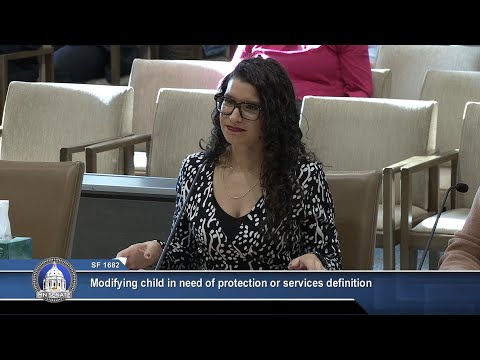
On March 13, 2025, the Minnesota Senate Health and Human Services Committee voted to recommend passage of Senate File 1682, which would put into statute a Department of Human Services policy adopted in 2023 that directs counties not to screen families into child protection solely because medically necessary children’s behavioral-health services are unavailable.
On March 13, 2025, the Minnesota Senate Health and Human Services Committee voted to recommend passage of Senate File 1682, which would put into statute a Department of Human Services policy adopted in 2023 that directs counties not to screen families into child protection solely because medically necessary children’s behavioral-health services are unavailable.
The measure’s sponsor, Senator May Quaid, introduced the bill and the committee adopted an A-1 author’s amendment before the final voice vote to refer the bill to the Judiciary Committee. The committee took extensive testimony from family members, advocates and county and hospital representatives about children boarding in emergency departments and the scarcity of residential and intensive treatment options.
Sue Abderholden, executive director of NAMI Minnesota, told the committee that parents who refuse unsafe hospital discharge plans are not neglectful. “We are talking about highly engaged parents. They are not neglecting their children,” Abderholden said, adding that referring families to child protection can threaten parents’ jobs and custody of other children.
Several parents described repeated hospital admissions and long waits for residential placements. Michelle Wood of Goodhue County described a December incident after which hospital staff threatened to report her to child protection despite ongoing placement efforts and long waiting lists. “We have faithfully cared for our daughter's special needs for years, but this time we knew she needed more than we alone could do for her,” Wood said.
Archie Manolis, an adoptive parent, described years of seeking services across the state and a period when his family faced a daily call to local CPS after refusing to take their child home from a hospital because no placement was available. “When a parent refuses to pick up a child at discharge from an ER or juvenile detention center, believe me, we are experiencing the most excruciating decision of our lives,” Manolis said.
Lisa Harrison Hedler, Ombudsman for Mental Health and Developmental Disabilities, supported the bill and said her office hears that counties and hospitals often treat the 2023 screening guidance as nonbinding. “We hear from counties and hospitals regularly that they do not consider the updated screening guidelines binding, but that they are simply guidelines. Senate File 1682 will change that by clarifying in statute,” Hedler said.
Dakota County official Nikki Conway, testifying for the Minnesota Association of County Social Service Administrators (MACSA), said counties generally follow the DHS screening guidelines and described Dakota County’s rapid response consultations used in complex boarding situations. Conway urged continued reliance on screening guidelines supported by training and interagency processes.
Danny Acker of the Minnesota Hospital Association said hospitals support the bill’s intent but warned that a statutory change could “delay necessary support to youth in crisis and their families” if it prevents timely coordination with counties; he urged recognition of the complexity of placing youth who are boarding in emergency departments.
After discussion, Senator Bolden moved that the bill, as amended, be recommended to pass and be referred to the Committee on Judiciary; the motion carried on a voice vote. No roll-call tally was recorded in the hearing transcript.
The bill now goes to the Judiciary Committee for further consideration.