Get Full Government Meeting Transcripts, Videos, & Alerts Forever!
Get email alerts on the Pathways Initiative Western Market Governance topic
No spam. Unsubscribe anytime.
Senate panel weighs Pathways regional-market plan as supporters tout savings and critics warn of lost state control
Summary
California State Senate members and a broad set of energy stakeholders spent several hours debating the Pathways Initiative — a proposal to create a new regional governance structure for Western electricity markets that would put market‑design authority for the Western Energy Imbalance Market (WEIM) and the Extended Day‑Ahead Market (EDAM) under a new regional organization while CAISO would continue to operate balancing‑authority functions.
California State Senate members and a broad set of energy stakeholders spent several hours debating the Pathways Initiative — a proposal to create a new regional governance structure for Western electricity markets that would put market‑design authority for the Western Energy Imbalance Market (WEIM) and the Extended Day‑Ahead Market (EDAM) under a new regional organization while CAISO would continue to operate balancing‑authority functions.
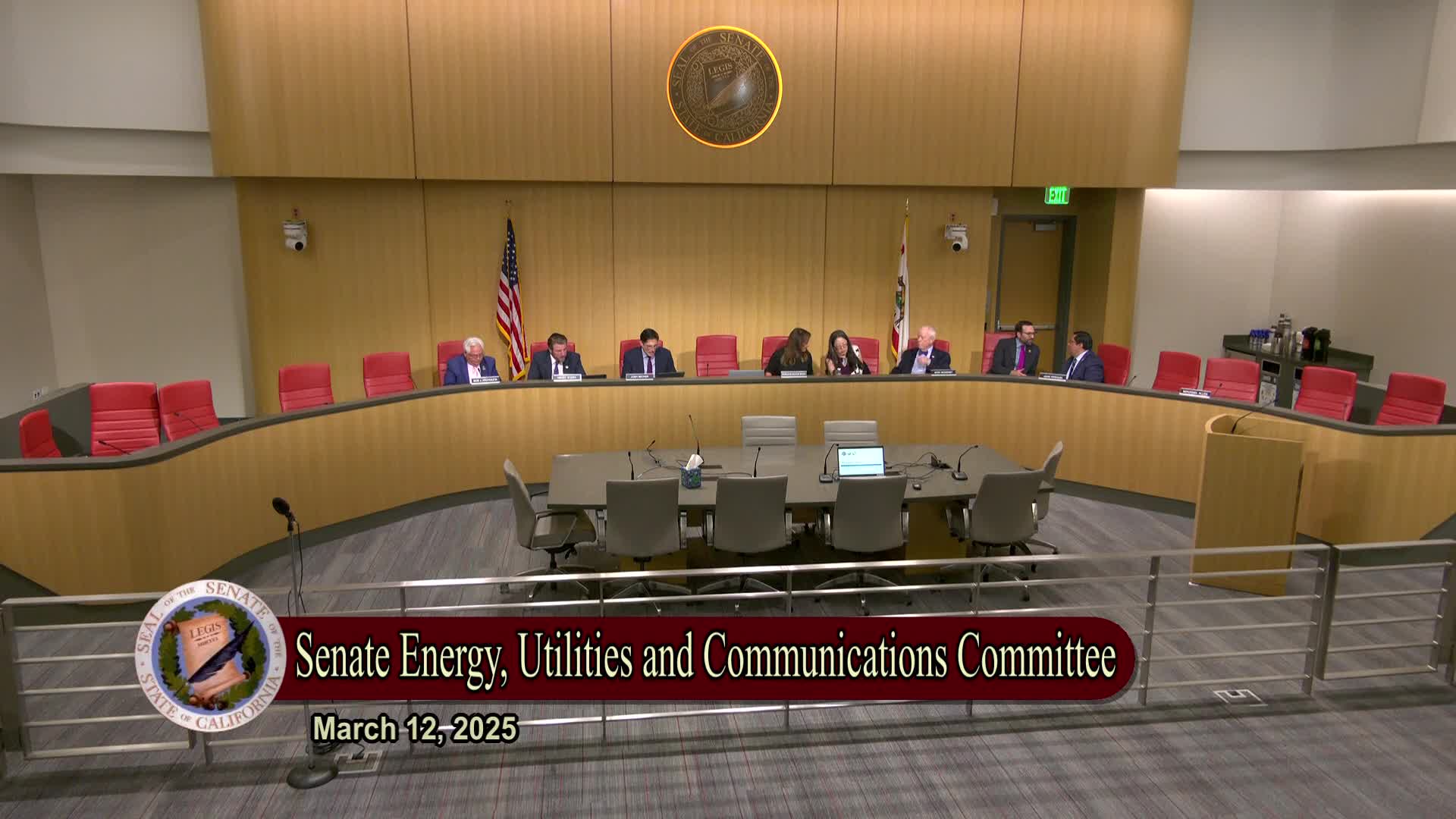
The hearing, convened by Chair Becker of the Senate Committee on Energy, Utilities and Communications, brought regulators from California and the West, CAISO officials, launch‑committee representatives and a mix of environmental groups, public advocates, labor and local utilities to describe the initiative, its expected benefits and remaining questions. Chair Becker opened the hearing by framing the session as an overview of the Pathways Initiative and asking witnesses to explain how the proposal would affect California reliability, costs and emissions.
Why this matters: Proponents say a larger, coordinated day‑ahead market can lower costs and reduce curtailment of renewable energy by enabling more efficient cross‑border dispatch and better use of transmission. Opponents say the plan risks exposing California to higher emissions and eroding legal protections that ensure state policy goals — including the Renewable Portfolio Standard (RPS) and other environmental statutes — are honored.
The proponents' case - CAISO and state regulators described the history and mechanics of existing Western markets. CAISO officials told the committee that the WEIM has operated for more than a decade and that participants have captured substantial benefits: the WEIM footprint already contains multiple utilities across Western states and "has generated nearly $7,000,000,000 in gross financial benefits for electricity customers," according to testimony. - CAISO and California regulators said Pathways would separate two sets of CAISO responsibilities: (1) balancing‑authority duties (real‑time reliability, transmission operations, interconnection queue and related planning), which CAISO would retain under California governance, and (2) market design and rules for a broader day‑ahead market, which Pathways would move to a new regional organization built and governed by stakeholders across the West. - Witnesses emphasized that both WEIM and EDAM are voluntary and "WEIM and EDAM are voluntary markets," meaning entities would decide whether to join or remain in the market. Proponents said participation and withdrawal rights would be negotiated into the tariff and that existing CAISO assets, staffing and IT would be used to operate the market. - Supporters including the Pathways Launch Committee, clean‑energy buyers and many utilities described preliminary modeling that found potential savings. The committee heard that early Brattle modeling estimated up to about $790,000,000 in annual net benefits under a largest‑footprint scenario and suggested reduced renewable curtailment and some reliability gains, while the WEIM has already produced documented benefits from cross‑regional dispatch. - The Pathways proposal would create several public‑interest features, as described by witnesses: a chartered public purpose for the regional organization, an expanded role for state regulators in advisory functions, a funded consumer‑advocate organization to represent state ratepayer interests and an office for public participation to augment stakeholder transparency.
The critics' case - Several witnesses and public commenters pressed substantive legal and policy concerns. Former CPUC President Loretta Lynch said Pathways "gives up California's control of the pilot seat," arguing the proposal would transfer the right to file market tariffs and rules (the market‑design "flight plan") to a new regional entity and thus weaken the state's ability to ensure that filings to FERC reflect California's statutory obligations on cost and environmental outcomes. - Environmental and civic groups warned that some Brattle sensitivities show scenarios in which coal or other higher‑emitting generation from outside California could be dispatched more often into regional markets depending on relative fuel prices; speakers urged rigorous guardrails and additional modeling. Jennifer Tanner (Indivisible California Green Team) told the committee she opposed the bill and said, among other points, that guardrails in law should be clear enough to prevent increased coal dispatch. - Labor and some local leaders said the proposal could shift job‑creating buildout out of state and urged careful attention to labor and procurement impacts. Several unions and construction groups asked for a clearer accounting of potential impacts to California project work and workforce opportunities. - Public advocates repeated requests for clear, auditable demonstrations that any rate savings modeled by consultants will be realized and passed through to customers. Linda Serra‑Gallo of the Public Advocates Office asked for robust, equal access to market data and a well‑funded consumer‑advocate structure inside the new regional organization.
What was clarified at the hearing - CAISO and regulators repeatedly emphasized that CAISO would keep balancing‑authority control and that the RPS, SB 100 and other California policy tools would remain in place for procurement, integrated resource planning and reliability planning. The Pathways proponents said the initiative is designed so state authorities retain procurement and policy choices while only market‑design functions would transfer to the regional organization. - Witnesses acknowledged the Brattle study was a Phase‑1, preliminary analysis that used selected sensitivities (for example, conservative fuel‑price cases) and that further modeling and additional sensitivities — including scenarios without Canadian hydro or with different gas/coal price assumptions — were planned. - Multiple witnesses pointed to specific existing protections: the Department of Market Monitoring at CAISO, a market surveillance committee, public stakeholder processes and the voluntary nature of market participation; they also pointed out that past reforms after the California market crisis strengthened resource adequacy and forward procurement to reduce exposure to spot‑market manipulation.
Remaining open questions and committee direction - Committee members repeatedly asked for more detailed sensitivities and further work on: (1) whether modeled benefits survive realistic assumptions about which Western balancing areas would actually participate; (2) how state RPS and GHG goals would be enforced and monitored in a regional market; (3) guardrails to prevent increased dispatch of high‑emitting resources into California load; (4) job and project‑location impacts for California construction and manufacturing; and (5) the specifics of withdrawal processes and the legal mechanics of tariff filings to FERC (including which entity would hold §205 filing rights for market rules). - Multiple witnesses and members said legislation will be needed to define and protect California's authorities and public‑interest safeguards before any transfer of market‑design control is finalized; the committee heard that the Pathways proposal is intended to be permissive and, if enacted, that further tariff and corporate steps would follow and be submitted to FERC for review.
What happens next - The hearing closed without formal votes. Legislators said they will request additional modeling and legal analyses, hold follow‑up hearings and draft statutory language that would attempt to capture the guardrails discussed at the hearing. Stakeholders on both sides asked for further hearings and more time to reconcile outstanding concerns.
Provenance excerpts supporting this article - "The senate committee on energy utilities and communications, welcome to order. Good afternoon. Welcome to committee's second meeting of the 20 25, 20 sixth legislative session." — Chair Becker (opening remarks) (transcript segment start) - "WEIM and EDAM are voluntary markets. Right? They're built on that long standing legal principle that FERC can neither require entities to participate in these markets nor prevent them from withdrawing if they choose to do so." — President Maeser, CAISO (transcript) - "The mission that the launch committee adopted ... independent governance structure, largest footprint possible." — Kathleen Stacks, Pathways Launch Committee co‑chair (transcript) - "Pathways gives up California's control of the pilot seat." — Loretta Lynch, former CPUC president (opposition testimony)
No formal actions recorded: The hearing was an informational overview and public testimony; no motions or votes were taken during the session.
Reporting note: Direct quotations in this article are drawn verbatim from the hearing transcript and are attributed to the speakers who made them during the committee hearing.