Get Full Government Meeting Transcripts, Videos, & Alerts Forever!
Get email alerts on the Promised Neighborhoods topic
No spam. Unsubscribe anytime.
Promised Neighborhoods leaders warn of fiscal cliff, urge $17.5 million to sustain services
Summary
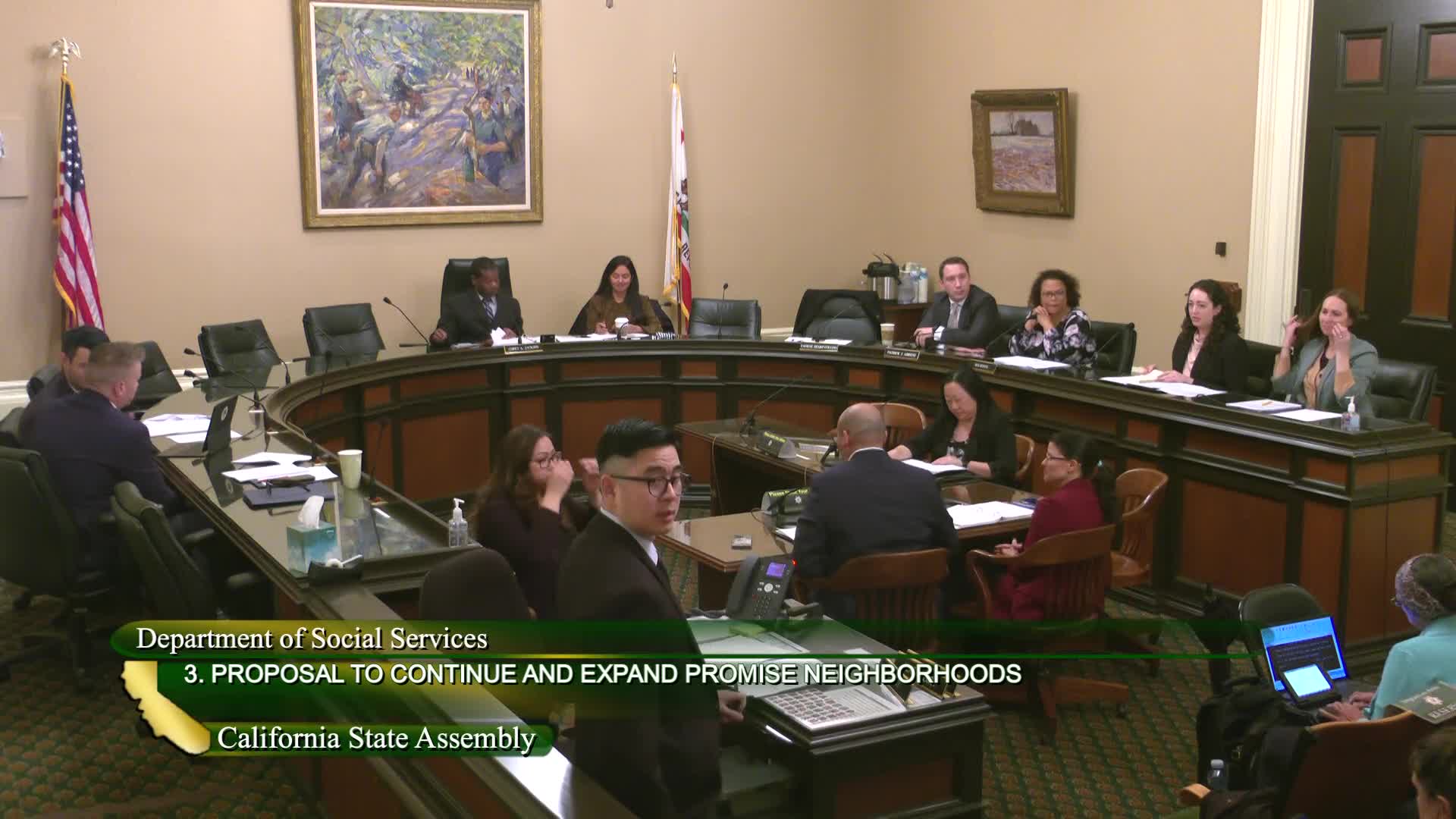
Program leaders and Assembly members told the subcommittee that four state-supported Promise Neighborhoods have shown measurable results but face a funding cliff this June without new state support.
Executive directors and state officials urged the subcommittee to provide bridge funding for California’s Promise Neighborhoods, a place‑based initiative that connects early‑childhood, education, mental‑health and family supports.
Edgar Chavez, executive director of Hayward Promise Neighborhoods, said four state‑supported Promise Neighborhoods have served tens of thousands of residents with measurable improvements in chronic absenteeism and graduation rates. Chavez said the statewide network estimates a one‑time ask of $17.5 million to prevent an immediate fiscal cliff and sustain evaluation and technical‑assistance infrastructure.
Jennifer Troia of CDSS said the current funding — a $12 million allocation in the 2022 budget act — was designed as one‑time money and sunsets June 30. CDSS has contracted with California State University, East Bay Foundation for evaluation and technical assistance and expects a final evaluation from Research Triangle Institute this summer.
Assemblymember Mia Bonta — a long‑standing sponsor of promise‑neighborhood strategies — and the committee emphasized that the program’s long‑term value depends on preserving local infrastructure and the ability to scale proven practices. Bonta and witnesses warned that losing the current network would make future rebuilding more difficult and more expensive.
CDSS and advocates said the Promise Neighborhoods use flexible local programming (promotores, academic advocates, food distribution, mental‑health services) tailored to each community and that federal and private funding uncertainties underscore the need for state support.
Committee members asked the Legislative Analyst’s Office and CDSS to identify the minimum funding necessary to maintain existing infrastructure and to report back with more detailed fiscal options.