Get Full Government Meeting Transcripts, Videos, & Alerts Forever!
Get email alerts on the Wireless Infrastructure topic
No spam. Unsubscribe anytime.
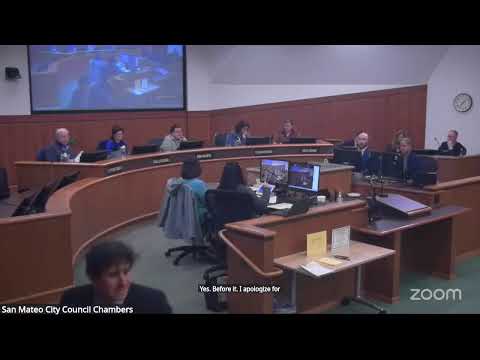
Commission upholds Public Works approval for 401 Dorchester small-cell permit, denies appeal 4-1
Summary
The Sustainability and Infrastructure Commission voted 4-1 on March 12 to deny an appeal and uphold the director—s conditional approval of a replacement wood-pole top-mount small cell at 401 Dorchester after staff said other candidate sites were technically infeasible under General Order 95 and the 2021 design standards.
The San Mateo Sustainability and Infrastructure Commission voted 4-1 on March 12 to deny an appeal against the Public Works director—s conditional approval for a Crown Castle small-cell wireless installation at 401 Dorchester.
Public Works staff presented the application as a top-mount canister on a replacement wood pole and said the parcel-specific alternative-site analysis showed the proposed site was the only technically feasible location. Staff said the application complied with the 2021 wireless design standards and that the project was categorically exempt from CEQA.
Appellant counsel Ariel Strauss argued the replacement pole was taller than necessary and the height had not been minimized as required under Design Standard 2. Strauss also questioned the sufficiency of the applicant—s alternate-sites analysis and said the application lacked site-specific evidence justifying why nearby poles were infeasible. —The pole is quite tall,— Strauss said; —there is a requirement — that the height be minimized.—
Crown Castle—s consultant, Tyler Reester, told the commission the company had submitted the required project purpose and technical objectives and that the configuration proposed would meet the company—s coverage and capacity goals for that location. —Our objective is to densify the network and add capacity in this area,— Reester said.
Public comment included the property owner at 401 Dorchester, Sam Schenk, who said the replacement pole and antenna would be —a big monstrosity on the street— visible from his balcony and garden. Schenk urged commissioners to weigh visual impacts and nearby uses in their decision.
Staff and Crown Castle representatives explained why other candidate poles in the immediate area were ruled infeasible: some had transformers or other utility gear that precluded additional attachments under CPUC General Order 95; others were embedded in tree canopies that would require significant trimming; and some would have required ground-mounted meters or cabinets on street frontage, which can be more obtrusive. Public Works said it consulted a third-party RF and technical reviewer and PG&E guidance in its feasibility assessment.
After discussion, commissioners voted 4-1 to deny the appeal and uphold the conditional permit. Roll call: Commissioner Robbins, aye; Commissioner Rubenski, aye; Commissioner Kranz, no; Vice Chair Michaels, aye; Chair Narita, aye.
The commission directed staff to finalize the written statement of decision documenting the bases for the ruling and return it for formal adoption. The ruling does not prevent the applicant from pursuing alternative designs or locations that comply with local standards and applicable state and federal law.
Why this matters: The decision demonstrates the commission—s role in weighing city design standards against applicants— stated technical objectives and state utility pole-clearance rules (General Order 95). The case highlights technical and procedural questions that frequently recur in small-cell reviews: how applicants define coverage objectives, how staff evaluates CPUC clearance constraints, and how visual/land-use impacts are balanced in dense urban corridors.