Get Full Government Meeting Transcripts, Videos, & Alerts Forever!
Get email alerts on the Wireless Infrastructure topic
No spam. Unsubscribe anytime.
Commission upholds appeal, denies Crown Castle permit for small cell at 16 Baldwin
Summary
The San Mateo Sustainability and Infrastructure Commission voted 4-1 to uphold an appeal and deny a conditional approval for a Crown Castle small-cell wireless permit at 16 Baldwin Avenue after residents and appellants argued the company—s alternative-sites analysis and technical evidence were insufficient.
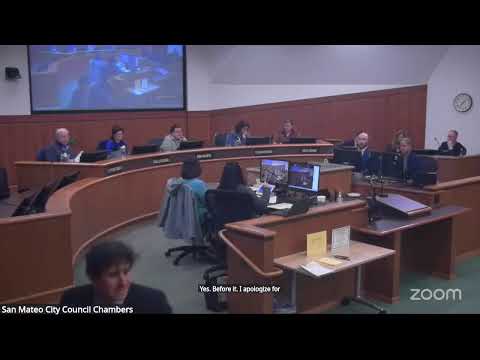
The San Mateo Sustainability and Infrastructure Commission voted 4-1 on March 12 to uphold an appeal and deny a conditional approval for a Crown Castle small-cell wireless permit at 16 Baldwin Avenue.
The vote came after appellants and several residents told the commission the applicant—s alternate-site analysis and technical documentation were incomplete and relied on an arbitrary —200-foot— range of service. Staff had recommended denying the appeal and upholding the director—s conditional approval, saying the application complied with the city—s 2021 wireless design standards and municipal checklist.
Appellants— attorney Grace Holbrook told the commission the application lacked the site-specific technical detail required by the design standards and the applicant had not shown —that these alternative sites are infeasible— with the level of clear and convincing evidence the code requires. —The applicant has clearly failed to establish with clear and convincing evidence as required by the design standards that these alternative sites are infeasible,— Holbrook said.
Crown Castle—s consulting engineer, Tyler Reester, countered that the company had met the city—s application requirements and that the technology being used shows meaningful dropoff in service beyond about 200 feet in the configuration Crown Castle would deploy. —The coverage and service drops off dramatically after that 200-foot range,— Reester said, describing the company—s technical objective as —to densify the network and add capacity in this area.— Public Works senior engineer Jason Hilari had briefed the commission that staff—s technical consultant concurred with the city—s conclusion that the proposed location met the design standards and that the application was categorically exempt from CEQA under the sections noted in the record.
Residents and local organizations who spoke during the public-comment and appeal portions emphasized the location—s proximity to a school, a church playfield and a retirement facility. Episcopal Day School head Quincy Grieve said the playfield is the school—s only regular outdoor recreation area and told commissioners, —300 children play there every day.— Parent and school trustee Catherine Collins said the proximity to the field had not been adequately weighed in staff—s assessment.
Commission discussion focused on whether staff and the applicant had shown, through site-specific facts and analysis, that the chosen location was the least-obtrusive feasible option under the design standards. Commissioners who supported the appeal said Crown Castle—s alternative-site analysis was conclusory for many candidate sites and did not provide the site-specific technical evidence needed to demonstrate infeasibility. Commissioners who opposed the appeal emphasized deference to the city—s technical review and the director—s findings.
The motion that carried found the application did not meet Design Standard 1 (least obtrusive) as applied to this specific location and ordered that staff prepare a statement of decision reflecting the commission—s findings. Commissioners voted as follows: Commissioner Robbins, yes; Commissioner Rowinski, no; Commissioner Kranz, yes; Vice Chair Michaels, yes; Chair Narita, yes.
What happens next: staff will draft the written statement of decision reflecting the commission—s ruling; the city indicated it will return the statement for adoption at the next available Commission meeting. The applicant may reapply or pursue other remedies allowed under state and federal law.
Why this matters: San Mateo adopted detailed small-cell design standards in 2021 to limit visual and land-use impacts while complying with federal telecommunications rules. The commission—s decision shows how local review can hinge on the depth of site-specific technical evidence applicants provide when seeking limited exceptions to local design standards.