Get Full Government Meeting Transcripts, Videos, & Alerts Forever!
Get email alerts on the Immigration Enforcement Local Cooperation topic
No spam. Unsubscribe anytime.
Minn. committee re-refers bill requiring local reporting to ICE after contentious debate
Summary
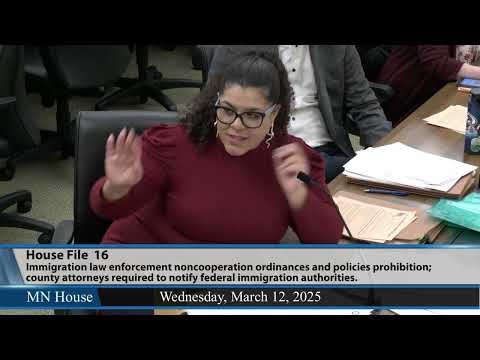
House File 16, which would require state and local entities to transmit immigration status information and require county attorneys to report arrested undocumented people suspected of violent crimes to ICE, was re-referred after a 10-9 roll-call vote amid extensive testimony and concerns from prosecutors, victim advocates and local officials.
House File 16, a bill that would limit state and local prohibitions on sharing immigration data with federal authorities and require county attorneys to notify federal immigration authorities when an undocumented person is arrested on suspicion of a violent crime, was re-referred to the Elections, Finance and Government Operations Committee after a 10-9 roll-call vote.
The bill’s sponsor, Representative Reimer, said the measure is intended to “bring us in accordance with” federal priorities and to focus on offenders the bill identifies as violent. "This bill targets violent offenders. That is what this bill is designed to do," Representative Reimer said during committee discussion.
Supporters framed the proposal as a public-safety measure to ensure cooperation with federal immigration enforcement in cases involving violent crime. Representative Hudson summarized the bill’s three sections during the hearing: it would (1) prohibit state or local entities from blocking receipt or transmission of federal immigration agency data, (2) prevent government entities from prohibiting cooperation with federal immigration enforcement, and (3) require county attorneys to convey information to ICE when an undocumented person is arrested on suspicion of a violent crime.
Opponents included county attorneys, the Minnesota Sheriffs Association and a swath of victim-advocate organizations who testified or were cited in letters as expressing concern. Representative Pinto, a former prosecutor, asked how the bill would avoid being used as a weapon against victims. "When a peace officer arrests an undocumented person on suspicion of committing a crime of violence... the county attorney has to report the person to ICE," Pinto said, adding that the bill’s use of "suspicion" raises practical and due-process concerns.
Committee members and testifiers raised multiple practical concerns: that sections 1 and 2 are broader than the sponsor described and could apply to noncriminal contacts with government (for example, background checks or social-service interactions); that mandatory reporting based on arrest or suspicion could occur before tests or charges are resolved; and that the change could deter immigrant victims and witnesses from cooperating with law enforcement, potentially undermining public safety and victim services. Representative Berg said advocates had described instances where victims came forward only because they believed they would not face immigration consequences.
Committee members also questioned interplay with federal immigration protections such as U and T visa certifications for immigrant victims and witnesses. Representative Feist summarized the visas’ role: U visas and T visas offer immigration relief for crime victims who cooperate with law enforcement, and she said the bill raises questions about the privacy and use of information that victims might provide.
Representative Greenman warned that the bill could effectively mandate a uniform local policy that would bind jurisdictions with different public-safety priorities and described constitutional concerns about commandeering local resources to carry out federal priorities. Representative Reimer and supporters said the bill is designed to align state law with what the sponsor described as federal enforcement priorities targeting violent offenders.
After debate and a request for a roll call, the committee approved a motion to re-refer House File 16 to the Elections, Finance and Government Operations Committee on a 10-9 vote. The clerk recorded 10 ayes and 9 nays; the roll call included the following votes as announced in committee: Novotny (Yes); Witte (Yes); Moller (No); Berg (No); Bliss (Yes); Curran (No); Juran (Yes); Hagen (Yes); Weist (No); Greenman (No); Harter (Yes); Hollins (No); Hudson (Yes); Johnson (No); Pinto (No); Ream (No); Repinski (Yes); Schwartz (Yes); Steer (Yes). The committee chair announced, "With 10 ayes and 9 nays, the motion prevails and House file 16 is re referred to elections and government operations."
The record of the hearing reflects broad disagreement about the bill’s scope and its potential effects on immigrant communities, victim reporting, and local law-enforcement practice. Several members said they would continue to work on the bill; others said they planned to oppose it in future committee action.