Get Full Government Meeting Transcripts, Videos, & Alerts Forever!
Get email alerts on the School Social Services topic
No spam. Unsubscribe anytime.
Ketchikan schools' RISE social work program reports growth, warns grant funding expires in 2026
Summary
The district's RISE school social work program reported expanded services and new data collection but said its four‑year federal grant runs through September 2026 and future funding is uncertain; staff described reduced suspensions and rising student contacts.
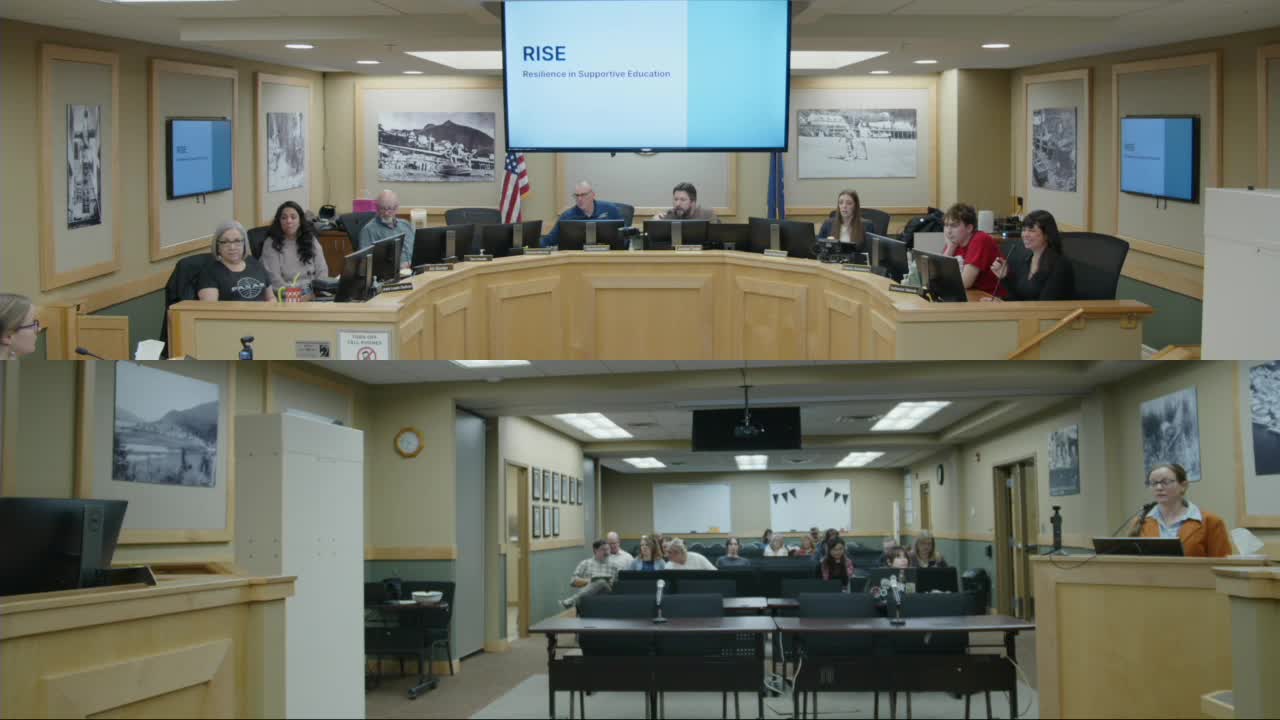
Ketchikan Gateway Borough School District staff reported on March 12 that the RISE School Social Work program has rapidly expanded services across district schools but faces funding uncertainty when a four‑year grant ends in September 2026.
Katie Frutiger, lead social worker for the RISE program, presented staffing, service levels and new case‑management data during the meeting. She said the social work team is made up of master’s‑level clinicians and school‑certified social workers; the team has been logging contacts more precisely since January and has recorded hundreds of student and family contacts in the current semester.
Key numbers and services
- Contacts August–December (previous system): 1,067 total contacts, including 639 student‑only contacts, 110 staff contacts and 238 parent/guardian contacts (data format limited by old logging system).
- New system (Jan 6–Mar 7): 659 contact notes in two months; 404 were student contacts and 126 parent/guardian or family contacts, showing substantially improved capture of services.
- McKinney‑Vento (homelessness) caseload: about 9% of students, approximately 180 students; the RISE team provides liaison and support services for those families.
Frutiger described a tiered service model: Tier 1 universal supports (classroom and MTSS participation); Tier 2 targeted small groups and interventions; and Tier 3 intensive services including crisis intervention, suicide assessments and in‑school/out‑of‑school behavioral supports. She said the program uses secure PowerSchool logs, written consent protocols, and memoranda of understanding with community partners to protect confidentiality and coordinate care.
Funding and sustainability
Superintendent Robbins and Frutiger said the program has been supported by a roughly $4 million grant that was originally written with WISH and later managed by district staff. Robbins said the grant runs through September 2026 and that sustained funding is uncertain: "The grant runs out September 26. So we have 1 more, really just 1 more school year. I don't know if we'll be able to necessarily continue the funding. Either we put it in the 100 budget [general fund] or we try to write another grant."
Robbins and Frutiger linked the program to measurable outcomes the district has tracked: suspension rates are down overall (Robbins said suspension rates were down about 25% from five years earlier; Native student suspensions were down by about 65% over the same period). The superintendent credited the cumulative effect of social work services, code‑of‑conduct work, and administrator training for the improvements.
Partnerships and workforce
Frutiger identified community partners and programs used for referrals and coordination, including KIC Behavioral Health, Community Connections, WISH, public health, and a newly executed partnership with University of Alaska Anchorage’s School Social Work Education Network (SWEN) which can support tuition pathways and internships for school social workers.
Frutiger also said the district still has one open RISE social work position and that recruiting and retaining licensed social workers is difficult; she described supervisory and professional development systems (weekly supervision and biweekly group consultation) to maintain case quality and ethics.
What happens next
Staff asked the board to note the program’s rapid expansion and to consider long‑term funding options before the grant expires. Frutiger and the superintendent said they will continue to refine reporting to the board and to the community and to bring budget scenarios for sustaining the program in future years.
Quotes in this article are taken verbatim from presenters and the March 12 meeting transcript.