Get Full Government Meeting Transcripts, Videos, & Alerts Forever!
Get email alerts on the Instructional Hours topic
No spam. Unsubscribe anytime.
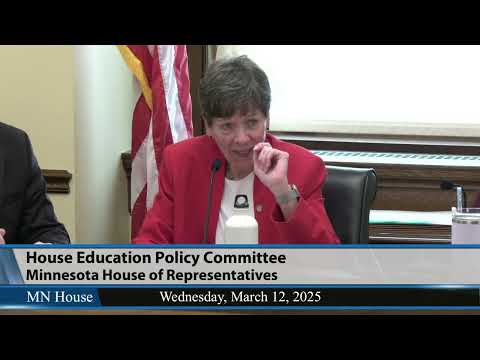
Committee sends bill to define secondary instructional hours and allow credit for internships and project‑based learning
Summary
House File 1607, carried by Representative Clardy, would define 'hours of instruction' for secondary schools and allow districts to count supervised internships, service learning and project‑based learning as credit‑bearing educational experiences. The Education Policy Committee voted to re‑refer the bill to Education Finance after hearing wide‑r
Representative Clardy introduced House File 1607 to define what counts as “hours of instruction” in secondary schools and to allow districts to count supervised internships, service learning, project‑based learning and other supervised out‑of‑school experiences toward academic hours. The bill does not mandate adoption by districts, the author said; rather it would provide a statutory framework districts can use to expand credit‑bearing, supervised educational experiences.
Supporters framed the bill as a response to student disengagement and chronic absenteeism. Dr. Akila Roberson of Education Evolving told the committee that “students spend only 20% of their waking time annually in formal classroom education,” and argued that clarifying instructional hours would allow districts to expand learning “anytime, anywhere.” Students and recent graduates testified about personal experience: Jose Perez described how project‑based and career‑focused learning helped him graduate; Sarah Bachia said a community‑based program “did not earn me a credit towards graduation, but they did save my life.” A senior from an alternative high school, Keith Blassingame, described wanting hands‑on trade learning and apprenticeships that currently may not count toward graduation credits.
Education Minnesota’s Caitlin Snyder and district leaders including Renee Cornell (St. Anthony‑New Brighton) and Michael Scott (Hutchinson Public Schools) testified in support, saying the bill would give teachers and districts the clarity to design supervised, credit‑bearing experiences outside the conventional seat‑time model. Several testifiers said the change would not reduce state or federal supports and that MDE would still conduct audits or oversight as provided in statute.
Members generally praised the bill’s intent but asked for guardrails. Representative Hill supported the bill but asked for assurance that expanded options would be available equitably to all students and said she wants structural protections to ensure distribution. Representative Keeler noted Minnesota requires 165 school days — the second‑lowest total nationally — and said the bill should maximize the effectiveness of limited instructional time; she also suggested expanding the list of eligible supervisors beyond licensed teachers to include designated liaisons or cultural staff where appropriate.
Representative Jordan renewed the motion to re‑refer House File 1607 to the Education Finance Committee; the motion prevailed and the measure was sent to finance for further consideration.
Ending: Committee members asked authors to work with members and stakeholders on equity, verification of supervised experiences and implementation guidance before the bill’s next stop in Education Finance.