Get Full Government Meeting Transcripts, Videos, & Alerts Forever!
Get email alerts on the Immigration Enforcement topic
No spam. Unsubscribe anytime.
Committee hears hours of testimony on HF 16, bill would require reporting of certain arrests to ICE
Summary
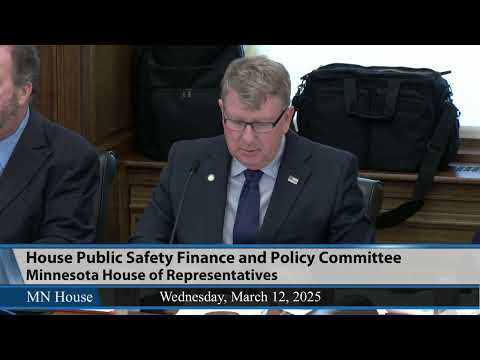
The Minnesota House Public Safety Committee heard extensive testimony on House File 16, a measure by Representative Reimer that would require state and local entities to report people suspected of being in the United States unlawfully who are arrested on suspicion of violent crimes listed in Minn. Stat. 624.172, subd. 5, and would prohibit state and local policies that limit cooperation with federal immigration enforcement.
The Minnesota House Public Safety Committee heard extensive testimony on House File 16, a measure by Representative Reimer that would require state and local entities to report people suspected of being in the United States unlawfully who are arrested on suspicion of violent crimes listed in Minn. Stat. 624.172, subd. 5, and would prohibit state and local policies that limit cooperation with federal immigration enforcement.
Representative Reimer told the committee the bill “accomplishes two main things.” He said the first is a mandate that “any illegal immigrant arrested on suspicion of a violent crime as defined by Minnesota state statute 624.172 subdivision 5, even in cases where the county attorney elects not to prosecute, be reported to ICE.” He described the second aim as preventing state and local entities from “actively prohibiting, restricting, or interfering with federal immigration authorities in carrying out the federal immigration enforcement.”
The bill drew sharply divided testimony. Supporters, including David Zimmer of the Center of the American Experiment, urged passage as consistent with federal law and as a means to improve interagency cooperation. Zimmer said cooperation “serves as the foundation for law enforcement,” noting that timely sharing of information can help ICE take custody when local detention timelines expire.
Opponents — including immigrant-rights advocates, victim-services organizations, public-health professionals, and city and county officials — warned the bill would undermine community trust, chill reporting by crime victims and witnesses, create conflicts with federal privacy laws, and divert scarce local law-enforcement resources. Ben Gleichel, a removal-defense attorney at the Immigrant Law Center of Minnesota, said HF 16 “will make all people residing in Minnesota less safe” by discouraging victims of domestic violence and trafficking from contacting police.
Family testimony underscored the emotional stakes. Charles Thayer told the committee about the 2024 murder of his mother and described her history of abuse; he said of reporting dangerous suspects to ICE, “The only question I really have left is how anybody on any side of any aisle would ever have a problem with reporting dangerous criminals to ICE so they can be considered for deportation immediately.”
Public-safety and local-government officials said the bill would interfere with local separation ordinances and established practices. Todd Barnett, Commissioner of Community Safety for the City of Minneapolis, said the city’s separation ordinance — adopted more than 20 years ago — directs city employees not to inquire about immigration status except in limited circumstances and was intended to increase trust. Barnett testified that preempting those local policies would “result in decreased safety for Minneapolis and its residents” because residents would be less likely to report crimes or seek services.
Legal and technical concerns were raised about data sharing. Anna Patratz Acosta, a law professor, testified that the bill’s language could conflict with the Minnesota Government Data Practices Act and federal statutes such as HIPAA and FERPA by broadly requiring disclosure of immigration-related information held by schools and health-care entities. She also explained limits to removal and detention under federal law and relevant court precedent, noting that some foreign nationals cannot be removed to their country of origin and that the Supreme Court’s 2001 decision in Zadvydas v. Davis limits how long ICE may detain certain noncitizens.
Hennepin County Assistant County Attorney Edgar Castillo warned the committee that HF 16 would “divert resources” from policing and prosecution to reporting duties for federal immigration enforcement and could undermine efforts to secure victims and witnesses for prosecutions. Violence-prevention and victim-service organizations likewise said the bill risks silencing survivors who fear immigration consequences.
Committee members pressed witnesses on details. Members raised whether existing booking and fingerprinting procedures already notify federal systems and whether diplomatic or legal constraints would have affected specific criminal cases cited by proponents. Representative Reimer acknowledged Minnesota-specific data on crime rates among undocumented people is limited and said he would follow up on technical definitions in the bill raised by other members.
Procedural note: at the start of the hearing the chair moved the bill before the committee with a recommendation and re-referred it to the committees on Elections, Finance, and Government Operations for further consideration; no final vote on the substance of HF 16 was taken at this hearing.
The committee heard from roughly a dozen speakers during a long public-testimony period, including advocates, city officials, public-health experts, a victim’s family member, law-enforcement representatives, and legal scholars. The bill’s next steps will be taken in the committees to which it was re-referred.