Get Full Government Meeting Transcripts, Videos, & Alerts Forever!
Get email alerts on the Housing Zoning topic
No spam. Unsubscribe anytime.
Committee advances bill to legalize duplexes through quadplexes on selected residential land
Summary
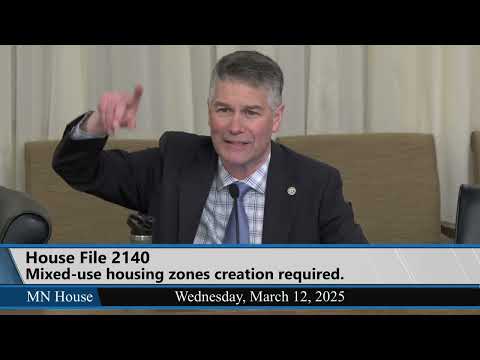
The House Housing and Finance Policy Committee adopted an amendment and voted to refer House File 2,140, a bill that would require cities to allow small-scale multifamily housing (duplexes, triplexes, quadplexes) on specified portions of residentially zoned land and set statewide performance standards and protections.
The House Committee on Housing and Finance Policy adopted the DE1 amendment and voted to re-refer House File 2,140 to the Elections, Finance and Government Operations Committee, moving forward a bill that would require cities to designate portions of residentially zoned districts where duplexes through quadplexes would be an allowed use.
Representative Kraft, sponsor of House File 2,140, told the committee the bill responds to what she described as a “massive housing shortage in Minnesota and really across the country,” and said the measure aims to put more housing near transit, services and existing neighborhoods while avoiding sprawl.
The bill sets a performance-based framework that gives cities choices about where to legalize additional housing types. Under the proposed language explained by Kraft, larger cities would have higher expectations (including an option tied to average density measurements), while nonurban cities would have a lower threshold (a proposed 50% of residential districts supporting up to triplexes or an alternative average density). The bill includes carve-outs where additional housing would not be forced—areas on well-and-septic systems, flood plains, wild and scenic river corridors, and certain historic or critical environmental areas. Kraft also described bulk standards intended to prevent local rules from effectively nullifying the new allowances by requiring a minimum of 1,500 square feet per residential unit as a backstop on dimensional controls.
Supporters told the committee the bill would help close a widely cited housing gap. Charles Gardner, research fellow at the Mercatus Center, recommended restoring ‘‘property owners’ flexibility to build housing in different configurations’’ and said similar reforms in other states have led to increased housing supply. Scarlett Bennett, director of housing development for Cascading Community Action, said the bill provides a baseline to help small and rural jurisdictions that lack planning capacity.
Local government officials and some cities warned the committee the measure, as drafted, could be difficult to implement or could force incompatible land uses. Brian Baer, city administrator for Hugo, said the bill’s requirement to legalize higher densities on a set percentage of residential land is “extraordinarily problematic” where much of a city lies in urban reserve or lacks infrastructure. Baer said municipal state-aid streets in Hugo are not appropriate corridors for higher density, that sewer capacity and posted no-parking rules complicate the proposal, and that the city is currently prohibited from drilling new wells for drinking water. He told the committee: “Mandating extra high densities in area of the city where we haven't planned for it is extraordinarily problematic for us.”
Other municipal witnesses, including representatives of the Coalition of Greater Minnesota Cities and several city administrators, urged more flexibility for node-based planning rather than corridor mandates, noted the cost and time of updating comprehensive plans, and raised concerns about parking, fire safety and water infrastructure in some communities.
Kraft said the bill contains a staggered implementation schedule so larger cities comply first and smaller cities later, and she emphasized the bill does not mandate construction of new housing; it makes additional housing types an allowable use and preserves local review where public health, safety or infrastructure limits apply. The committee adopted the DE1 amendment by voice vote before referring the bill.
The bill will now move to Elections, Finance and Government Operations for further consideration.