Get Full Government Meeting Transcripts, Videos, & Alerts Forever!
Get email alerts on the Fentanyl Child Exposure topic
No spam. Unsubscribe anytime.
Committee backs bill to make fentanyl exposure of children a felony and refers it to Children and Families panel
Summary
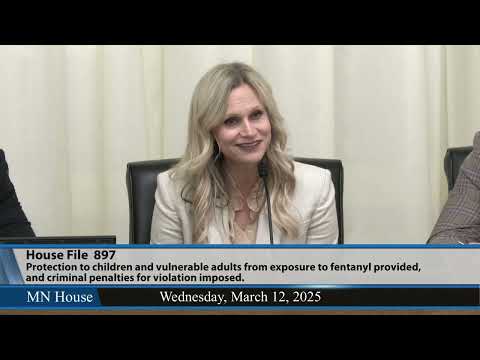
Representative Steve Knudson, author of House File 897, told the Minnesota House Public Safety Committee on March 12 that the bill, as amended, would align criminal penalties for exposing children and vulnerable adults to fentanyl with existing law on methamphetamine exposure.
Representative Steve Knudson, author of House File 897, told the Minnesota House Public Safety Committee on March 12 that the bill, as amended, would align criminal penalties for exposing children and vulnerable adults to fentanyl with existing law on methamphetamine exposure. The committee adopted an author's amendment and re‑referred the bill to the House Children and Families Finance and Policy Committee.
Supporters said the change closes a gap in state law and cited recent child deaths linked to fentanyl. Sebastian Mesa, an assistant county attorney in Aitkin County, said, "152.137 makes it a felony to expose a child or vulnerable adult to methamphetamine, and it struck me as rather peculiar that a drug as dangerous as fentanyl ... would not fit under that same legislative scheme." Mesa described cases in which children were exposed to fentanyl left in living areas and said prosecutors have been limited in charging under current law.
Jeff Potts, executive director of the Minnesota Chiefs of Police Association, told the committee that fentanyl remains a major contributor to overdose deaths. "In 2023, there were still 1,338 overdose deaths, 919 of those related to opioids," Potts said, adding that preliminary 2024 data suggest many of those fatalities were linked to fentanyl and that fentanyl is frequently found mixed into other seized drugs. Paul Ostrow, chair of Fentanyl Free Communities and a retired prosecutor, said infant exposures have risen sharply: "Infant exposure to fentanyl increased by 449 percent between 2020 and 2023." He and other advocates emphasized pairing enforcement with treatment and harm‑reduction measures such as wider availability of naloxone.
Representative Knudson said the bill responds to recommendations from the Minnesota County Attorneys Association and that the DE1 amendment adds fentanyl to the statute text and defines fentanyl consistent with chapter 152.137, subdivision 25. Representative Lee Muller asked whether the bill should include an exception for medically prescribed fentanyl; Knudson said the sponsors could consider language similar to the exception in a bill that had been pulled from the agenda.
The committee adopted the DE1 amendment by voice vote and then voted to re‑refer House File 897 to the Children and Families Finance and Policy Committee. No fiscal details or sentencing changes beyond aligning exposure penalties with the existing methamphetamine provision were included in committee discussion recorded on the transcript.
The bill packet submitted to members includes a letter from the Minnesota County Attorneys Association and media material referenced by the author; proponents cited Minnesota Department of Health statistics on nonfatal overdoses and several local child fatality cases included in the packet.