Get Full Government Meeting Transcripts, Videos, & Alerts Forever!
Get email alerts on the Immigration Enforcement topic
No spam. Unsubscribe anytime.
Committee re-refers bill on local cooperation with ICE after hours of debate
Summary
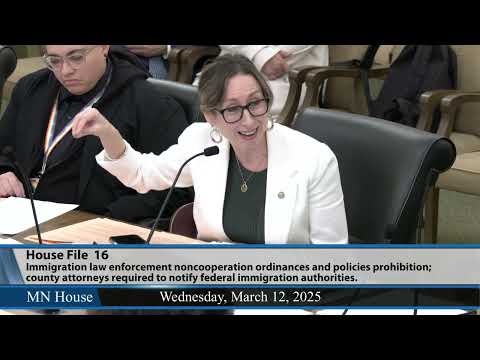
A Minnesota House committee voted 10-9 to re-refer House File 16 after lawmakers debated whether the measure — which would limit state and local restrictions on cooperation with federal immigration authorities and require certain arrest reporting to ICE — would harm immigrant victims and public safety trust.
A Minnesota House committee voted 10-9 to re-refer House File 16 to the Elections, Finance and Government Operations Committee after extended debate over a bill that would restrict state and local limits on cooperation with federal immigration authorities and require county attorneys to report certain arrests to U.S. Immigration and Customs Enforcement (ICE).
The bill, presented by Representative Reimer, contains three sections: one bars Minnesota government entities from prohibiting receipt or transmission of federal immigration data; a second prevents local government entities from prohibiting cooperation with federal immigration authorities; and a third requires county attorneys to notify ICE if an undocumented person is arrested on suspicion of a violent crime, even if the county attorney later declines to prosecute.
Supporters led by Representative Reimer said the measure is narrowly targeted at violent offenders and is intended to align state practice with federal priorities. "This bill targets violent offenders. That is what this bill is designed to do," Representative Reimer said during the hearing.
Opponents — including prosecutors, victim advocates and several committee members — argued the bill is broader than its sponsors portray, could be used as a bargaining or intimidation tool in domestic violence and custody disputes, and would discourage immigrant victims and witnesses from reporting crimes or cooperating with law enforcement. "This bill is in fact so much broader than been referenced," Representative Pinto said, adding that sections beyond the narrow definition in section 3 could apply across many interactions with government agencies.
Committee members raised several practical and legal concerns. Multiple speakers warned that the bill’s reporting requirement, which applies at the point of arrest based on suspicion, lacks prosecutorial discretion and could force county attorneys into reporting situations where charges are never filed or evidence is later shown to be invalid. Representative Pinto described a hypothetical in which an arrest for suspected drugs later proves to be a false positive and said the bill would nevertheless require notification to federal immigration authorities.
Advocates for victims and public-safety critics said the measure could undermine trust between immigrant communities and emergency responders or social-service providers. Representative Johnson warned that the bill could make marginalized communities less likely to call for help: "A lot of folks that are in those marginalized communities are fearful as it is and this adds another layer that will impact their willingness to call and ask for help." Representative Berg recounted a sexual-assault survivor’s decision to come forward only because she trusted law enforcement and prosecutors not to expose her to immigration enforcement.
Several statewide organizations were cited during the hearing as opposing the bill, including the Minnesota Sheriffs Association, the Association of Minnesota Counties, the League of Minnesota Cities and multiple victims’ advocacy groups such as the Minnesota Coalition Against Sexual Assault and Violence Free Minnesota. Committee members also referenced letters from county attorneys and other local officials raising legal concerns about due process, equal protection and exposure to civil liability.
Other witnesses and members highlighted potential economic and workforce effects, noting testimony and letters from the Minnesota Chamber of Commerce and analyses suggesting that immigrant households contribute significant tax revenue and labor to sectors such as health care and agriculture.
Supporters said the measure is intended to bring Minnesota law into alignment with recent federal and congressional initiatives, which Representative Reimer and others referenced as the "Lake and Riley Act" during discussion, and to ensure violent offenders who are noncitizens can be identified to federal authorities. Representative Hudson summarized the bill’s structure in committee: "Section 1 says that a government entity will provide information... Section 2 says that we're not going to allow government entities... to prohibit the ability of law enforcement to cooperate... and then section 3... the county attorney... convey that information to ICE." (Representative Hudson: committee remarks.)
After discussion and a requested roll call, the committee approved the motion to re-refer House File 16 by a roll-call vote of 10 ayes and 9 nays. Representative Reimer renewed the motion to recommend re-referral; the clerk recorded the following roll-call votes: Novotny (yes), Witte (yes), Moller (no), Berg (no), Bliss (yes), Curran (no), Juran (yes), Hagen (yes), Weist (no), Greenman (no), Harter (yes), Hollins (no), Hudson (yes), Johnson (no), Pinto (no), Ream (no), Repinski (yes), Schwartz (yes), Steer (yes). With 10 ayes and 9 nays, the motion prevailed.
The committee did not finalize policy on the bill; instead it forwarded the proposal with the recommendation to re-refer to Elections, Finance and Government Operations for further consideration.