Get Full Government Meeting Transcripts, Videos, & Alerts Forever!
Get email alerts on the Design Review Ordinance topic
No spam. Unsubscribe anytime.
Laguna Beach staff pitches faster, more objective design-review process; council and advisory bodies urge caution on exemptions
Summary
City staff presented an urgency ordinance and a concurrent comprehensive zoning-code update to reduce subjective design review and speed routine projects; staff and advisory bodies agreed change is needed but urged caution about broad exemptions that could affect views, privacy and public‑realm projects.
City staff outlined proposed changes to Laguna Beach's design-review process on Oct. 27, proposing an urgency ordinance to speed review of routine work and a parallel comprehensive zoning-code update to create objective design standards for certain projects.
The proposed urgency ordinance would exempt narrowly defined ministerial projects from discretionary design review and create a new “zone clearance” path for projects that plainly meet objective code standards. Staff also proposed shifting some work from the Design Review Board and Planning Commission to an administrative design-review process that would remain callable up to those bodies. Staff said the changes respond both to new state housing laws such as SB 9 and to long internal delays that have strained planning staff and the city budget.
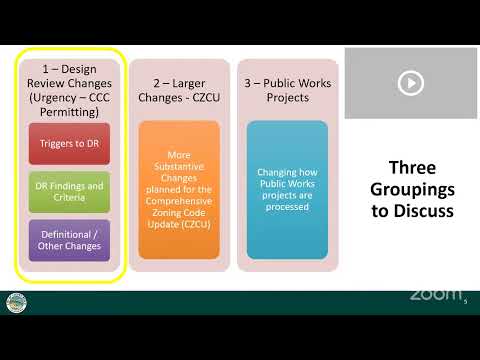
The proposal starts with three broad pieces of work, staff said: (1) short-term “efficiency ordinance” changes to design-review triggers, (2) a longer-term comprehensive zoning-code update to add objective design standards (for multifamily and potentially some single-family projects), and (3) changes to how public-works projects are processed.
“Has a lot to do with state law, has a lot to do with recent changes that guide us towards more objective design standards,” city staff member Jane said in the presentation, noting state statutes and the city's own housing element as drivers. Staff explained examples of items proposed for exemption or administrative review: small additions and repairs that do not exceed about 16 feet above adjacent ground; decks and patios that are three feet or less above grade; reroofing that does not alter roof dimensions; small landscaping within setbacks (front setbacks under 4 feet; side/rear under 6 feet); and certain in-kind repair work. Staff also proposed excluding environmentally sensitive parcels and any development on slopes of 30 percent or greater from the new administrative tracks.
The revisions would also collapse the existing four design-review findings into two: that a project complies with the Laguna Beach Municipal Code and that improvements are designed in overall consistency with design-review criteria. Staff proposed reducing the number of explicit criteria (currently 16) by removing overlapping items that staff said are enforced elsewhere in the municipal code or general plan.
At the same time, staff asked the council for direction on a separate path: creating objective design standards for multifamily projects (required by state law) and a potential “pathway” of limited objective standards for smaller single-family projects that would be allowed without discretionary review if they fit the code envelope. “The idea with this is to have a streamlined approach to single-family residences,” planner Megan said, while acknowledging that projects needing variances or other discretionary approvals would still use the subjective pathway.
Public comment reflected a split of concerns. Labor union representative Perry Mead of United Local 11 urged that hotel work remain discretionary to preserve Laguna Beach’s character: “we recommend that Laguna Beach maintain transparency and ensure that hotel projects and improvements at existing hotels continue to be subject to design review,” he said. Multiple longtime residents and local architects urged a faster, more predictable process. “Subjectivity equals uncertainty and uncertainty equals time,” resident Newt Morris told the council, describing multi‑year delays he said had affected property owners and developers.
Design Review Board and Planning Commission members generally supported trimming redundant criteria and creating objective standards where appropriate but urged caution about broad exemptions. Jessica Gannon, chair of the Design Review Board, told the council that “neighborhood compatibility is subjective, so that should stay,” while Tom Gibbs recommended keeping a safety valve that allows staff to refer administratively reviewed projects to the board when impacts on views, privacy or massing are likely.
Planning Commissioners repeated concerns about public‑realm projects and utilities. Commissioner Ken Sadler and others said projects such as fire stations, beach access improvements and undergrounding programs have strong aesthetic implications and benefit from discretionary review and early consultation with advisory bodies.
City Manager Dave said staff supports streamlining in order to reduce the load on planners and improve recruitment and retention. He described the reforms as necessary to avoid an unsustainable cycle of backlog and turnover: “I have not been able to conclude that this is resolvable without the kinds of changes that we’re proposing,” he said.
Staff emphasized next steps if council directs staff to proceed: consult the California Coastal Commission as soon as possible about an interim/urgency ordinance; move formal zoning-code text amendments through the Planning Commission; and then return to council for public hearings and readings. Staff noted the city has a consultant on the comprehensive zoning-code update through roughly October 2026 and is considering a phased approach to accelerate pressing elements.
The meeting was a study session; councilmembers and staff explicitly noted that no formal action was taken. Councilmembers asked staff to return with a revised draft that sharpens definitions (particularly the phrase “does not constitute a major remodel”), clarifies measurement points (e.g., whether the 16‑foot threshold is measured from adjacent grade), and more clearly enumerates the types of public works that should remain discretionary. Advisory board members urged adding clearer criteria and a stronger early‑consultation program, and several asked staff to preserve a role for the Planning Commission on larger public‑realm projects.
The study session produced direction to continue refining the ordinance language, consult the Coastal Commission about an interim approach, and return in a subsequent public session with a revised draft incorporating council and advisory‑body feedback.
Votes: none — study session only. No motions or final votes were taken.