Get Full Government Meeting Transcripts, Videos, & Alerts Forever!
Get email alerts on the Disability Accessibility topic
No spam. Unsubscribe anytime.
Disability advocates present Tivoli zoning amendment as local model for accessibility
Summary
A Taconic Resources for Independence representative briefed the Village of Red Hook Board of Trustees on a Tivoli site-plan amendment adopted in August 2024 to strengthen ADA compliance and promote temporary accessibility solutions for older buildings.
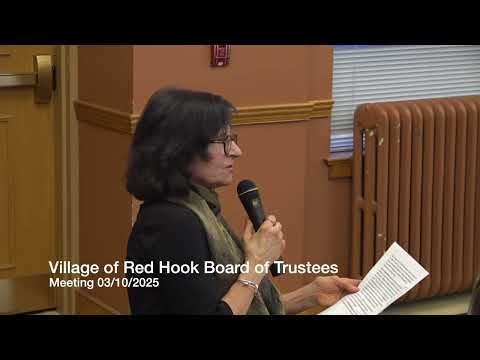
Lisa Tarakani, executive director of Taconic Resources for Independence, told the Village of Red Hook Board of Trustees on March 10 that a site-plan amendment passed in the village of Tivoli in August 2024 could serve as a model for municipalities seeking to improve access for people with disabilities. "The code serves to increase ADA compliance within the village," Tarakani said during a presentation to the board.
The amendment, Tarakani said, embeds language in Tivoli’s site-plan approval process that charges local officials — including building inspectors and the village engineer — with assessing whether modifications to existing buildings are "readily achievable" under the Americans with Disabilities Act (ADA). Tarakani, who also represents the Disability Advocacy Partnership, said the change is intended to promote inclusion in places of public accommodation across Dutchess County.
"While Tivoli, like many communities, still has a long way to go, by codifying this assertion and assuming that responsibility, we are both broadcasting our belief and institutionalizing a mechanic for positive change," Tarakani read from a statement by Tivoli Mayor Joel Griffith that she brought to the meeting.
Trustees and the mayor asked practical questions about older downtown buildings, many with narrow sidewalks and two- or three-step entries. Tarakani described temporary and low-cost options she and co-presenter John Rossi recommended during prior outreach: removable ramps pinned in place, door buzzers to summon assistance, QR-code menus and expanded curbside delivery. She also said building inspectors said ADA Title III enforcement is not emphasized in their training and requested more county guidance.
Tarakani said she and Rossi plan to meet with the county planning and development commissioner to "assess the viability of the county codifying ADA enforcement to local code." She offered to provide the village with resource documents and a short checklist of temporary solutions; Mayor Smythe asked for those materials to share with the village building department.
The presentation included comments from Paul Higgins, identified as a partner in the Advocacy Partnership, and an acknowledgement that some solutions — such as permanent ramps — are not feasible on constrained sidewalks but that other reasonable accommodations may improve access.
Tarakani framed the Tivoli amendment as an example rather than a one-size-fits-all prescription. She emphasized that when projects expand the building footprint or trigger new construction, the local review process can require higher accessibility standards. "There are solutions that can address some of those issues," she said, "and the importance of the code is that it actually puts language in there in the local law and it does charge the building inspector and the planning ... with the assessment process to determine whether it would be feasible or not."