
School board hears K–12 math curriculum rollout, coaching expansion and tutoring plans
Get AI-powered insights, summaries, and transcripts
Sign Up Free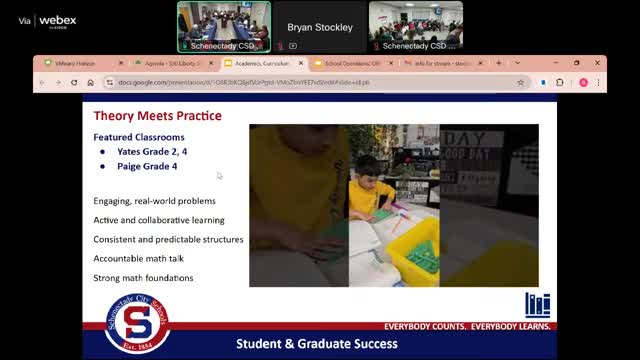
Summary
District math leaders told the board they are rolling out I‑Ready as the K–8 core curriculum, strengthening algebra supports at the high school and expanding coaching and tutoring to improve student outcomes in algebra and higher mathematics.
Schenectady City School District leaders told the board on March 12 that the district is continuing to roll out a new K–8 mathematics curriculum and expanding supports at the middle and high school levels as part of a multiyear effort to strengthen student outcomes in algebra and higher mathematics.
“Last year, we adopted I‑Ready classroom mathematics as our tier 1 K through 8 mathematics curriculum,” Assistant Superintendent of Teaching Dr. Lauren LaChisholm told the board. She and Assistant Director of Mathematics Michael Coval framed the presentation around the district’s stated vision and four organizational pillars and said the work is intended to improve logical reasoning, critical thinking and problem‑solving across disciplines.
Why it matters: Algebra proficiency is a graduation gatekeeper in New York State. District staff said they have focused resources on the algebra pathway and on consistent K–8 instruction so students arrive in ninth grade better prepared.
What the board heard
- Curriculum adoption and pedagogy — Coval said the new K–8 program begins each lesson with a real‑world “Try It” prompt, emphasizes accountable math talk, and follows a concrete→pictorial→abstract progression for concepts. “Every single lesson, kindergarten through eighth grade, starts with an engaging real world prompt,” he said. Presenters stressed consistent lesson structure across buildings so students experience predictable routines as they move grades or schools.
- High‑school supports — Toby Valentino, department chair and math educator at Schenectady High School, described a range of high‑school offerings and supports, including the algebra lab introduced in 2023 and an expanding set of upper‑level electives (AP/CHS and project‑based options). Valentino said the algebra regents in ninth grade is a key milestone and that the school runs after‑school math support Monday–Thursday and Saturday review sessions before regents.
- Coaching and interventions — Staff outlined a coaching structure that has grown from two coaches in earlier years to five and then to nine instructional math coaches across the district. Coval and Jen Hart, middle‑school instructional coach, described tiered supports: • Tier 1: I‑Ready as core instruction K–8 and e‑math at the high school. • Tier 2: Reflex (fact‑fluency games) at elementary; IXL at secondary as a targeted practice tool. • Tier 3: Paper‑based, manipulative‑rich interventions and AIS (academic intervention services) with shifting groups based on ongoing data.
- Family engagement and multilingual resources — Presenters noted that I‑Ready offers weekly family letters and multilingual math discourse cards (English and Spanish). Staff said the district is working on consistent distribution so families across buildings can access the materials.
- Early implementation observations — Staff described year‑one implementation patterns: classrooms observed using manipulatives and structured talk, and teachers editing and adapting the provided slide decks and materials to local pacing and student needs.
Board questions and responses
Board members raised questions on coach deployment across levels, how math vocabulary is taught, whether alternative high‑school pathways (non‑Regents project‑based geometry) are available to students who do not pursue the traditional Regents track, and diagnosis and intervention when students struggle with the digital diagnostic (I‑Ready). Coval and Valentino described efforts to increase communication with families about on‑ramps to advanced course sequences and said intervention groups are shifted in “real time” based on formative data.
Data and results
Presenters said some early signs are promising (for example, expanded algebra supports and increased student use of after‑school labs) but did not provide systemwide numeric outcomes in the work session; when board members asked for specific recent regents pass rates the presenters said the January results were low and that staff would provide detailed data after the meeting.
Direct quotes from presenters
- “What we know is that a strong foundation in mathematics can positively impact student achievement,” Dr. Lauren LaChisholm said. - “Active and collaborative learning ... it’s looking at the students, having them justify their own work, critique the reasoning of others,” Michael Coval said when describing accountable math talk. - “It is our main goal to have kids pass algebra in ninth grade. It is the one math regents that they are required to pass in order to graduate,” Toby Valentino said of high‑school priorities.
Clarifying details from the meeting
- Curriculum provider: I‑Ready classroom mathematics for K–8; district is using e‑math resources at the high‑school level (presenters referenced prior use of Eureka Math and a multi‑year transition away from it). - Coaching: district increased coaching capacity over recent years (presenters described an expansion from 2 coaches to 5, and currently to 9 coaches distributed at elementary and middle levels). - Intervention blocks: elementary core math allotment described as 60 minutes of core math plus a 30‑minute small‑group intervention period; middle/high schools described a 45‑minute core math block plus an every‑other‑day 45‑minute intervention period. - Tutoring: high school math support runs Monday–Thursday after school, with Saturday review sessions before regents; presenters cited 25–30 students in intensive late‑year sessions in a recent cycle.
What the board asked staff to do
Board members requested more specific outcome data on regents and diagnostic assessments and asked staff to improve communications to families about pathways into accelerated middle‑ and high‑school mathematics sequences.
Next steps
Staff said they will continue to refine pacing and training during year one of implementation, circulate more complete achievement data to the board, and prepare a follow‑up budget presentation on March 26.