Get Full Government Meeting Transcripts, Videos, & Alerts Forever!
Get email alerts on the Utility Tax topic
No spam. Unsubscribe anytime.
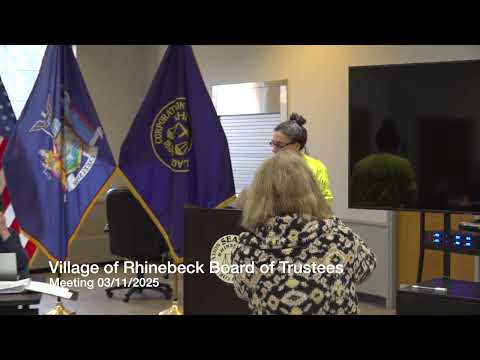
Rhinebeck board holds public hearing on proposed 1% utility tax, defers decision until budget is clearer
Summary
Trustees opened a public hearing on a state‑authorized 1% utility gross‑receipts tax that could raise village revenue but may be passed through to local customers; board members and residents debated timing and potential impact and said the decision will wait until the budget is finalized.
The Village of Rhinebeck Board of Trustees opened a public hearing on a proposed 1% utility tax that, if adopted, would allow the village to collect a one‑percent levy on gross receipts of utilities operating within village boundaries.
The hearing drew residents and board discussion about how the tax would take effect, who would ultimately pay it and whether the village should adopt the measure now or wait until the fiscal 2026 budget is clearer.
The tax is authorized by a New York State law originally passed in 1959 allowing cities and villages to levy up to 1% on gross receipts of utilities operating in their boundaries. The law applies to utility providers such as electric and telephone companies; municipal water and sewer systems operated by the village are not subject to the statute, the board noted. Central Hudson and telephone providers were cited as examples of affected companies.
Brandy Nelson, the consultant later in the meeting, was not part of the hearing but board members referenced prior contacts: Town staff said Central Hudson told village staff that “we will abide by the law” if the village adopts the tax, but Central Hudson would not specify how or when it would list the charge on customer bills. The state Public Service Commission, board members said, indicated the decision to list a separate line item or to fold it into existing rates is typically up to the utility company.
Several residents spoke in the public comment portion. Susanna (last name not given), identified as a resident, said the measure was “a gamble” because the village cannot confirm whether utilities will pass the charge directly onto customers or absorb it. She said a 1% increase “doesn’t seem like a lot” but could be meaningful to households already struggling with energy costs.
Trustees discussed timing at length. Karen (last name not recorded), the village treasurer, and other board members said the revenue could be used to help balance the general fund before or after the village reaches the state’s 2% tax cap for property tax increases. Several trustees recommended waiting until the budget process concludes — the board plans additional meetings before its April 8 public hearing on the budget — so the village knows whether the revenue is needed to avoid cuts or a property tax increase.
Board members also reported outreach to nearby villages that levy the tax: the Village of Fishkill said its utility tax yields about $50,000 a year (mostly from Central Hudson and Verizon), while the Village of Millbrook reported roughly $30,000 annually. Trustees said Rhinebeck’s population and utility profile likely put it between those figures, but the village has no local estimate yet and would only receive payments after adopting a local law and the utilities’ subsequent accounting for the prior calendar year (payments are typically calculated on a January–December basis and due in March).
No adoption vote was taken. The board closed public comment for the hearing but agreed the hearing itself remains open for further public input until the trustees decide whether to adopt a local law. Multiple trustees urged staff to include any projected utility‑tax revenue in upcoming budget calculations and to return to the board with more precise budget implications.
Ending
The board left the matter pending. Trustees directed staff to continue budget work and return with numbers and options; they scheduled additional meetings before the April 8 budget hearing so the board can decide whether to adopt the utility tax in time for the next fiscal cycle.