Get Full Government Meeting Transcripts, Videos, & Alerts Forever!
Get email alerts on the Yerba Buena Restoration topic
No spam. Unsubscribe anytime.
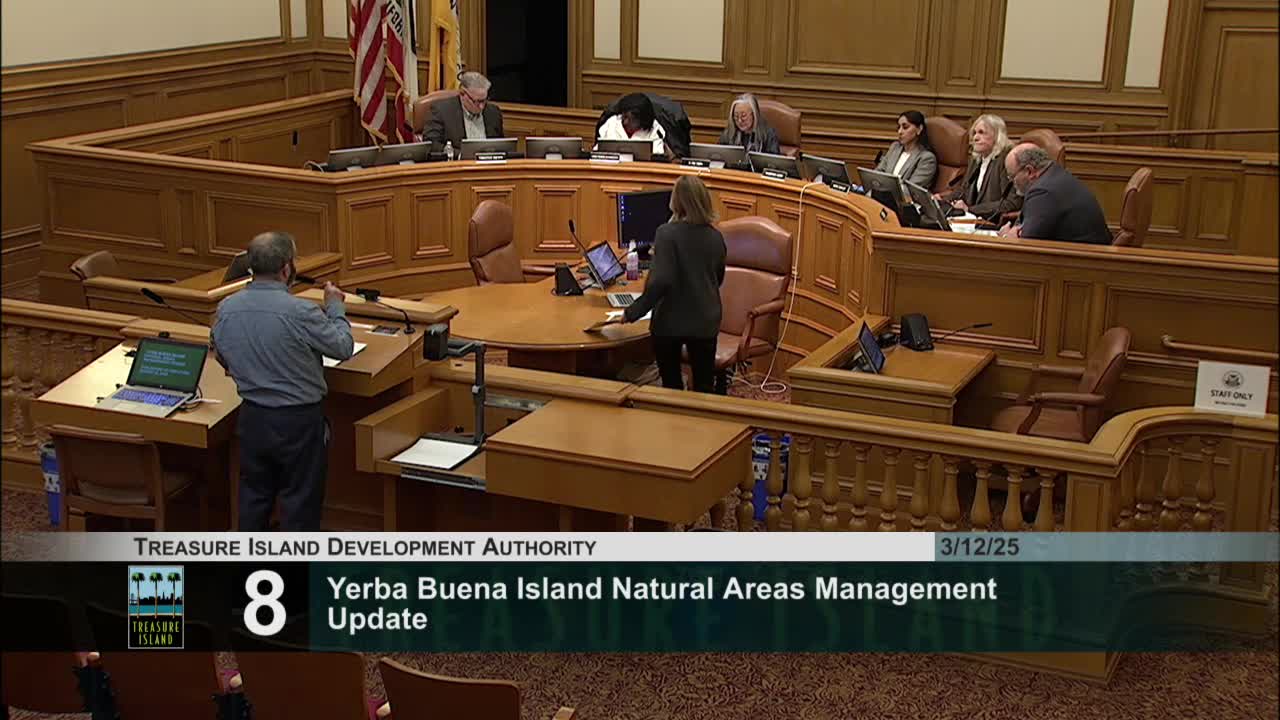
TIDA presents Yerba Buena Island restoration work; contractors report on invasive‑weed removals and plantings
Summary
TIDA staff and contractors presented a multi‑site update on restoration work across Yerba Buena Island, describing invasive‑weed removals, erosion control and new native plantings at oak woodlands, Clipper Cove and other sites.
TIDA staff and contractors provided a multi‑site update on natural areas management for Yerba Buena Island, reporting work on oak woodlands, coastal bluffs, Clipper Cove and other remnant habitats.
Peter Somerville (TIDA) set out the contractor roles: Habitat Potential is undertaking technical restoration work in more challenging ecological zones and Rubicon is executing broader habitat and landscape maintenance in managed areas. Presenters described a phased approach to work across the island, with higher‑priority, technical remediation performed in targeted areas and routine maintenance in other zones.
Peter Brasdow (Habitat Potential) walked the board through multiple sites. He described follow‑up work after a June 2020 fire in the oak woodlands and emphasized hand‑weeding, composting removed materials and targeted techniques to control yellow oxalis and Australian fireweed. “Nature is pretty resilient, even in a system where you don’t typically think of fire happening regularly there,” Brasdow said while summarizing regrowth and resprouting in the oak canopy.
Contractors demonstrated non‑herbicidal methods used in some priority spots, including thermal weed control (a propane‑fired “weed dragon”), hand‑pulling and strategic log placement for erosion control; staff said herbicide remains in the toolbox for areas where other approaches fail. Rubicon’s scope includes site cleanup, erosion control measures and new plantings; staff showed a recent example where removal of downed eucalyptus exposed a seep that supported native rushes and monkey flower and was then reinforced with erosion‑control plantings.
The presentation highlighted several priority weeds: yellow oxalis (sour grass), Australian fireweed, French broom and South African ice plant. Staff described work at specific locations including Northgate and Southgate oak woodlands, Central Clipper Cove, the Torpedo House cliffs and demo gardens along Whiting Way. The report noted practical on‑site reuse of cut material for erosion control and trail demarcation and described ongoing removal and disposal methods used by contractors.
Board members asked about public signage and community stewardship. Staff said additional interpretive and “sensitive habitat” signage is planned, and that TIDA is rebuilding public programming and partnerships with local groups including Life Learning Academy, Community Housing Partnership, Job Corps, the Golden Gate Bird Alliance, the California Native Plant Society and the Academy of Sciences. Somerville and staff also described outreach to Native American and local community groups via the American Indian Cultural District to develop interpretation and stewardship opportunities.
Board members praised the visual improvements and stressed timely action on plantings and vegetation decisions for Panorama Park and other public areas. Staff said transplanting and planting will be coordinated with developers and park partners, with target planting windows scheduled for winter planting seasons when appropriate.