Get Full Government Meeting Transcripts, Videos, & Alerts Forever!
Get email alerts on the Live Local Act topic
No spam. Unsubscribe anytime.
Florida housing analyst outlines effects, gaps of Live Local Act
Summary
Ryan Kinless of the Florida Housing Coalition briefed the committee on the Live Local Act’s property tax exemptions, land‑use mandate and state funding tied to the law, noting strong interest around South Florida and the absence of statewide tracking requirements.
Ryan Kinless, a policy analyst with the Florida Housing Coalition, told the committee that the Live Local Act, passed in 2023, is a major housing law and is already prompting a range of local proposals across Florida.
"Live Local Act was originally passed in 2023. Huge piece of housing legislation. I can't overstate that," Kinless said in his presentation, which summarized the law’s two main components: property tax exemptions for certain multifamily developments and a land‑use mandate that allows administrative approval of multifamily in some nonresidential zones.
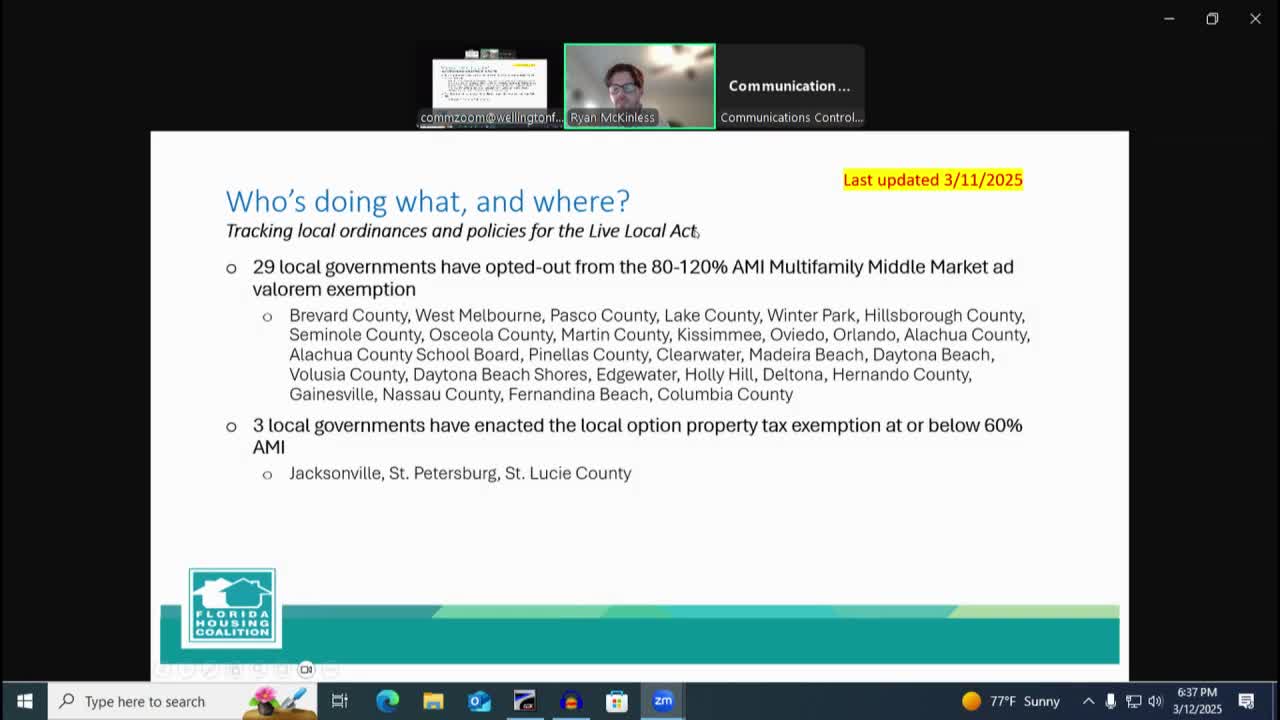
Kinless described two tiers of the property tax exemption: units at or below 80% of area median income (AMI) may qualify for a 100% per‑unit property tax exemption, and units in the 80%–120% AMI range may be eligible for a smaller exemption. He said some local governments objected to the upper tier and the legislature gave jurisdictions meeting certain criteria the option to opt out. "So far, we have been keeping track of this. There have been 29 local governments, as of earlier this week that have opted out of providing that 80 to 20% that upper level threshold, property tax exemption," he said.
Kinless said the land‑use mandate requires that at least 40% of a project’s units serve households at or below 120% AMI; there is no state minimum project size for that administrative pathway. He cautioned that the state law does not include mandatory reporting or a single state agency charged with tracking how the law is used. "Right now... the Live Local Act, does not have any tracking requirements. There's no state agency right that's, required to oversee how this is being used," Kinless said, adding that the Coalition’s tracking is based on news alerts, partner reports and local agendas and is therefore not comprehensive.
Kinless highlighted examples of proposed projects using the statute, noting higher activity in Miami‑Dade, Broward and Hillsborough counties and some deeply affordable projects near transit in Osceola County. He also summarized state funding connected to the law: a 10‑year allocation of SAIL (State Apartment Incentive Loan) funds totaling $150 million, administered by the Florida Housing Finance Corporation (FHFC), which the legislature tied to Live Local implementation.
On compliance and monitoring, Kinless said different elements of Live Local have different oversight. For example, he said local property appraisers handle compliance verification for the multifamily middle‑market property tax exemption. He acknowledged local governments face challenges standing up monitoring infrastructure and that many compliance details are left to local jurisdictions.
Kinless fielded questions from committee members about whether use of the tool has been "under the table" and about related bills in the 2025 legislative session. He clarified the land‑use approval process "has to go through an administrative approval process," and noted the 2025 session includes multiple proposed amendments sometimes referred to as "Live Local 3." He also said some proposals unrelated to Live Local — for example, changes to SHIP allocations proposed as part of a separate legislative initiative by Senate leadership — could affect how housing dollars flow to counties.
The presentation concluded with Kinless offering to share the Coalition’s slide deck and summaries of recently filed bills.