
Home for Good outlines plan for community land trust to preserve long‑term affordable homeownership
Get AI-powered insights, summaries, and transcripts
Sign Up Free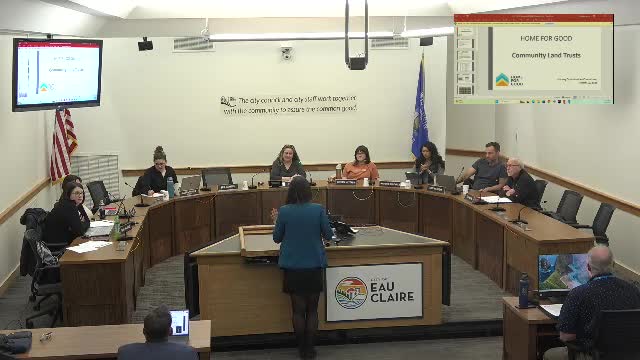
Summary
Home for Good presented a plan to establish a community land trust (CLT) for Eau Claire County, describing how CLTs preserve long‑term affordability, potential funding sources and implementation questions raised by commissioners.
A presentation to the Housing Opportunities Commission on March 12, 2025 introduced Home for Good’s initiative to start a community land trust aimed at preserving permanently affordable homeownership in Eau Claire County.
Home for Good Executive Director Austria Gracehart told commissioners the nonprofit is convening a community advisory committee and working with consultant Jeff Washburn of Burlington Associates in Community Development to design the CLT. "We're excited to present to you this evening the beginning of our journey towards the community land trust in Eau Claire County," Gracehart said.
A CLT separates ownership of land from ownership of the home and uses a ground lease to keep resale prices affordable for income‑qualified buyers. Consultant Jeff Washburn described typical CLT mechanics: the CLT holds title to land and an assisted buyer owns the home improvements and a lease governs resale terms so subsequent buyers also qualify by income. Washburn used a fixed‑rate resale example to show how proceeds to a seller can be limited so the home stays affordable for future buyers.
Why it matters: presenters said CLTs can protect long‑term community ownership of housing and prevent investor conversions of small single‑family stock. Washburn cited national experience — ‘‘over 350 active community land trusts nationally’’ — and said CLTs can operate at scale if local, state and federal funding are layered with private philanthropy.
Key details from the presentation and discussion
- Intended beneficiaries and mission: Home for Good emphasized serving lower‑income households including families it currently supports in its programs and noted options to prioritize deeper affordability (e.g., households at 50% AMI). Washburn said CLTs can be structured to serve low‑ and moderate‑income households and retain community control of assets.
- Funding sources: Washburn said most capital for CLT purchases and rehabs in his Minneapolis experience came from public funding programs layered with other sources, naming CDBG, HOME, NSP and ARPA as examples. He described past local investments by cities, counties and state programs and noted that federal programs (including opportunities that appeared under NSP and ARPA) can create unexpected funding windows.
- Financing mortgages: Washburn said Fannie Mae and Freddie Mac now buy loans on CLT properties, and that several banks offer portfolio mortgage products for CLT borrowers, improving mortgage availability compared with earlier decades.
- Program models and partners: Home for Good intends a mix of approaches: stewarding an existing portfolio of homes, partnering with Habitat for Humanity to preserve new affordable homes as CLT properties, and pursuing buyer‑driven acquisitions. Washburn described CLT roles in foreclosure response, rehab, and long‑term stewardship.
- Implementation questions and concerns raised by commissioners: Commissioners asked about resale formulas, how lenders treat ground‑leased properties, accessibility and whether CLTs can include rental properties. Washburn said resale formulas vary (appraisal‑based or fixed‑rate examples were given), mortgage products now exist for CLT homes, and CLTs sometimes hold or support rental projects (though many CLTs focus on homeownership stewardship).
Outstanding items and next steps
Home for Good is convening local advisory sessions, drafting a business plan and will return with more specifics on targeted income bands, a resale formula, proposed governance and a funding plan. Commissioners asked Home for Good to follow up on specific local financing questions and capacity estimates for how many homes the CLT could support annually.
Ending: Commissioners generally expressed support and asked staff and Home for Good to continue the planning process and return with a refined business plan and funding scenarios.