Get Full Government Meeting Transcripts, Videos, & Alerts Forever!
Get email alerts on the Infrastructure Assessment topic
No spam. Unsubscribe anytime.
Parkland reviews methodology for Ranches roadway special assessment; collection deferred to 2026
Summary
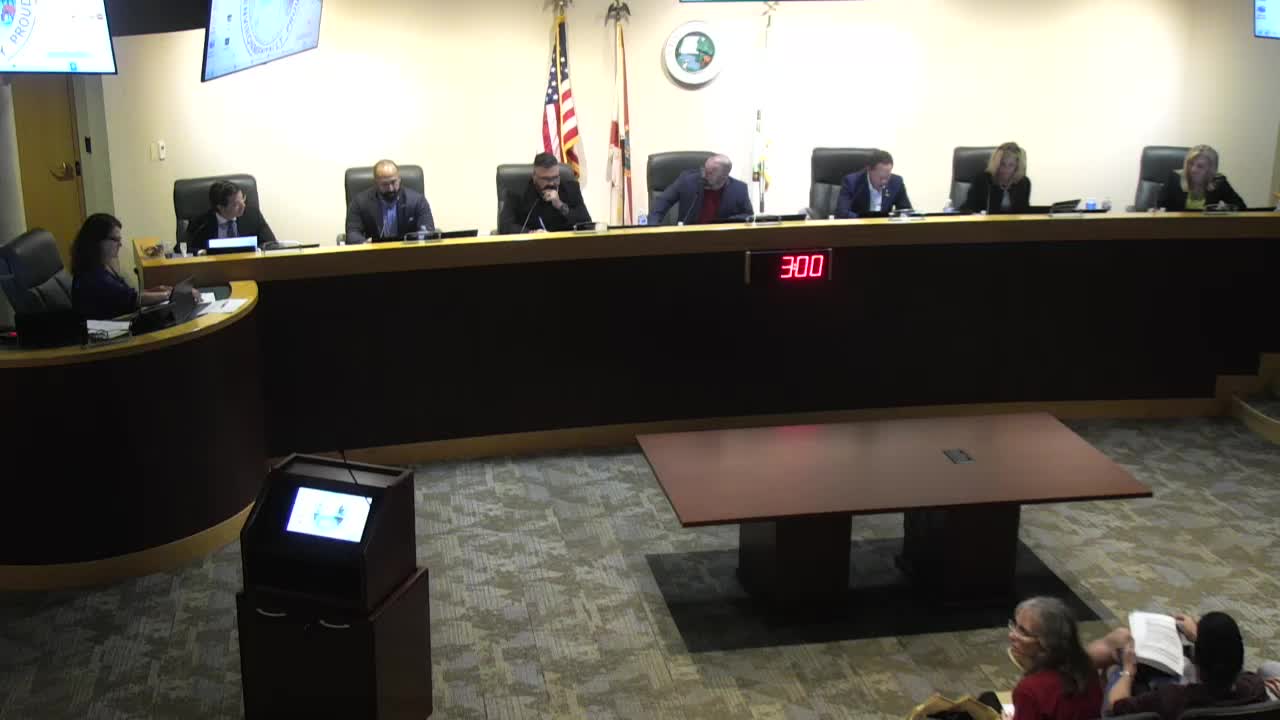
City of Parkland finance staff and outside consultants presented a proposed special-assessment methodology on March 12 to pay for roadway improvements in the Ranches subdivision, outlining project costs, how assessments would be apportioned by acreage and a timetable that would delay collection until 2026.
City of Parkland finance staff and outside consultants presented a proposed special-assessment methodology on March 12 to pay for roadway improvements in the Ranches subdivision, outlining project costs, how assessments would be apportioned by acreage and a timetable that would delay collection until 2026.
The Finance Director, Kelly Schwartz, told the commission that staff had been instructed during strategic planning to investigate assessing impacted homeowners. She said the city hired Governmental Management Services South Florida LLC (GMS) to develop the methodology and Neighbors, Giblin & Nickerson PA to provide legal guidance. "Conversations about the roads and the ranches have been discussed for quite some time now," Schwartz said.
The presentation and ensuing public comment focused on three questions: how much the work will cost, who will pay, and whether the city has the easements needed to complete the work.
Heather, a lawyer with Neighbors, Giblin & Nickerson (presenting remotely), explained the legal standard for special assessments under Florida law: the improvement must confer a "special benefit" on properties being charged and the assessment must be "fairly and reasonably apportioned." She said courts give local officials deference on those determinations provided the method is not arbitrary.
Rich Hans of GMS described the technical proposal, telling the commission the roadway portion of the Ranches project is estimated at $4,768,830 for construction, contingencies and professional fees. He said the full Ranches program, which also includes drainage work that staff expects to fund from other sources, is about $15.2 million.
GMS recommended apportioning assessment costs by "assigned acreage" — parcels sized from Broward County Property Appraiser records and rounded down to the nearest half-acre — because, Hans said, a larger parcel has more potential uses and thus derives more benefit. Using that method, Hans said there are about 471 assigned acres in the assessment area, which produces a per-acre capital allocation of about $10,114.17.
Hans presented a financing example that assumed a direct-placement note (bank loan) sized at about $5,387,848 (including financing reserves and issuance costs), a 20-year amortization and a 5.5% interest assumption. Under that example GMS reported an annual debt service of roughly $450,852 and a maximum annual assessment of about $956.21 per assigned acre; after county tax-bill collection fees and early-pay discounts the estimated tax-bill amount would be about $1,028.18 per assigned acre. GMS also noted an average parcel in the area would be about 2.5 assigned acres, producing an illustrative average annual assessment of about $2,570.45 per property under the example. Hans emphasized the numbers are preliminary and would change with final financing terms.
Schwartz and staff said the overall project funding plan includes three sources: American Rescue Plan Act (ARPA) funds of about $5,274,000 earmarked primarily for drainage, approximately $5.6 million from city general funds (including the city's proportion for properties it owns in the area), and roughly $4.3 million in assessments to affected property owners for the residential road portion.
Schwartz described a multi-step schedule: a master capital ordinance (two readings) expected in June and July; an initial assessment resolution in July; notifications and advertisements in August; and a public hearing to adopt a final assessment resolution in September. She confirmed that, if the commission follows the planned timeline, assessment charges would not appear on tax bills until 2026 and that property owners may prepay the capital share before financing is issued.
Commissioners and residents pressed staff on several points during the public comment period. Residents raised concerns about: whether roads are city-owned or privately owned (staff said the Ranches roads are public rights-of-way, which simplifies assessment and construction); whether churches or other nonresidential parcels would be assessed (staff said any property that receives the special benefit is included); the method of rounding acreage; and whether the city had obtained the easements necessary to perform the construction. Several speakers said they believed the original development conveyed road and canal areas to the city and urged the commission to use city funds rather than assessments.
Vice Mayor Israel and other commissioners said the city intends to proceed with the project and that staff will keep working to identify additional grant funds and to minimize costs; Mayor Walker stressed that the commission will not "kick the can down the road" and framed the package of city and ARPA funding as a significant investment in long-deferred infrastructure. Several residents urged mediation or negotiation about easements and called for more outreach and detail on final assessments.
No formal motion or vote was taken on the assessment itself at the March 12 meeting. The city manager and finance staff said more opportunities for public comment and information will follow in the ordinance and resolution hearings this summer. Staff also provided contact details for follow-up questions and noted the full methodology report is posted with the meeting agenda.
Why it matters: The Ranches assessment would allocate a portion of a multi-million-dollar infrastructure program directly to property owners in a long-established neighborhood. The proposed method and schedule determine who pays when and how much; residents said easements and fairness issues must be clarified before assessments are finalized.