Get Full Government Meeting Transcripts, Videos, & Alerts Forever!
Get email alerts on the Co Responder Program topic
No spam. Unsubscribe anytime.
Council committee approves 4-year interlocal to continue Johnson County co-responder program in Overland Park
Summary
The committee approved a four-year interlocal agreement (with a one-year renewal option) with the Johnson County Mental Health Center to continue embedding mental-health clinicians inside Overland Park Police operations; presenters said the co-responder team handled more than 1,400 911 responses in 2024 and nearly 7,500 total interventions.
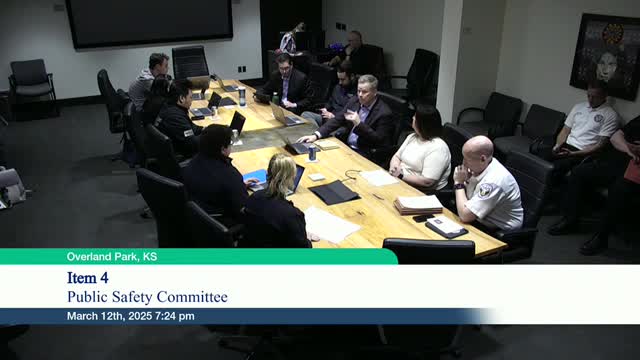
The Public Safety Committee voted to recommend city council approval of a four-year interlocal service agreement with the Board of County Commissioners of Johnson County, Kansas, by and through the Johnson County Mental Health Center to continue co-responder services embedded in Overland Park Police Department operations.
Captain Otero, who presented the item for the police department, told the committee the city began a co-responder partnership in 2014 and has expanded the embedded clinician team in Overland Park from one to six clinicians. "The expertise provided from the correspondents is invaluable," Otero said, describing clinicians' roles responding to mental and behavioral health calls and providing in‑service training to officers.
Jessica Murphy, deputy division director of emergency services at the Johnson County Mental Health Center, provided program data and operational detail. She said co-responders in Overland Park responded to about 1,475 911 calls in 2024, completed 2,886 phone outreach contacts and 624 in-person follow-ups, and recorded nearly 7,500 total interventions countywide attributed to the co-responder program during the year. Murphy said the team documented roughly 296 repeat contacts and cited 230 calls in which the co-responder intervention prevented transport to an emergency room.
Murphy described clinicians as master’s-level, licensed mental health professionals who are Johnson County Mental Health Center employees but are paid for and housed within the Overland Park Police Department. She said the interlocal agreement was updated to reflect the program’s expanded size, to add required insurance provisions, and to remove outdated references to equipment no longer used (for example, portable GPS units). The contract term is four years with a one-year renewal option.
Committee members asked about coverage and capacity. Murphy said the program currently has one vacancy (a Sunday 8 a.m.–6 p.m. position) and limited overnight coverage between 2 a.m. and 8 a.m. She described busiest periods as evenings, with Wednesdays being the single highest-volume day; when fully staffed the department schedules multiple co-responders to match that demand. Murphy said Johnson County also maintains a mobile crisis team and a crisis line that can provide support when embedded clinicians are occupied.
Captain Otero and Murphy also described specialty outreach the team provides, including condolence and follow-up contacts after suicide fatalities and overdose deaths, firearm-safety interventions (distributing biometric firearm safes obtained via grant), and outreach to family members and witnesses after traumatic calls. Murphy emphasized that many outreach contacts are intended to prevent repeat crises and to connect people with community resources rather than defaulting to emergency-room transport.
Councilmember Richard made the motion recommending city council approval. The motion was seconded; the committee approved it by voice vote.
The committee discussion emphasized the program’s role in reducing emergency-room transports and freeing officers for other calls. Multiple committee members expressed support for expanding coverage if staffing gaps persist.