Get Full Government Meeting Transcripts, Videos, & Alerts Forever!
Get email alerts on the Wastewater Treatment topic
No spam. Unsubscribe anytime.
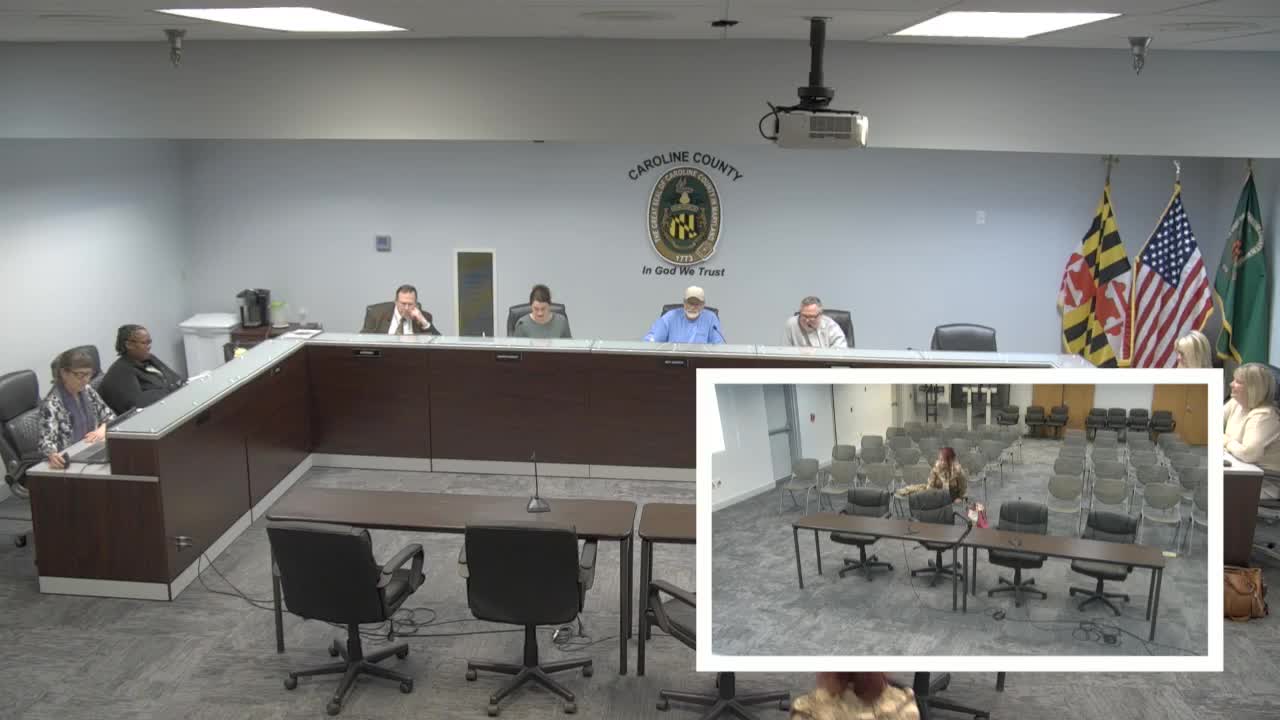
Planning commission recommends banning non‑accessory wastewater treatment facilities in county rural district
Summary
On March 12 the Planning Commission voted to recommend a text amendment to Chapter 175 removing the allowance for standalone (non‑accessory) wastewater treatment facilities from the county's rural zoning district, citing concerns about off‑site trucked waste, infrastructure impacts and odors.
The Caroline County Planning Commission on March 12 voted to recommend that the County Commissioners amend the zoning ordinance to remove allowance for non‑accessory wastewater treatment facilities in the county's rural district.
Staff described the proposed text amendment as narrowing the locations where standalone wastewater treatment facilities may be permitted. Under the draft language presented, non‑accessory facilities would continue to be allowed in I‑2 (industrial) and mobile‑home districts but not in the county's rural district. Staff defined a non‑accessory wastewater treatment facility as a standalone treatment, storage or disposal operation that treats or stores waste generated off the parcel where the facility sits.
Planning staff and commissioners expressed several concerns about standalone facilities in rural areas, including the unknown volume and origin of trucked waste, wear and tear and maintenance costs for county roads, potential odors and noise, impacts on agricultural lands and tourism, and the county's limited ability to inspect and chemically test off‑site wastes without a formal controlling authority.
Staff noted an example of a lagoon that had been approved in the past through a Board of Zoning Appeals special‑use exception; that operation is no longer active and its special exception was forfeited when operations ceased. Staff said seasonal land‑application and certain on‑site treatment for use by the generating property would remain permissible under existing definitions and rules.
Commissioner discussion emphasized the county's limited I‑2 zoning (few industrial parcels), the state septic‑tier rules that limit where sewer or shared systems can be used, and that shared systems require a controlling authority the county does not currently operate. Multiple commissioners cited transportation of waste as the key problem the amendment seeks to address.
A motion to recommend approval of the amendment '2to remove non‑accessory wastewater from the "our rural" zoning district'2 carried by voice vote; a second was recorded as coming from Mr. Roubarou and the commission recorded the vote as "aye" with no opposition. The commission agreed staff would send a letter of recommendation to the County Commissioners.