Get Full Government Meeting Transcripts, Videos, & Alerts Forever!
Get email alerts on the Procurement topic
No spam. Unsubscribe anytime.
Austin Transit Partnership board adopts procurement policy updates to align with federal guidance, allow progressive design‑build
Summary
The Austin Transit Partnership board unanimously approved amendments to its procurement policy to align with updated Federal Transit Administration guidance, explicitly allow progressive design‑build, and adopt other procurement clarifications ahead of major solicitations for light rail construction and vehicles.
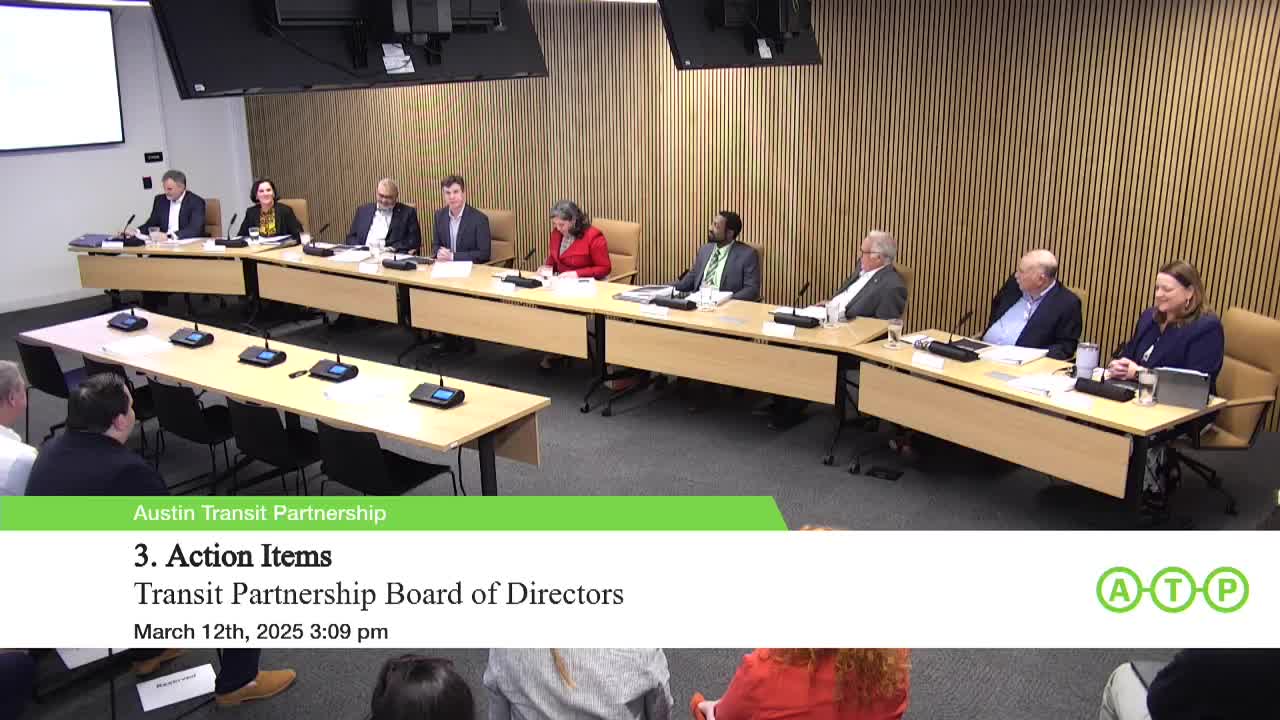
The Austin Transit Partnership board on March 12 unanimously approved amendments to ATP's procurement policy to align with updated federal guidance and to explicitly allow progressive design‑build contracting for the project.
The changes incorporate language from the federal guidance update identified at the meeting as FTA Circular 4220.1F (third‑party contracting guidance), revise evaluation and procurement procedures, expand the agency's micropurchase threshold under the simplified acquisition approach, and clarify that ATP may use alternative delivery methods authorized by Texas law (Chapter 2269 of the Texas Government Code). ATP staff said the updates also allow multiple‑award indefinite delivery contracts for architecture/engineering services to support ongoing maintenance and upgrades.
Why it matters: ATP staff told the board the policy revisions are intended to reduce legal and procurement uncertainty as the agency moves into the next phase of delivery, to encourage competition and industry participation, and to make ATP an “owner of choice” for firms bidding on the multibillion‑dollar light rail program.
Greg Canale, ATP executive director, and procurement staff described how the changes tie to the agency's delivery strategy. ATP has already hired AECOM as a delivery partner and has issued draft solicitation and contract documents for a progressive design‑build (PDB) contract for the main light‑rail alignment. ATP staff said an industry RFI comment period was under way and responses were expected the week after the meeting.
Jim Mitchell, program director for the delivery partner AECOM, praised the progressive design‑build approach as an industry best practice and said bringing contractors into the design process earlier improves constructability and team alignment. “By getting the teams involved early on, helping to share the vision so it becomes a common vision, is best of class,” Mitchell said.
ATP staff described several specific procurement changes discussed in the board materials: - Updating references to the federal circular (referred to in the meeting as FTA Circular 4220.1F) and adopting the circular's simplified instructions on stated evaluation criteria. - Adding explicit allowance for progressive design‑build delivery methods in ATP policy. - Permitting multiple‑award indefinite delivery A/E contracts to create an on‑call list of firms for long‑term maintenance and upgrades. - Changing procurement language to adopt the Federal Acquisition Regulation (FAR) simplified acquisition approach and noting an updated micropurchase threshold in the federal guidance (described in the meeting as increasing from $10,000 to $50,000 for micropurchases). - Narrowing ATP's DBE language to follow federal DBE law requirements rather than prescribing additional administrative language. - Requesting delegation under Texas Government Code Chapter 2269 to allow ATP to use alternative delivery methods beyond design‑bid‑build.
A staff member said ATP will continue to solicit and incorporate industry feedback as it finalizes the progressive design‑build solicitation. ATP staff also described how the agency is evaluating how to divide scope across multiple contracts — for example, whether track work inside the operations and maintenance facility should be included under the maintenance‑facility contract so that contractor can “own” outcomes at that site.
Board members congratulated staff on the outreach and the procurement approach. Board Member Horn said maintainability for the system's long life must remain “front and center,” while Board Member Garza and others emphasized inclusion of local, small and disadvantaged firms in procurements.
Action: The board approved the procurement policy amendments unanimously. The motion and roll call were recorded in the meeting as approved without recorded dissent.
What's next: ATP staff said they expect to issue an RFQ for the main system in June, an RFI for the operations and maintenance facility in April, and an RFI for light rail vehicles in May, with follow‑on RFPs later in the year. Staff encouraged industry to register via ATP's procurement webpage (atptx.org/buildwithus) and said they would review RFI comments before issuing solicitations.