Get Full Government Meeting Transcripts, Videos, & Alerts Forever!
Get email alerts on the Education topic
No spam. Unsubscribe anytime.
Senate committee advances bill to remove Red 40 dye from public school meals after contested hearing
Summary
Lawmakers heard hours of testimony for and against a bill that would prohibit red dye 40 in foods sold or provided in public schools; experts and parents described behavioral effects, while the beverage industry warned of supply and regulatory disruption. The committee advanced the bill to the calendar, 5-4.
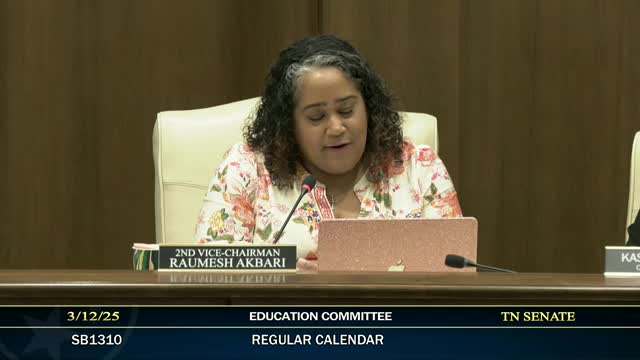
The Senate Education Committee voted to advance legislation aimed at restricting Red 40, a synthetic food dye, from foods and beverages served in Tennessee public schools.
Sen. Sandra Bolling, sponsor of Senate Bill 4-76, framed the bill as a child-health measure: she pointed to findings from the European Union and reviews by health agencies that link synthetic food dyes to increased hyperactivity and attention problems in some children. "If we claim to care about education and test scores ... we must take simple actions, and moving Red 40 from our school meals is a simple common-sense step toward making Tennessee a leader in child health," Bolling told the committee.
Medical and parent witnesses described individual cases and cited scientific reviews. Dr. Denise Sibley, an internal-medicine physician, referenced a 2021 health assessment and said the literature "provides evidence in humans and animals...that synthetic food dyes can cause or exacerbate neurobehavioral problems in some children." Parents and advocates related anecdotes of children whose behavior improved after removing dyes from their diets.
Opponents included the Tennessee Beverage Association. Greg Adkins, the association's president and CEO, warned the committee that states do not typically regulate food additives and said the FDA has primary authority. Adkins also cautioned that a patchwork of state rules would complicate production and distribution for multistate bottlers and could raise costs.
Committee members asked witnesses whether other states had acted; speakers pointed to recent and pending state actions in California, Virginia and several other states. Supporters said alternatives exist and manufacturers have reformulated products for European markets.
After testimony and questioning, the committee voted to place the bill on the Senate calendar by a narrow tally: 5 ayes and 4 noes (as announced by the clerk). The bill's sponsor said the measure would align school meals with health-promoting goals; opponents said the FDA and a national approach would be preferable.
Actions: Motion to advance SB 4-76 carried on a roll-call tally reported as 5 ayes, 4 noes; the committee placed the bill on the calendar.
Provenance: Extensive testimony and the roll-call tally appear in the committee transcript during the bill presentation and witness testimony.