Get Full Government Meeting Transcripts, Videos, & Alerts Forever!
Get email alerts on the Cross State Background Checks topic
No spam. Unsubscribe anytime.
Committee hears debate on cross‑state background checks and merchant‑code proposal for firearm retailers
Summary
The Judiciary Committee discussed HB 7137 and a proposal to assign merchant category codes to firearm retailers; researchers urged accounting for neighboring states' laws in background checks while retailers warned MCCs could create a privacy and regulatory minefield.
The Judiciary Committee’s March 12 hearing also included discussion of HB 7137 — a package of provisions that would, at the sponsors’ request, bring some out‑of‑state convictions into Connecticut eligibility decisions for firearm permits — and a separate policy debate about merchant category codes (MCCs) to flag firearm retail transactions.
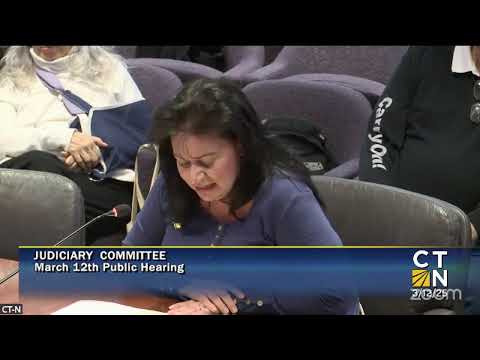
Jennifer Deneen, associate director of UConn’s ARMS (Advancing Research Methods and Scholarship) Center, told the committee that the research supports considering neighboring states’ laws when crafting purchase and permitting rules because firearms frequently move across borders and state laws can affect each other. "Stronger firearm regulations are associated with lower firearm homicide rates," she told lawmakers, and she cited New York’s recent experience after that state's law as one example supporters point to.
Several committee members pushed on administrative logistics and due process. Representative Fishman asked whether Connecticut could fairly treat an in‑state resident more harshly than a recent mover with a substantially similar out‑of‑state conviction; Deneen and others said the issue is complex and would require careful statute drafting and systems for checking out‑of‑state records. Representative Fishbein raised problems of comparing statutory elements across jurisdictions; witnesses acknowledged the practical challenges of operationalizing cross‑state comparisons.
Separately, a contentious provision discussed in testimony would require payment processors to designate firearm retailers with a distinct MCC. Proponents argued targeted financial signals help identify suspicious purchasing patterns; opponents, including the National Rifle Association and payments‑industry skeptics, said MCC tagging could be used to surveil or stigmatize lawful purchasers and create interstate commerce complications. "MCCs enable payment processors and banks to monitor and collect data on certain types of transactions," the NRA's spokeswoman told the committee, arguing the data could be used for registration or enforcement in ways the organization opposes.
Lawmakers heard conflicting views on administrative feasibility and enforcement: some witnesses urged tools to curb cross‑border trafficking and better data; retailers warned about privacy, data security and compliance costs. The committee asked for more detail on how law enforcement would operationalize cross‑state comparisons and whether existing background‑check architecture (NICS and state police systems) could be adapted.
No decision was reached; members signaled they would weigh technical fixes, due‑process protections and privacy safeguards if any proposal moves forward.