Get Full Government Meeting Transcripts, Videos, & Alerts Forever!
Get email alerts on the Education topic
No spam. Unsubscribe anytime.
Committee approves charter-school changes allowing public universities to sponsor schools, adds rulemaking authority
Summary
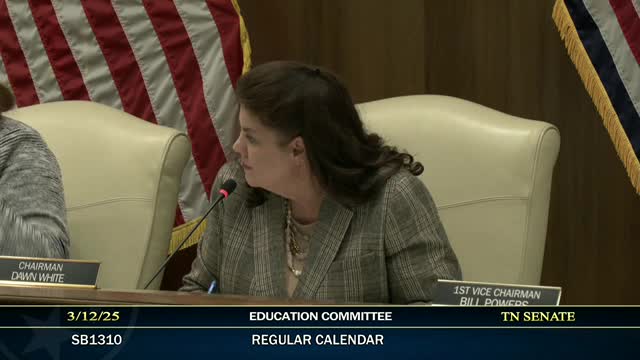
The Senate Education Committee approved Senate Bill 13-10, which allows public colleges and universities to serve as charter-school sponsors and adds rulemaking authority to the Tennessee Public Charter School Commission. The measure drew questions about bypassing local school districts and appeal processes and passed to the calendar 7-2.
The Senate Education Committee voted to approve Senate Bill 13-10, a measure that would allow public colleges and universities to apply directly to the Tennessee Public Charter School Commission to sponsor public charter schools, and to give that commission additional rulemaking authority for applications and renewals.
Sponsor Sen. Ken Lowe said the bill "makes it easier for public colleges and universities to sponsor charter schools" and described several specific changes: the measure allows colleges and universities to apply directly to the state commission under limited circumstances; it permits a sponsor to prioritize children of employees for up to 25% of enrollment; it permits replication applications from governing bodies with at least one operational charter school; and it shifts certain duties such as renewals, monitoring and reporting from the Department of Education to the Charter School Commission.
Several senators raised concerns about bypassing local school boards and the appeals process. Leader Bass Akbari questioned the policy's effect on local authority and said he was "always concerned when you can skip the LEA and go straight to the Charter Commission." Department officials and a policy director from the governor's office said the bill was intended to lean on the Charter Commission's sector expertise and that the existing appeals procedures were not broadly changed.
Sen. Lowe and department staff explained that the bill would allow an LEA to retain oversight, and that an operator applying directly to the commission would still be subject to the commission's review and existing appeal processes. A key trigger in the bill allows an operator to go directly to the state commission if an LEA has had three decisions overturned by the commission in a specified period; senators asked whether repeated overturned denials by a large district would lead to a long-term bypass. Staff said the three-overturn threshold would apply at least to a charter management organization and that the bill includes procedural guardrails.
The committee also approved an administration amendment adding explicit rulemaking authority for the Charter Commission. After extended questioning and debate, the committee voted 7-2 to move the bill to the Senate calendar.
The measure appeals to charter advocates who argue it expands sponsorship options and gives the commission technical capacity to manage charter authorizing; critics said it could reduce local control and asked for safeguards to protect local review. The bill now goes to the Senate calendar.
Actions: Committee adopted an amendment (4910) granting the Charter Commission rulemaking authority; the committee then voted to advance the amended bill to the calendar with 7 ayes and 2 noes.
Provenance: Committee discussion and the recorded vote appear in the transcript around the bill's presentation and questioning of Department of Education and governor's office staff.