Get Full Government Meeting Transcripts, Videos, & Alerts Forever!
Get email alerts on the School Calendar topic
No spam. Unsubscribe anytime.
Senate panel advances two-year option letting districts start school before Labor Day
Summary
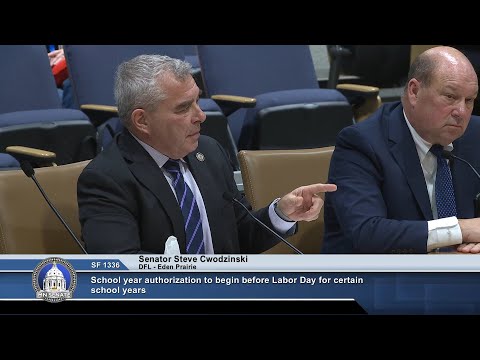
Senate File 1336, which would permit Minnesota school boards to choose an earlier school-year start for the 2026–27 and 2027–28 school years, advanced from the Senate Education Policy Committee on March 12 after the committee adopted an A2 amendment.
Senate File 1336, which would permit Minnesota school boards to choose an earlier school-year start for the 2026–27 and 2027–28 school years, advanced from the Senate Education Policy Committee on March 12 after the committee adopted an A2 amendment.
The bill’s sponsor, Senator Swazinski, argued the measure simply restores local control rather than imposing an earlier start statewide. “This isn’t a mandate for an early start date. It simply allows local school boards to use the best decisions possible,” he told the committee. The A2 amendment, which the sponsor said reduced paperwork burdens on districts and the Minnesota Department of Education, was moved by Senator Swazinski and adopted in voice vote.
Why it matters: Supporters said allowing local boards to choose earlier starts could increase instructional days before spring assessments, reduce summer learning loss and better align with internship and technical-education schedules. Opponents — principally representatives of Minnesota’s family-owned seasonal resorts — said starting school earlier would sharply reduce August travel and lodging revenue and could threaten small resort economies.
Supporters’ testimony Colin Cox, chair of the St. Louis Park School Board, testified in support and described calendar planning challenges his district faced for 2026–27. He said district staff proposed a calendar that would end around June 15 and that local boards must balance instructional days, staff professional development, transportation costs and religious holidays. “So we ask that you give that power to our school boards, who do have a pulse on what is needed in the community,” Cox said.
Manny Fletcher, superintendent of Blue Earth Area Schools, said his district adopted a pre–Labor Day start last year to provide extra instruction before the MCA testing window and that the current statutory path to an early start is limited by a construction-exception threshold. “Current state statute requires either special permission from MDE or a district investment exceeding $400,000 in construction projects to qualify for an early start,” Fletcher said, adding that the cost is “unsustainable” for a district of Blue Earth’s size.
Christie Peterson, vice chair of the Shakopee Public School Board and president of the Minnesota School Board Association, said the bill aligns with MSBA policy by preserving local decision-making and does not require districts to start before Labor Day.
Resort industry concerns Joel Carlson, who represents Minnesota Resorts, described the industry as largely family owned and seasonal and said the number of resorts had declined from about 1,100 in the past to under 600 today. He cited research indicating that families are 40–50% less likely to book an August vacation if school begins before Labor Day and warned that even modest calendar shifts could eliminate a meaningful share of a resort’s seasonal revenue.
Joanna Wallenberg, co-owner of Brookside Resort in Park Rapids, told the committee many small resorts rely on a short open season and estimated roughly one-third of her revenue comes in August. “We make a third of our revenue in August,” Wallenberg said, adding that many resorts cannot afford to winterize facilities if seasonal revenue shrinks.
Questions from senators Committee members asked whether districts that start earlier plan to end earlier, and whether the bill’s two-year window would be long enough to assess effects on students and local economies. Senator Duckworth said she would want clearer data on how many days districts intend to shift and whether earlier starts would truly increase net instructional time rather than merely shifting calendars earlier.
Procedure and outcome Senator Swazinski moved and the committee adopted the A2 amendment by voice vote. Senate File 1336, as amended, was laid over for possible inclusion in the omnibus education bill.
What the bill does and limits Senate File 1336 would: allow local school boards to adopt an earlier start date for two school years (2026–27 and 2027–28); remove the need for the current construction-based exception as the only path to an early start; and limit the change to a two-year window to permit evaluation of impacts on student outcomes and local economies. The bill does not mandate districts start before Labor Day, nor does it specify exact earliest start dates; individual boards would make calendar decisions.
Next steps The measure was laid over for possible inclusion in the omnibus education bill. If included and passed by the Legislature, districts exercising the option would still need to follow any statutory requirements and any administrative rules set by the Minnesota Department of Education.