Get Full Government Meeting Transcripts, Videos, & Alerts Forever!
Get email alerts on the Agriculture Grants And Programs topic
No spam. Unsubscribe anytime.
Minn. Senate Ag Committee hears multiple agriculture grants; veterans bill amended and sent to judiciary
Summary
The Minnesota Senate Committee on Agriculture, Veterans, Broadband and Rural Development met March 12, 2025, to consider a package of agriculture grants, program changes and a university research proposal; the committee adopted an amendment to Senate File 1894 (veterans claims) and referred it to the Judiciary Committee, and it laid over several appropriation requests for possible inclusion in the omnibus budget.
The Minnesota Senate Committee on Agriculture, Veterans, Broadband and Rural Development met March 12, 2025, to hear a slate of bills including appropriations for horticulture programming, county agricultural inspector grants, livestock investment grant changes, support for processing facilities, and a University of Minnesota presentation on a proposed FARM research hub and biomanufacturing facilities.
The committee adopted an amendment to Senate File 1894, debated several appropriation bills that were laid over for possible inclusion in the omnibus, and accepted author amendments to the Livestock Investment Grant program before laying that bill over for further work. The University of Minnesota delivered a 25-minute presentation on a proposed FARM research site, precision agriculture investments and a new biomanufacturing pilot-scale facility.
Senate File 1894: amendment adopted, referred to Judiciary Senate File 1894, a bill addressing individuals who profit from veterans disability claims, was discussed early in the hearing. Senator Andrew Putnam (author) said the bill “builds off the great work started by Senator Anderson 2017” and that penalties language still needed review by Judiciary. The committee adopted the A7 amendment, which removed a requirement referencing federal accreditation and instead defined covered activities as work performed by “a person seeking to receive compensation in connection with benefits.” After the amendment was adopted, Senator Putnam moved that SF 1894 as amended be recommended to pass and be referred to the Committee on Judiciary; the motion was carried by voice vote and the file was sent to Judiciary for consideration of penalties and enforcement details.
Horticultural society appropriation (SF 2217) laid over Senator Karin Seaburger presented Senate File 22-17, seeking $210,000 from the general fund across the upcoming biennium for the Minnesota State Horticultural Society. Paul Marquardt, identified as the treasurer and a member of the board of directors for the Minnesota State Horticultural Society, told the committee, “We are a hundred and 59 year old organization,” and described signature programs the funding would expand: the quarterly Northern Gardener publication, the Garden in a Box education program, and the Minnesota Green surplus-distribution effort. Fiscal staff said the society received a one-time appropriation of $68,000 in fiscal 2024; SF 22-17 would provide $100,000 in fiscal 2026 and $110,000 in fiscal 2027. The file was laid over for possible inclusion.
County agricultural inspector grants (SF 1831) proposed $2 million; eligibility requirements discussed Senate File 18-31 would appropriate $2,000,000 from the general fund for county agricultural (noxious weed) inspector grants, with up to 3% available for Department of Agriculture (MDA) administrative costs. Bob Dunning, representing the Association of County Agricultural Inspectors, testified that county inspectors “enforce the Minnesota Noxious Weed Law” and described local duties including education, training, biological control, and complaint responses. Department witness Anthony Cordeletta said roughly half the counties currently provide dedicated county inspector services and that the bill requires counties to meet basic duties to be eligible; MDA would divide funds equally among eligible counties (e.g., split among the number that apply and meet requirements). Committee members asked which counties are currently eligible; the department said the bill’s eligibility checklist (training, annual reports, meetings, and program coordination) is intended to encourage broader participation. SF 18-31 was laid over for possible inclusion.
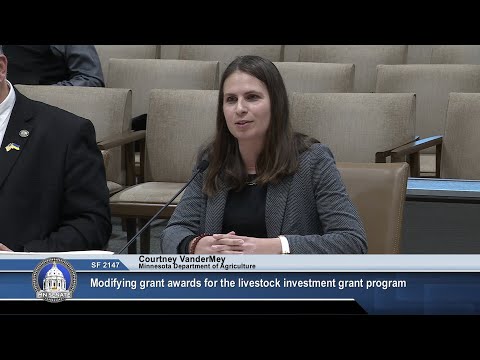
Livestock Investment Grant modifications (SF 21-47) amended and laid over Senate File 21-47 would change the Livestock Investment Grant program’s applicant definitions, project-size thresholds and matching percentages. Senator Kupack moved and the committee adopted an author amendment (A1) changing terminology from “person” to “eligible applicant,” adjusting dollar amounts, and revising how livestock are defined for the program (broadly: those producing fiber, meat, or animal byproducts). Hannah Bernhardt, a beginning diversified livestock farmer, described how the program’s prior $4,000 minimum project size and 10% cost share made the grant unattractive to small beginning farmers and said the proposed changes would better serve smaller producers: “I very much appreciate that the Department of Agriculture has recognized the need for the proposed changes and I strongly encourage passage of Senator Kupack’s bill.” Department staff explained the program uses a scored review process — “in the last round, we had 41 applications,” said Courtney VanderMey of MDA — and a review committee recommends awards to the commissioner who has final decision authority. The amendment also clarified tribal governments could apply. Members discussed proposed matching percentages (including suggestions for alternative percentages); Senator Kupack indicated willingness to continue working with MDA and stakeholders on the exact match levels. SF 21-47, as amended, was laid over for further consideration.
Northern Crops Institute appropriation (SF 1770) laid over Senate File 17-70 would provide $60,000 per year for the Northern Crops Institute (NCI), a collaborative, four-state technical and market-development center located at North Dakota State University that serves Minnesota producers and processors. David Boehm, NCI director, said NCI programming led to increased U.S. commodity purchases and overseas market gains. The file was laid over for possible inclusion.
Processing facilities funding (SF 305) laid over Senate File 305 would appropriate $1,250,000 per year to support startup, modernization and expansion of meat, poultry, egg and milk processing facilities through the AGRI program. Senator Lang and Paul Sobocinski of the Minnesota Farmers Union described local supply-chain and workforce benefits. Department witnesses said AGRI grants are paid on a reimbursement basis, require receipts and include site visits. Ashley Brass of MDA explained the bill’s $200,000 per-grant cap clarifies award limits for single projects and that historically the program has had more requests than available funds (MDA reported $3.9 million in requests in fiscal year 2024 and spent just over $1.25 million). The file was laid over for possible inclusion.
Minnesota Livestock Breeders Association appropriation (SF 1805) laid over Senate File 18-05 would appropriate $18,000 in fiscal 2026 and $18,000 in fiscal 2027 to support administrative costs for the Minnesota Livestock Breeders Association; John Dvorak testified the funding supports scholarships, youth programs and administrative needs. The file was laid over for possible inclusion.
Turf seed research appropriation (SF 2137) laid over Senate File 2,137 (turf seed research) requests $75,000 per year to the Minnesota Turf Seed Council to support research on turf and perennial seed varieties, seed production systems and environmental impacts of perennial seed production. Testimony noted the program partners with the University of Minnesota and the Magnusson Research Farm in Roseau. The file was laid over for possible inclusion.
University of Minnesota presentation: FARM, biomanufacturing, and pilot-scale food science infrastructure University witnesses presented a multi-part request. Shishank Priya, vice president for research and innovation at the University of Minnesota, outlined plans for a biomanufacturing research and pilot facility that would scale microbial fermentation from lab to 500–1,000 liter production and train a biomanufacturing workforce. “Biomanufacturing leverages agricultural products such as corn, soybean, specialty crops, and forestry residues as raw materials to produce sustainable fuels, bioplastics, fertilizers, fuel cells, pharmaceuticals, and other materials,” Priya said.
Brian Borer, dean of the College of Food, Agricultural and Natural Resource Sciences, described the FARM proposal — a multi-use research and demonstration site on approximately 1,360 acres acquired in Mower County — and said the site would be used to integrate water, soil, crop, and livestock research while emphasizing environmental outcomes and workforce training. “FARM in a nutshell is an attempt to try to take advanced agricultural research and address those goals while preserving and protecting the environment at the same time,” Borer said. The university’s request includes capital and HEAPR elements for predesign and improvements to food science pilot facilities on the St. Paul campus (HVAC/electrical upgrades were described as needed for the pilot plant used for dairy and small-scale food manufacturing). The committee received questions about how FARM would interact with existing Research & Outreach Centers across the state; university officials said ROCs would be retained and FARM would complement, not replace, the statewide ROC network while offering integrated facilities and efficiencies.
What happens next The committee laid most appropriation bills over for possible inclusion in the omnibus budget. SF 1894 was amended and referred to the Judiciary Committee for further work on penalties and enforcement; the livestock grant bill was amended and remains under consideration with the author indicating willingness to continue working with MDA and stakeholders on match levels and other details.
Votes at a glance - SF 1894 (veterans claims): A7 amendment adopted; SF 1894 as amended recommended to pass and referred to Judiciary (voice vote, unrecorded). - SF 22-17 (Minnesota State Horticultural Society appropriations): laid over for possible inclusion ($100,000 FY26; $110,000 FY27 requested). - SF 18-31 (county agricultural inspector grants): $2,000,000 requested; laid over for possible inclusion; MDA may use up to 3% for administration; funds to be divided equally among eligible counties. - SF 21-47 (Livestock Investment Grant modifications): A1 amendment adopted; laid over for possible inclusion; program scoring/award process uses a review committee and commissioner final approval; tribal governments now eligible. - SF 17-70 (Northern Crops Institute): $60,000 per year requested; laid over. - SF 305 (meat/poultry/egg/milk processing grants via AGRI): $1,250,000 per year requested; laid over; awards are reimbursable with receipts and site visits. - SF 18-05 (Minnesota Livestock Breeders Association): $18,000 per year requested; laid over. - SF 2,137 (turf seed research): $75,000 per year requested; laid over.
Committee context and process notes - Several items were described as “laid over for possible inclusion” rather than passed; that means the committee did not make final funding decisions on those appropriation requests during this hearing. - The committee repeatedly emphasized that the Livestock Investment Grant uses a scoring rubric and a reviewer panel; department staff confirmed the commissioner makes the final awards from recommendations. - Members pressed MDA and bill authors on eligibility criteria (county inspector grants), award criteria and available funding (livestock grants), and reimbursement processes (processing grants). Department staff said AGRI grants are reimbursed after proof of purchase and that MDA conducts site visits.
For readers: this report is based on testimony and committee discussion recorded at the March 12, 2025 hearing. The committee’s formal votes (where recorded) and work product will be reflected in subsequent committee minutes and the Judiciary Committee’s docket for SF 1894.