Get Full Government Meeting Transcripts, Videos, & Alerts Forever!
Get email alerts on the Lobbying Registration topic
No spam. Unsubscribe anytime.
House committee advances bill to clarify Minnesota lobbyist registration after 2023 changes
Summary
The committee recommended passage of House File 2105, a bill from Rep. Nash that would add time and role-based tests and carve-outs to Minnesota's lobbyist-registration rules. Supporters said the 2023 expansion caused confusion and chilled civic participation; opponents warned it could reduce transparency for wealthy or corporate actors.
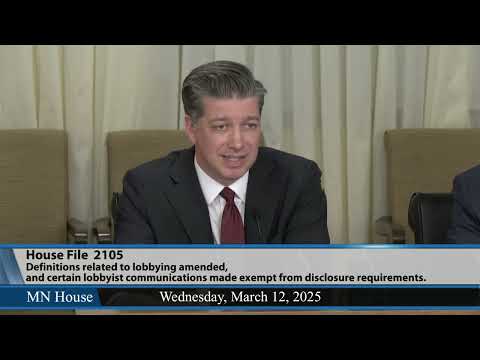
A House committee on March 24 recommended passage of House File 2105, a bill from Rep. Nolan Nash that would change how Minnesota determines who must register as a lobbyist by adding time-based and role-based thresholds and exemptions to the 2023 expansion of registration requirements.
The bill was recommended to pass on a recorded roll call, 6–5, and will be referred to the State Government Committee. Committee members who voted yes were Chair Quam, Vice Chair Altendorf, Rep. Davis (recorded as “I”), Rep. Gordon, Rep. McDonald and Rep. Roach; members voting no were Rep. Acom, Rep. Coulter, Rep. Greenman, Rep. Lee and Rep. Verneig.
Supporters, led by the Minnesota Governmental Relations Council (MGRC), told the committee the patchwork of statutory changes enacted in 2023 left many paid professionals and unpaid subject-matter experts unsure whether routine contacts with officials required registration.
"Since the law passed, MGRC has worked very closely with the campaign finance board…and despite these efforts, further statutory clarification is needed," said Amy Walstein, vice president of MGRC. She urged passage, saying the bill "is balanced, necessary reform that clarifies lobbying regulations, protects free speech, and ensures transparency without discouraging participation."
Paul Cassidy, a lawyer with the Stinson Law Firm and MGRC member, said practitioners from nonprofits to engineers "have consistently struggled with uncertainty and compliance complexities relating to the 2023 law." He said the changes have chilled ordinary participation: "community members who previously participated in routine meetings…now hesitate concerned they'll unintentionally violate ambiguous lobbying requirements," he said.
The bill would retain Minnesota's existing $3,000-per-year compensation trigger but add a measurable time test (the bill language as presented proposes a ten-hour monthly threshold) so that registration would require both compensation and a defined amount of lobbying time. It also would add exemptions and clarifications for volunteer board members, employees whose jobs do not include lobbying, unpaid citizens acting on their own behalf, and certain subject-matter experts who provide factual technical information rather than advocacy.
Several professional groups supported the measure's carve-outs. Brian Lake, representing the Minnesota State Bar Association, said section 2 clarifies the definition of "official action" at the political-subdivision level and would exempt local bodies acting in a quasi‑judicial or adjudicative capacity: "What section 2 does is it provides an exemption when political subdivisions are acting in this court‑like capacity," Lake said, describing the provision as an attempt to align local practice with existing law for executive-branch agencies.
Engineers who do routine project work with local officials also testified. Eric Heiberg of ACEC Minnesota said current language could be read to require registration for engineers who act as contract city engineers or who interact frequently with local officials on technical matters. "We're concerned that if the language in the current bill persists, those people acting as a city engineer may be considered lobbyists," Heiberg said.
Opponents said the bill would undermine disclosure and carve a path for wealthy or corporate actors to avoid timely public registration. Rep. Frank Greenman, a leading critic, warned the proposal "would tilt the law in that direction even more," arguing that the public has a right to know when paid actors are attempting to influence officials. "When folks get paid to lobby, when they profit from influencing our government, Minnesotans have a right to know," Greenman said.
Rep. Ron Coulter, who helped draft earlier 2023 clarifications, pushed back on the testimony that ordinary citizens would be captured. "Members of the general public, volunteers who show up, who are not getting paid to advocate, are not lobbyists," Coulter said, urging care in how a time test would be implemented.
Jeff Sigurdsson of the Campaign Finance and Public Disclosure Board told the committee the current $3,000 compensation threshold can capture employees with mixed duties: "If the amount of time that they spend at the legislature times their salary takes them over $3,000, then that person may be required to register as a lobbyist," he said, adding that the board adopted administrative rules to clarify some situations but that statutory change may be necessary.
Committee debate focused on balancing two aims: preserving transparency about who is paid to influence government while avoiding rules that would discourage subject-matter experts, volunteers or professionals from engaging with local officials.
Votes at a glance: House File 2105 — recommended to pass and re-referred to State Government (recorded 6–5). House File 1723 (St. Louis County statutory cleanup) — recommended to pass as amended and referred to General Registry (voice vote/adopted). House File 1840 (allocating votes for civilly committed individuals to last known residential address) — recommended to pass as amended and referred to Human Services (voice vote/adopted).
What happens next: HF2105 now moves to the State Government Committee for further consideration and potential amendment. If enacted, the bill would change the statutory test for who must register as a lobbyist in Minnesota and add specified exemptions and a time-based standard in addition to the compensation threshold.
Ending: Supporters said the bill restores predictability for professionals who interact regularly with government; opponents said it risks reducing public disclosure for powerful interests. The committee's recommendation sends the debate to the next legislative stage where lawmakers may further revise the balance between disclosure and participation.