Get Full Government Meeting Transcripts, Videos, & Alerts Forever!
Get email alerts on the Transportation Greenhouse Gas Mitigation topic
No spam. Unsubscribe anytime.
House panel advances bill narrowing greenhouse-gas requirements for trunk-highway projects
Summary
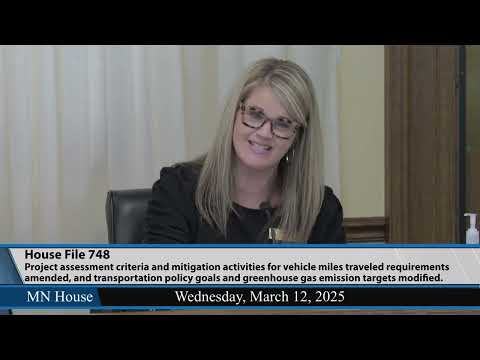
The Minnesota House Transportation Committee on a split vote moved House File 748 to the general register after adopting two author amendments that drop vehicle‑miles‑traveled assessments, extend implementation timing and carve safety exemptions for certain highway projects.
The Minnesota House Transportation Committee voted 8-7 to send House File 748 to the general register after adopting two author amendments that narrow the scope of the state's 2023 greenhouse-gas (GHG) and vehicle-miles-traveled (VMT) assessment law and create safety exemptions for some trunk-highway projects.
The measure, as amended, removes VMT from required assessments, extends the implementation timetable and exempts critical safety projects when mitigation is infeasible, backers said. The committee approved the A2 and A3 amendments before moving the bill forward.
Supporters of the bill, including county and city engineers and county commissioners, said the original law risks adding 20 to 40 percent to project costs and could halt projects that address long-standing safety and infrastructure needs. "When the TAC modeled an in-progress interchange in Scott County . . . the TAC metrics estimate[d] that to offset the increase in emissions, the County would need to build 68 miles of bike trails," Scott County Commissioner Barb Weckman Brecke said, adding that the TAC estimate for that mitigation was about $34,000,000 and that an alternative 2.25 miles of sidewalk was estimated at $22,500,000.
Joe McPherson, chief officer of transportation and county engineer for Anoka County, told the committee the Technical Advisory Committee's early spot-project runs produced "staggering" mitigation estimates, including additional offsets of "approximately 33, 35 percent of the project cost," depending on mitigation choices. McPherson and other county engineers said the law, as implemented, lacked clear administration and funding for mitigation and could leave local governments on the hook for large, unfunded obligations.
Advocates for stronger mitigation told the committee the goals of safety and emissions reduction need not conflict. "Traffic safety is not at odds with ensuring our infrastructure gives people more choices in how they get around," said Alyssa Shuffman, interim executive director of Move Minnesota Action, who described personal injuries and public-health harms tied to vehicle dependence and highway pollution and urged the committee to oppose the bill.
Officials from MnDOT and the Technical Advisory Committee (TAC) told lawmakers the TAC has drafted assessment procedures and will publish them this month; MnDOT staff said the department can apply the assessment work alongside its other statutory goals. Committee members discussed whether mitigation approaches used for other environmental programs, such as wetlands mitigation, provide a precedent for administering offsets at scale.
Representative Kosnick, the committee chair, offered the amendments that were adopted before the committee vote. After the roll call the clerk announced, "There being 8 ayes and 7 nays, the bill is moved on to the general register as amended." The committee recording shows the aye votes and no votes in the roll call.
What the bill does and why it matters
House File 748 narrows which trunk-highway projects must undergo GHG assessment and removes VMT assessment and mitigation requirements. The amendments adopted by the committee also delay the date when assessments take effect and add explicit exemptions for projects defined as safety-critical where mitigation would prevent construction.
Supporters argued the statute, as written in 2023 and enacted in February, lacks an implementation structure, creates significant cost uncertainty and could stop projects meant to reduce crashes and replace aging infrastructure. Opponents and environmental advocates said removing VMT and carving safety exemptions would undermine the law's ability to reduce emissions and that design choices that improve safety often also reduce emissions.
Formal action
The committee adopted the author's amendment A2 and then A3. After debate and questions, the committee approved a motion to move House File 748, as amended, to the general register. The committee roll call recorded 8 ayes and 7 nays.
Votes at a glance
- Motion: Move House File 748 to the general register as amended (A2 and A3 adopted). Outcome: Moved to general register; roll-call result 8 ayes, 7 nays.
Next steps
With the committee's action the bill proceeds to the general register for further consideration by the full House. MnDOT and the Technical Advisory Committee told members they will publish the TAC assessment procedures this month and continue work on methodology and implementation guidance.
Reporting note: Quotes and attributions in this article are drawn from committee testimony and are attributed to the speakers who appeared on the record at the March committee hearing.