Get Full Government Meeting Transcripts, Videos, & Alerts Forever!
Get email alerts on the Newborn Screening topic
No spam. Unsubscribe anytime.
Committee hears bill to add metachromatic leukodystrophy to Minnesota newborn screening panel
Summary
A bill (HF1029) to add metachromatic leukodystrophy, a rare but treatable neurodegenerative disorder, to Minnesota's newborn screening panel was presented to the House Health Finance and Policy Committee. Family members and clinicians urged early detection so presymptomatic children can access available therapies.
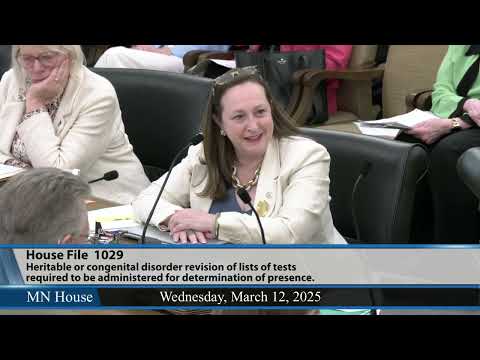
Representative Torkelson presented House File 1029 to the Health Finance and Policy Committee on March 12, urging the panel to add metachromatic leukodystrophy (MLD) to Minnesota's newborn screening panel.
The bill's supporters said early identification through newborn screening would allow presymptomatic infants to receive recently developed treatments. “No child should ever suffer the way Chloe did,” Erica Barnes testified, describing her daughter's diagnosis and death from MLD and asking the committee to "please pass this bill and add MLD to the newborn screening panel." Jennifer Braun, a nurse practitioner and clinical director at the University of Minnesota, described clinical experience in which families often learn of MLD only after an older sibling becomes symptomatic; she told the committee that presymptomatic patients could benefit from cellular therapies.
The committee discussed alignment with federal and state screening lists. Representative Biermann asked whether Minnesota follows the federal recommended panel; Representative Torkelson responded that Minnesota generally follows the federal list but can and occasionally does add conditions beyond the federal recommendation. He said MLD had recently come close to Minnesota's list and was under re-examination.
No formal public opposition appeared in the record and the chair laid HF1029 over for possible inclusion in the omnibus bill. The committee did not take a final vote on the substantive policy in this hearing.
Why it matters: Witnesses emphasized that MLD can be rapidly progressive and that newer treatments are effective only if given before irreversible neurologic decline. Adding MLD to the screening panel would change the timing of diagnosis from symptomatic presentation to the newborn period for some families, potentially enabling treatment.
Next steps: The chair laid the bill over for possible inclusion in an omnibus bill; further committee action or adoption into larger legislation would be required for the change to take effect.