Get Full Government Meeting Transcripts, Videos, & Alerts Forever!
Get email alerts on the Population Based Total Cost Of Care Models topic
No spam. Unsubscribe anytime.
HHS PTAC members cite multipayer alignment, rural infrastructure and payment timing as barriers to wider participation in population-based total cost-of-care
Summary
At a U.S. Department of Health and Human Services public meeting, members of the Payment and Technical Advisory Committee (PTAC) summarized themes and tactical suggestions to expand participation in population-based total cost-of-care models, emphasizing multipayer alignment, rural provider support, attribution methods and faster payment timing.
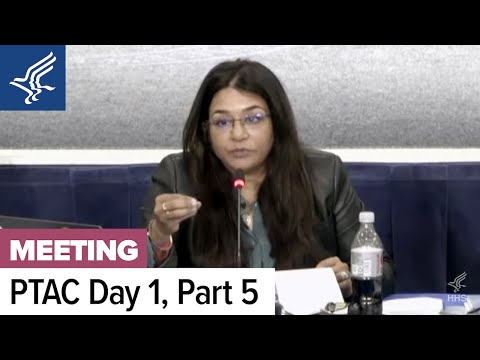
On the first day of a U.S. Department of Health and Human Services public meeting, members of the Payment and Technical Advisory Committee (PTAC) summarized takeaways from panels on reducing barriers to participation in population‑based total cost‑of‑care models and on supporting primary and specialty care transformation.
PTAC committee member Walter Lin said the committee “will issue a report to the secretary of HHS that will describe our key findings from this public meeting,” and committee members spent the closing session consolidating themes they heard from expert panels and public discussion.
Why it matters: PTAC’s recommendations are intended for the HHS secretary and can influence federal guidance or model design that affects Medicare, Medicaid and commercial payers. Committee members repeatedly raised concerns that current design features—complex attribution, slow reconciliation and limited upfront support—reduce provider participation, especially among rural and low‑volume providers.
Members emphasized multipayer alignment as a central requirement for scale. Committee member Lindsey said a critical mass of patients in at‑risk arrangements—“somewhere between 40 and 60 percent”—is needed before practices can materially change operations; other members said even higher thresholds were cited in panels. Multiple speakers recommended simplifying measures across payers and reducing administrative burden to lower the barrier to entry.
Several members urged changes to attribution. Lindsey highlighted a panel suggestion to improve attribution by considering clinicians at both Tax Identification Number (TIN) and National Provider Identifier (NPI) levels rather than only at the TIN level to avoid attributing outcomes solely to specialty care.
Rural providers and low‑volume hospitals drew repeated attention. Jim said innovation is “really, really hard to innovate when your ship’s got holes in it,” arguing that critical access hospitals and rural providers may need a tailored pathway or additional infrastructure support. Lee and others noted that low patient volume raises risk for rural providers and that traditional benchmarks and retrospective reconciliation timelines (often cited as 12–18 months) can make early cash flow a barrier.
Payment timing and upfront support were recurring tactical themes. Multiple committee members called for reducing the time between performance and payment and including upfront or bridging payments to ease early‑stage cash flow pressure. Larry said “the time between performance and payment must be reduced,” and several speakers suggested prospective or subscription‑style primary care payments and hybrid fee‑for‑service/capitation models as areas for further work.
Specialist participation and measures received sustained attention. Speakers said specialist revenue must be meaningfully at risk or otherwise aligned for specialists to join risk‑bearing arrangements; several committee members cited a threshold near 40 percent of a practice’s panel being in at‑risk arrangements as influential to adoption. Members also suggested quality measures focus more on positive outcomes (for example, mobility after joint replacement) and referenced the International Consortium for Health Outcomes Measurement when discussing outcome alignment.
Committee members raised concerns about Medicare Advantage’s marketplace dynamics and how differences in tools, coding and utilization management could disadvantage fee‑for‑service ACOs. Walter Lin summarized the point: “fee for service is the real villain here,” saying ACOs may lack tools that Medicare Advantage plans use to manage utilization and risk scoring.
Technology and workforce pressures were also mentioned. Lauren and others flagged the potential role of artificial intelligence for predictive population health and anticipatory disease management, particularly as the population ages and the workforce declines. Panelists and committee members emphasized that technical assistance, data infrastructure and funding for population health capacity are prerequisites for smaller providers to participate.
Committee members reported several specific, repeatable suggestions heard from panels: simplify measures for multipayer use, strengthen attribution methodology, provide upfront financing or short‑term cash flow support, shorten reconciliation timelines, and invest in technical assistance and data infrastructure. Jenny noted existing regulatory flexibilities and asked why waivers such as the “2000 20 OIG rules” are not more widely used, recommending PTAC consider whether to encourage greater uptake of those flexibilities.
Votes and formal actions: PTAC did not take any formal votes or adopt motions during this closing reflection period; members agreed to continue deliberations and to reconvene the next day for additional expert panels and a final listening session.
What’s next: Chiny (PTAC committee member) closed by asking staff whether they had clarifying questions, thanked panelists and committee members, and said the meeting would resume the next day at 9 a.m. Eastern with opening remarks from Abe Sutton, director of the Center for Medicare and Medicaid Innovation. Walter Lin noted the committee will compile a report for the HHS secretary that synthesizes these findings.
Ending note: Several committee members praised the specificity of the day’s panels; Lee closed one segment with a paraphrase used during the meeting: “may we all be the madmen in our arenas.”