
Health‑system leaders say clinical integration and payment mix must reach critical mass to sustain value‑based care
Get AI-powered insights, summaries, and transcripts
Sign Up Free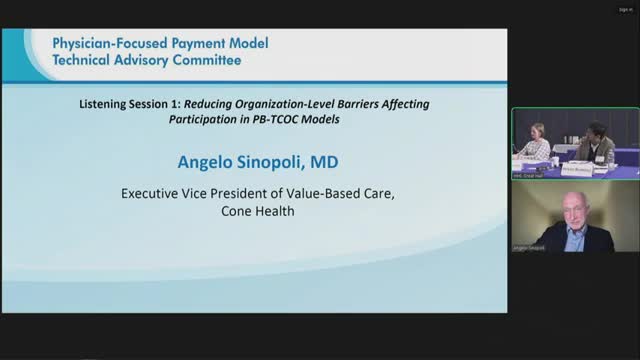
Summary
Speakers from Cone Health, NACOS and Intermountain told PTAC that health systems need a high share of patients under alternative payment models and expanded payer mixes to justify investments in clinical integration and to align specialist incentives.
During a PTAC listening session hosted by the U.S. Department of Health and Human Services, Dr. Angelo Sinopoli, executive vice president of value‑based care at Cone Health, and Dan Wilchenquist, chief strategy officer at Intermountain Health, described the scale, governance and payment‑mix requirements health systems say are necessary to support clinical integration and long‑term value‑based transformation.
Sinopoli said clinical integration requires coordinated assets—hospitals, physicians, care teams, community resources and shared data—and strong physician leadership. He said organizations generally do not reach a tipping point for broad transformation until roughly 40–50 percent of patients are under value‑based care arrangements. “Until you hit about 40 to 50% of the practices, patient panels under some type of significant value based care, it is very difficult to really transform care,” he said.
Intermountain’s Wilchenquist emphasized similar themes and described operational priorities: simplifying the user experience for patients and caregivers, building real‑time situational awareness with data, expanding proactive care and shifting volume out of high‑cost settings. He said Intermountain operates more than 30 hospitals and about 400 clinics across multiple states, with tens of thousands of caregivers, and reported roughly $18 billion in revenue with about $5 billion fully capitated at the time of the presentation.
Key operational and policy points raised by panelists: - Start‑up investment: Sinopoli cited prior estimates of start‑up costs for clinical transformation—one $1.8 million estimate and an outlier quote of $30 million—underscoring variation and the need for substantial capital for true integration. - Payment mix: Both speakers urged moving beyond traditional Medicare APMs to include Medicare Advantage, Medicaid and commercial payers to reach a financial critical mass that sustains transformation and justifies investments in technology and care coordination. - Regulatory posture: Sinopoli noted that OIG guidance issued in 2020 permits more flexible arrangements for physician support in higher‑risk contracts, which can facilitate payments for care coordination and technology under appropriate legal review. - Specialist engagement: Health systems with global risk arrangements can structure bundled payments and gain‑share arrangements that make specialist participation more attractive; small ACOs without sufficiently large risk pools must rely on targeted high‑impact interventions or partnerships with conveners.
Ending: Panelists framed clinical integration as a system‑level undertaking that requires aligned incentives, governance and sustained capital. They recommended expanding value‑based contracts across payers and carefully using regulatory flexibilities to support physician alignment.