Get Full Government Meeting Transcripts, Videos, & Alerts Forever!
Get email alerts on the Health Policy topic
No spam. Unsubscribe anytime.
Health and Government Operations Committee advances slate of health, procurement and public-safety bills
Summary
The Health and Government Operations Committee on June 12 advanced a package of health, procurement and public-safety bills, approving most as amended and withdrawing three, with extended debate on prior-authorization fee bans, a phased restriction on PFAS pesticides and additional requirements for the state 988 crisis response system.
The Health and Government Operations Committee on Wednesday considered a slate of bills on procurement, behavioral health, pesticides containing PFAS, Medicaid and disability advisory groups and several other health-related measures, approving most as amended and withdrawing three. The panel discussed several measures at length — including a prohibition on provider charges for prior authorization requests, a compromise to limit certain PFAS pesticides, and expanded requirements for the state's 988 crisis response system — and referred the bills to the House floor.
The committee chair opened the session by noting the bills had been vetted in subcommittee and would move quickly. A pair of bills were withdrawn before the committee took up substantive items.
The most contested items centered on prior-authorization billing, PFAS in pesticides and crisis-response oversight. On House Bill 1314, the committee approved an amendment that removed proposed restrictions on the use of artificial intelligence and clarified the prohibition would apply to in-network (contracted) providers. Delegate Lisa M. Collison, sponsor of HB1314, told the committee the amended bill "prohibits a healthcare provider from charging a fee to obtain a prior authorization from a health insurer, a nonprofit health service plan, a health maintenance organization, any other entity that provides health benefit plans subject to state regulation or a Medicaid managed care organization." Delegate Hill said she remained uncertain about codifying practices already governed by contracts, saying she was "very uncertain about why we want to codify something that we're not sure is a major practice." The committee added language limiting the fee ban to in-network providers and passed the bill as amended; Delegate Hill later indicated she did not want her name on the bill.
House Bill 386, a bill targeting PFAS in pesticides, drew substantial floor discussion. The measure, as amended, requires the Department of Agriculture to develop and post a list of PFAS pesticides registered in the state and phases in a ban on listed PFAS pesticides for use at healthcare facilities, schools, daycares, residential lawn care and commercial mosquito spraying beginning June 1, 2032, with notification requirements for certified applicators in advance. Sponsors and supporters described the bill as a compromise to balance public-health concerns, agricultural needs and the availability of substitutes. Committee members and sponsors repeatedly stressed the bill is limited to pesticides and is based on EPA guidance for the PFAS definition. Several delegates voiced concern about enforcement and the complexity of active ingredients in pesticides; committee members said enforcement mechanisms and implementation details will be determined as the ban's effective date approaches. The amended bill passed, with several members recording they did not want to be listed on the measure.
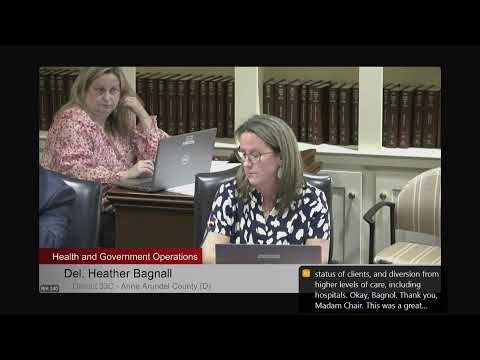
House Bill 1146, which revises responsibilities for the state 988 suicide and crisis lifeline and the crisis response system, also received detailed attention. The amendment requires coordination with the national 988 Lifeline, evaluation and annual public reporting on outcomes, and mandates that the statewide lifeline provide direct referrals, warm handoffs and dispatch to mobile crisis response and stabilization services. Sponsors said the changes are intended to strengthen continuity of care and better track law-enforcement involvement and diversions from higher levels of care. The committee approved the amendments and advanced the bill unanimously.
Other measures approved by the committee included changes to state procurement procedures (HB304), expansion of a work group on substance-use outcomes and continuity of care (HB1066), a pilot preferences program for contractors that use employee stock ownership plans (HB819, narrowed in scope in amendment), authorization for community-health-worker workforce programs to count as community benefits for nonprofit hospitals (HB871), and codification or adjustment of several advisory groups and collaboratives (HB1142, HB1244, HB1083 and others). Lawmakers also advanced bills clarifying self-directed services for Medicaid recipients (HB1053) and a collaborative to improve children's oral health through school-based programs (HB1143) after amending them to address concerns raised in subcommittee.
Votes at a glance (committee action and recorded oppositions where noted): - HB1314 (healthcare prior-auth fees) — passed as amended; Delegate Hill recorded as not wishing to be listed on the bill. - HB304 (state procurement transparency) — passed as amended; Del. Hill recorded as not wanting to be on the bill. - HB386 (PFAS pesticides) — passed as amended; several members (including Delegates Morgan, Chisholm, Riley and Kipke) recorded as not wanting to be on the bill. - HB728 (opioid restitution fund uses) — passed as amended; recorded oppositions from Delegates Shaliga, Chisholm, Morgan, Riley, Hutchinson and Kipke. - HB819 (ESOP preference pilot) — passed as amended. - HB871 (community health worker workforce as community benefit) — passed as amended. - HB1027 (expanded 311 work group) — passed as amended. - HB1053 (self-directed services and parents as providers) — passed as amended. - HB1066 (behavioral health commission work group on substance use) — passed as amended; recorded oppositions from Delegates Shaliga, Chisholm, Morgan and Riley. - HB1083 (EPSDT recommendations via work group) — passed as amended. - HB1142 (Medicaid interested parties advisory group codified) — passed as amended. - HB1143 (children's oral health collaborative) — passed as amended. - HB1146 (988/crisis response system, reporting and outcomes) — passed as amended. - HB1244 (DDA waiver advisory council codified; increased lived-experience membership) — passed as amended.
Committee members frequently described amendments as the product of negotiation with stakeholders and subcommittees. Several sponsors and members emphasized the bills were intended to strike balances among public-health protections, operational feasibility and existing industry practices. Most bills moved forward by voice vote; where opposition names were recorded in the transcript, the committee clerk logged those members as not wishing to be on the measure.
Next steps: the bills as reported will go to the House floor for further consideration and any floor amendments. For measures that set implementation dates (notably HB386's phased PFAS pesticide prohibition and HB1142/HB1244 statutory codifications), sponsors and departments said they expect follow-up work on implementation details and reporting requirements.
Sources: Health and Government Operations Committee session transcript, June 12 (committee remarks, sponsor summaries, recorded statements and committee roll calls).