Get Full Government Meeting Transcripts, Videos, & Alerts Forever!
Get email alerts on the Higher Education Finance topic
No spam. Unsubscribe anytime.
Bill would expand Tuition Equalization Grant to additional accredited Georgia institutions; committee hears concerns about scope and funding
Summary
Sen. Hickman presented SB 149 to expand Georgia’s Tuition Equalization Grant eligibility to certain newly qualified four‑year private institutions accredited at the highest level (SACSCOC level 6); GSFC testified only one institution likely meets the bill’s parameters and estimated a $1.7 million first‑year fiscal need.
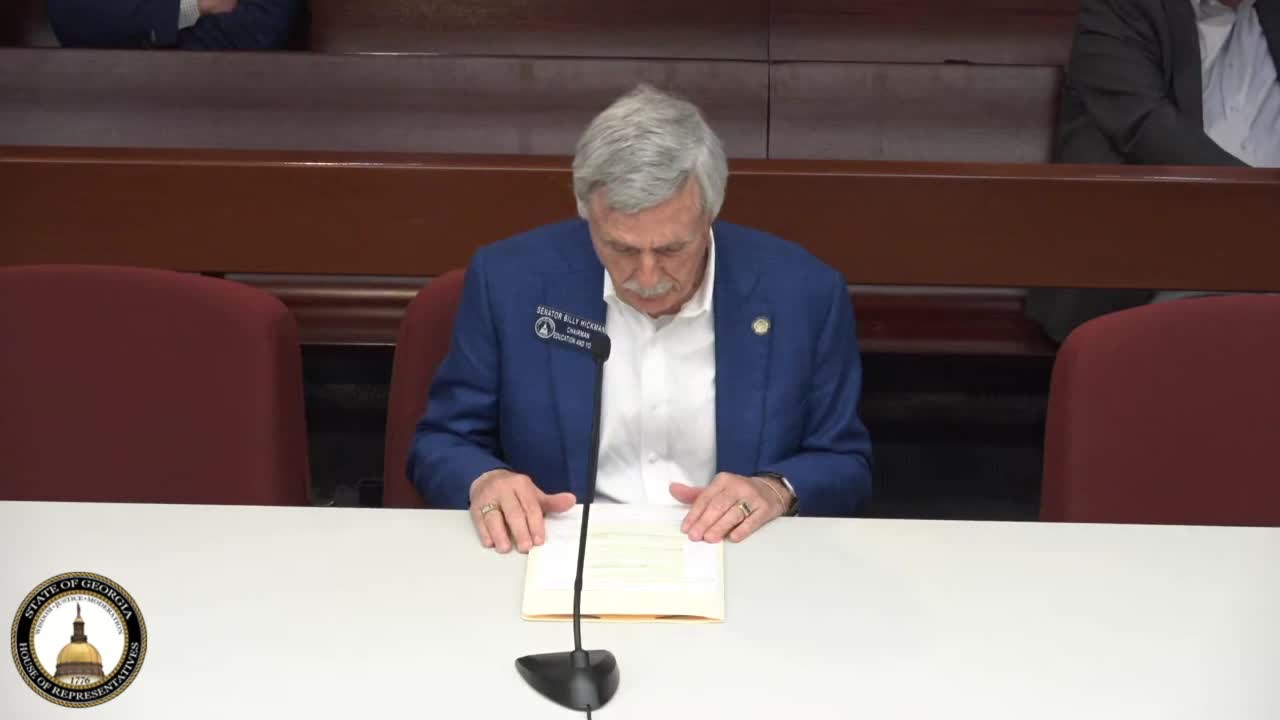
Senator Hickman presented Senate Bill 149, a hearing‑only proposal that would modify Georgia’s Tuition Equalization Grant (TEG) eligibility to allow certain newly qualified four‑year private institutions accredited as a "level 6" school by the Southern Association of Colleges and Schools Commission on Colleges to participate in the program.
Hickman said TEG was created in 1971 and currently provides non‑need‑based awards (cited figures in the hearing: $550 per semester and $367 per quarter) and covers 32 eligible colleges. He said SB 149 would keep "rigorous requirements for qualified institutions" while allowing the program to serve more students as workforce demands grow.
Members questioned which accrediting bodies would be acceptable and whether the change would effectively favor particular institutions. The committee asked how many new schools would become eligible under the bill; Hickman said he did not have that number. Lynn Riley of the Georgia Student Finance Commission (GSFC) was asked to clarify fiscal and eligibility points. Riley told the committee that, to their knowledge, only one institution would become eligible under the bill as currently written and that GSFC estimated a first‑year fiscal need of $1,700,000; she said that amount had been contemplated in the FY '26 budget.
Representatives from private cosmetology and barber schools (Tiffany Walker of Style Mob University and other private cosmetology stakeholders) testified they were concerned that nationally accredited private cosmetology schools were excluded from the expansion and urged amendment to include them so those schools' students could access TEG funds. Walker described state approval and national accreditation requirements for private cosmetology programs and requested parity with public technical schools.
Committee members asked whether the governor had indicated support; Hickman said the governor’s office had signaled the governor would sign the bill in its present form and requested the committee leave the eligibility language unchanged. Several members said they had received emails from other schools seeking inclusion.
Ending: The committee treated SB 149 as a hearing item; GSFC provided a fiscal estimate and members directed further outreach rather than taking action at this session.