Get Full Government Meeting Transcripts, Videos, & Alerts Forever!
Get email alerts on the Utility Usage Tax topic
No spam. Unsubscribe anytime.
Committee backs usage tax to replace property tax for centrally assessed utilities
Summary
Members voted to send House Bill 329 to the floor with a due-pass recommendation after sponsors described a switch from property valuation to usage-based taxation (kilowatt-hour and therm taxes) intended to stabilize revenue amid appraisal litigation.
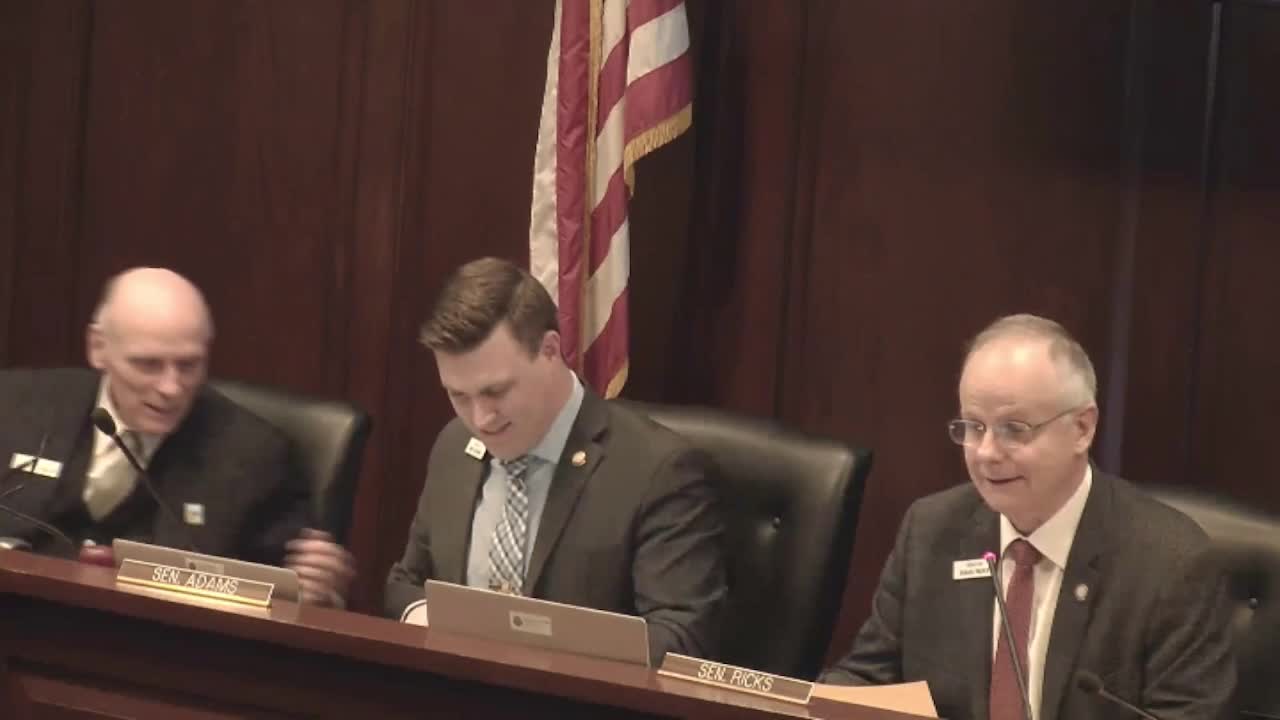
The Senate Local Government and Taxation Committee voted to send House Bill 329 to the Senate floor with a due-pass recommendation after hearing that the measure would replace property tax assessments for certain centrally assessed utility properties with a usage-based tax.
Representative Jeff Ehlers, District 21 (Meridian), told the committee the change is designed to resolve recurring litigation under the federal ‘‘4R Act’’ by converting centrally assessed utility valuations to a usage tax — kilowatt hours for electric utilities and therms for gas utilities — and setting rates to approximate historical revenue. “So when it changes from property tax over to this usage tax, it's essentially the same,” Ehlers said, adding the bill’s rate calculations aim to yield roughly $23 million statewide, apportioned across taxing districts.
Ehlers said the bill developed from multiyear negotiations among utilities, counties and other stakeholders and that it had stakeholder support. Committee members raised fiscal questions about revenue certainty. Senator Adams asked how confident sponsors were that the new usage-based approach would be revenue neutral; Ehlers responded that historical averages were used but that actual future usage can fluctuate and that property tax bases could continue to change because of litigation and other factors.
The bill includes a mechanism for periodic review; sponsors noted a five-year review provision in the draft. A motion to send H329 to the floor with a due-pass recommendation was offered and seconded; the committee approved the motion by voice vote. Committee members identified the measure as a negotiated compromise intended to reduce litigation risk and stabilize revenue apportionment across local taxing districts.
The committee action advanced the bill to the Senate floor with a due-pass recommendation; no floor passage or final enactment was taken in the committee meeting.