Get Full Government Meeting Transcripts, Videos, & Alerts Forever!
Get email alerts on the Wind Energy Decommissioning topic
No spam. Unsubscribe anytime.
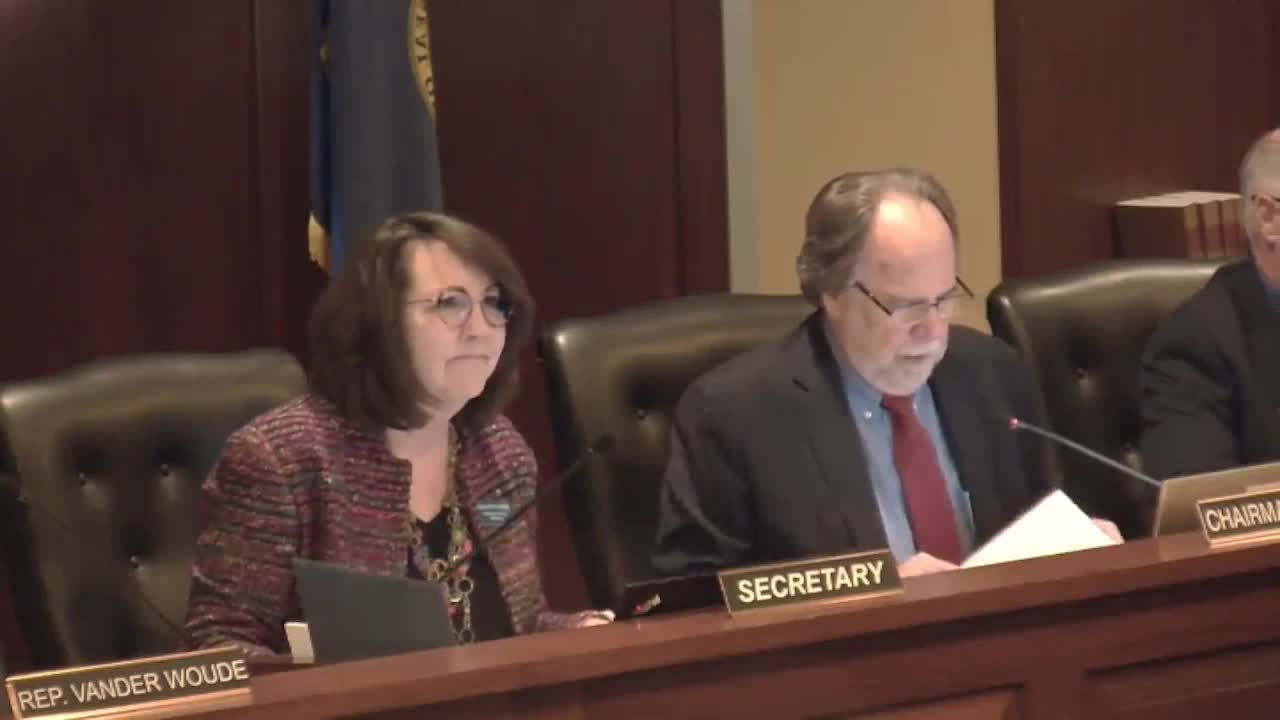
House committee sends wind-turbine decommissioning bill to amending order
Summary
A state House committee voted to send House Bill 387 to the amending order after testimony and questions about requiring developers to post decommissioning security for wind turbines.
A state House committee voted to send House Bill 387 to the amending order after a floor of testimony and questions about how the state should require and secure wind-turbine decommissioning.
Representative Kevin Andrus, sponsor of House Bill 387, told the committee the bill would require developers to obtain a cost estimate for decommissioning and “put those dollars into a fund at the treasurer's office, so that that money can be used as a guarantee that the remediation will be done at the termination of the contract.” Andrus said the measure is intended to ensure sites are returned toward their prior condition after turbines are removed.
The bill prompted sustained questioning from committee members and testimony from two industry witnesses. Lance Giles, a contract lobbyist for Renewable Northwest, urged the committee to send the bill to general orders for amendment, saying the bill “will raise electricity prices for Idaho's residents and businesses” by requiring decommissioning security up front rather than later in a project’s life. Giles also said the bill “would institute a new requirement to remove the entirety of every subsurface structure and road” and risked duplicating county and state requirements.
Ken McClure, representing the Utah Associated Municipal Power Systems (UAMPS), told lawmakers his organization operates Horse Butte Wind Farm in Bonneville County under a 99‑year lease that includes reclamation provisions. McClure said the bill’s current language would require a cash deposit at repowering or expansion and warned that “paying now for the decommissioning of a facility in 30 or 40 years, and we're requiring to put cash down upfront and the interest on that cash does not go to the benefit or to the credit of the owner. It goes to the State General Fund under this bill.” He said that could make projects economically unfeasible.
Committee members probed specifics the bill does not specify, including how deep foundations should be removed and whether state requirements should override county conditional use permits and existing Department of Lands standards. Representative Scott and others asked whether other industries — such as mining or landfills — face similar up‑front obligations. Andrus acknowledged a range of possible amendments, including allowing commercial bonds instead of cash deposits, limiting how much subsurface material must be removed, or leaving certain decisions to local permitting authorities.
After questions and testimony, Representative Burgoyne moved to send House Bill 387 to the amending order. The committee approved the motion by voice vote; the record shows the motion carried and the bill will be revised in the amending order before further committee consideration.
The hearing included repeated distinctions between discussion, potential directions for amendment and formal action: the committee did not adopt policy language into law at the hearing but directed that the bill proceed for amendment. Witnesses and members emphasized unresolved implementation details — timing of any security (up front versus mid‑life), whether security could be a commercial bond rather than cash, what interest on posted funds would accrue to, and how state requirements would interact with county permits and existing state or federal reclamation rules.
The committee’s next steps are to work on amendments in the House amending order; no vote on final passage was taken at the hearing.