Get Full Government Meeting Transcripts, Videos, & Alerts Forever!
Get email alerts on the Child Welfare topic
No spam. Unsubscribe anytime.
Committee advances bill to place safe-haven infants with waiting adoptive families
Summary
A legislative committee voted to send Senate Bill 1058 to the floor with a due-pass recommendation. The bill would allow infants surrendered at safe-haven locations to be matched with vetted adoptive parents more quickly while preserving procedures to identify Indian children under federal law.
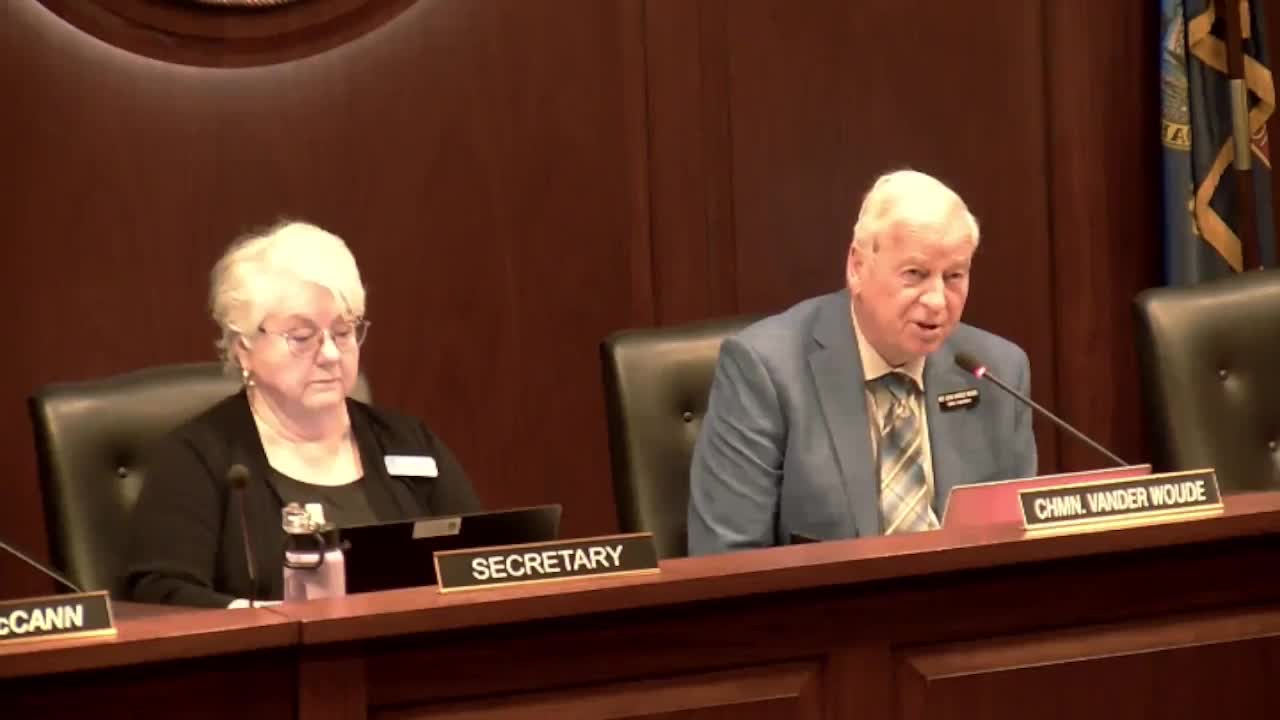
The Health and Welfare Committee voted to send Senate Bill 1058 to the floor with a due-pass recommendation after sponsors and tribal representatives described changes intended to speed placement of infants left at safe-haven facilities.
Representative Heather Scott of District 2, the House sponsor, told the committee the bill "deals with safe haven babies" and would allow healthy newborns who are surrendered at designated locations to be placed with waiting, licensed adoptive parents rather than entering the foster-care system. Scott said the bill directs the Idaho Department of Health and Welfare to maintain a list of licensed adoption agencies and requires the department to contact an agency within 24 hours, with a 48-hour fallback to the regular foster process if placement cannot be found.
The bill adds a definition for "Indian child" consistent with federal usage, and sponsors said that language was developed in consultation with tribes. Senator Julie Van Orden (District 30), who worked on the measure, said she and other sponsors engaged tribal leaders after tribes raised concerns about the existing safe-haven law.
Tyrell Stevenson, legislative director for the Coeur d'Alene Tribe, testified in support and described how the federal Indian Child Welfare Act (ICWA) affects placements. Stevenson said ICWA, enacted in 1975, was intended to address historic practices of removing Native children from their families, and that the bill "does a great job of balancing that and I think sets forth a clear process for the department to follow." He told the committee that if it is learned after an initial placement that an infant is an Indian child, ICWA protections can apply until an adoption decree is entered, and an adoption can be overturned only in limited circumstances such as fraud within two years of the decree.
Blake Hude, representing the Shoshone-Bannock Tribes, and Terry Marcroft of the nonprofit Unplanned Good also testified in favor, saying they worked with sponsors and the department on the language and that faster placement with vetted parents is preferable to placement in the foster system. Marcroft noted that recent changes to school health education will lead more young people to know about the safe-haven option and that quicker placement into a permanent home is a better outcome.
Representative Healy moved the committee recommendation to send the bill to the floor with a due-pass recommendation. The committee conducted a voice vote; the clerk announced "aye," then "opposed, no," and the motion passed. The transcript records no roll-call vote or individual vote tallies.
Key statutory references cited in committee discussion include an Idaho code section referenced in the bill text (recorded in committee as "Idaho code 398202") and language described as relating to "protective custody placement and immunity" (recorded in committee as "82 0 4"). Committee testimony repeatedly referenced compliance with the federal Indian Child Welfare Act.
The committee record shows tribal governments and the Idaho Department of Health and Welfare participated in drafting language. Sponsors and witnesses described the bill as an attempt to reduce transitions through multiple foster placements by enabling immediate bonding between an infant and an adoptive family when a safe-haven surrender occurs and the adoptive family has already completed vetting requirements.
The bill will next be carried by Representative Scott on the House floor, according to the committee record.