Get Full Government Meeting Transcripts, Videos, & Alerts Forever!
Get email alerts on the Generation Replacement Policy topic
No spam. Unsubscribe anytime.
Committee advances bill requiring dispatchable replacements for retiring power plants amid debate
Summary
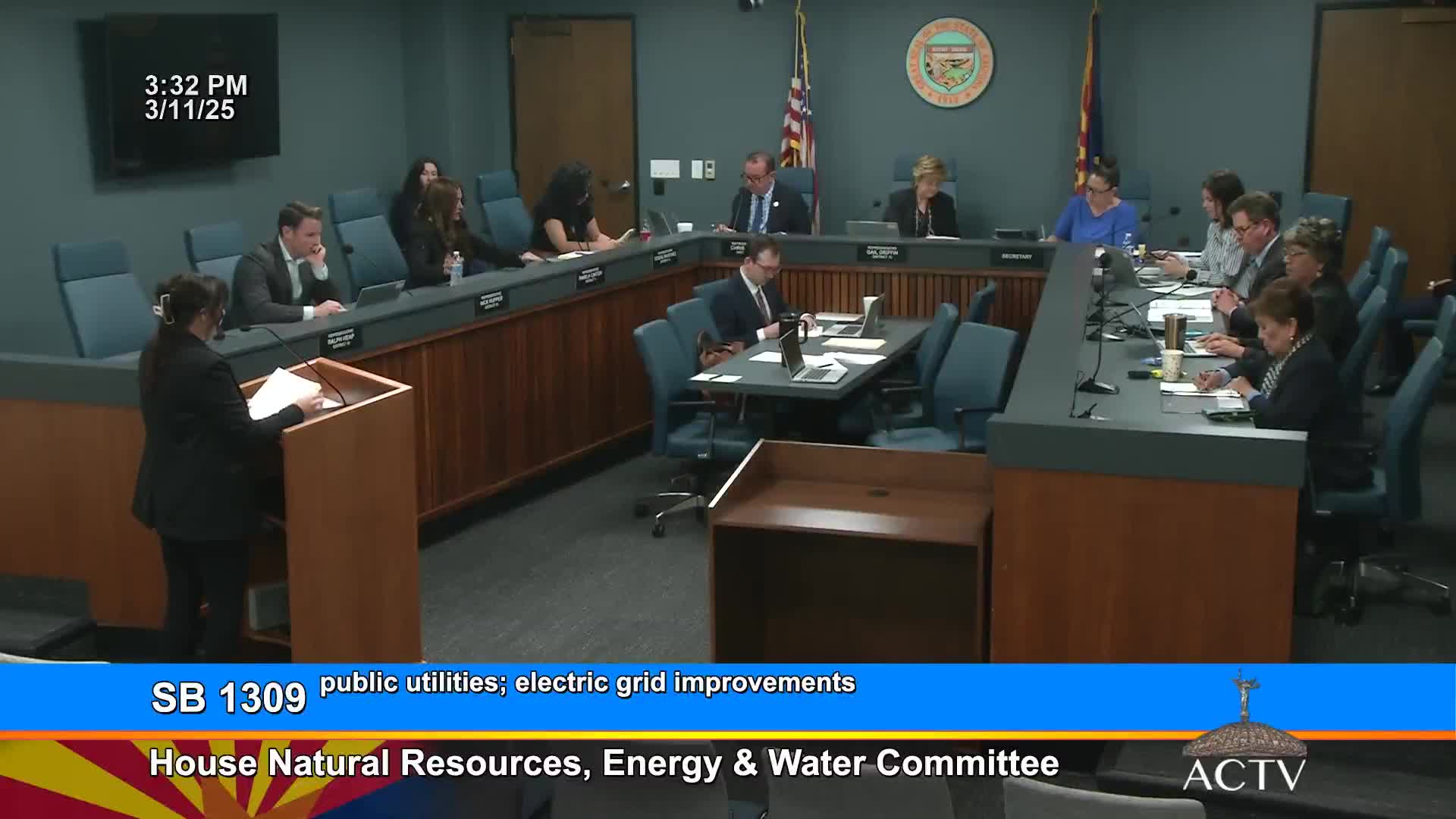
Senate Bill 1309, which would require dispatchable replacements for retiring generation plants, passed the Senate committee with a due-pass recommendation after testimony and debate about reliability, battery storage capabilities and supply-chain issues.
Senate Bill 1309, which directs the Arizona Corporation Commission to ensure that retiring electric generation plants are replaced by dispatchable resources, was returned with a due-pass recommendation by the Senate Committee on Natural Resources, Energy and Water following testimony and extended questioning.
James Taylor, testifying for the Heartland Institute, told the committee the bill is intended to "get in front of the upcoming crisis" he said would occur if the state does not ensure sufficient dispatchable base-load generation as demand rises. "Energy experts tell us we're going to have a 15% increase in electricity demand during just the next five years," Taylor said. He warned that scheduled retirements of base-load plants, particularly coal units, could make it difficult to maintain reliable supply without dispatchable replacements.
Taylor described dispatchable resources as those "available on demand" and characterized current large-scale battery storage as limited to "minutes or at most a few hours" of support. "If batteries were developed that could perform the functions that are desired and economically desirable, that would be something I would be all in favor of," he said. He also raised supply-chain concerns for some battery technologies, including dependence on cobalt and other minerals largely mined and refined outside the United States, and said mining practices in some countries have serious human-rights and environmental consequences.
Committee members questioned Taylor about technical and environmental tradeoffs. One member described the bill as potentially creating an "unequal playing field" for energy sources by dictating that only dispatchable resources could be used as replacements, and argued that such requirements could limit market-driven adoption of future technologies. The exchange included a procedural call to the question by a member seeking to move to a vote.
After debate, a motion to return the bill with a due-pass recommendation carried; the chair announced the committee had passed Senate Bill 1309 with a due-pass recommendation by a vote of 5 ayes, 4 nays and 1 absent.
The hearing record includes technical claims and studies offered by the witness (for example, the cited forecast of rising demand and a study Taylor referenced about consequences of a major blackout); those claims were presented as testimony and were not independently verified in the hearing.
Votes at a glance: Committee returned Senate Bill 1309 with a due-pass recommendation; announced roll-call totals were 5 ayes, 4 nays and 1 absent.